Who is this advice for?

Occasional ironer

You want to smooth out a few pairs of shorts when changing your seasonal wardrobe, then store your iron away neatly. The Consumentenbond says that a small amount of ironing and limited storage space are reasons to consider a steam iron.

Careful clothes presser

Your shorts have different care labels, colours or fabric blends, and you want to adjust the temperature and steam for each item. The Consumentenbond advises following the care label; GINETEX explains what the ironing symbols mean.

Ironer with a large pile of thick laundry

You regularly iron thick cotton or other clothes as well as shorts. In that case, tank capacity and the ability to tackle stubborn creases may matter more than compact storage.

What should you look for when choosing?

Steam iron

Choose this when: you’re ironing a few pairs of shorts as you change your wardrobe for the season and want to store away a compact appliance.

The trade-off: the water is held in the handheld appliance; with a larger or heavier pile of laundry, you may need to refill it or go over creases more often.

Steam generator

Choose this when: shorts are part of a large pile of ironing, including thick fabrics or stubborn creases, and you have room for a separate tank.

The trade-off: according to the Consumentenbond, the complete system is larger and harder to store. Also check that your ironing board is suitable.

What to consider What to look for when buying Who should pay extra attention?
Size and tank Compare the size, how easy it is to fill, and whether you usually iron more than a few items in one session. Philips lists a 300 ml tank for the DST3031/20. If I’m only ironing a few pairs of shorts after changing my seasonal wardrobe, I want to be able to store the appliance away easily afterwards. Around 36% of consumers say compact storage after a short ironing session is their main concern.
Temperature and steam Check the ironing symbol and see whether you can adjust the temperature and steam, or what method the instruction manual recommends. When my shorts have different care labels, I want to be able to adjust how I iron each item. Around 29% of consumers put control over temperature and steam first.
Thick fabrics and creases Consider whether you mainly iron a few pairs of shorts or regularly tackle a large pile of thick fabrics. Don’t compare continuous steam in g/min directly with a separate steam boost. If I have a lot of thick laundry to iron as well as shorts, capacity matters more to me than compact storage. Around 21% of consumers say a large or heavy pile of ironing is their main reason for choosing a particular iron.
Descaling and maintenance Check the descaling method for the specific model, read the instruction manual and see whether the appliance uses consumable parts. I want to know in advance how much maintenance the appliance needs and whether it uses replaceable parts. For around 14% of consumers, maintenance or limiting consumable parts is the main factor in their choice.

Common buying mistakes

  • Ironing every pair of cotton shorts on the highest setting

    A cotton blend or special finish may need a lower temperature. The care label on the specific pair of shorts sets the maximum heat you should use.

    Check the ironing symbol before you start and adjust the temperature and steam accordingly.

  • Choosing a steam generator just because it has a higher steam figure

    A generator can be useful for a large pile of ironing, but it’s bigger and harder to store. Too much steam can also leave your laundry and ironing board damp.

    Choose based on the amount of ironing you usually do, and don’t compare continuous steam with a short steam boost. Also check that your ironing board is suitable for the system.

  • Assuming an anti-scale feature means no maintenance

    The Consumentenbond says that anti-scale systems slow the build-up of limescale, but maintenance is still needed. Replaceable cartridges are not used in every model.

    Check the maintenance instructions for the exact model and see whether it needs consumable parts.

Brands to consider

Philips

Philips offers both compact steam irons and steam generators for longer ironing sessions.

  • Philips lists a ceramic soleplate and a 300 ml tank for the DST3031/20. For the PSG7200/20, Philips lists a separate 1.5-litre tank and a maximum steam output of 160 g/min.
  • These specifications apply to specific models and are not an independent comparison of how well they iron cotton shorts. The generator needs more storage space.

Braun

The Braun TexStyle 3 SI 3030 is worth considering if you want to set the temperature manually to suit the care label.

  • Braun lists a thermostat dial, a 270 ml tank and a 140 g steam boost for this version. The stated 45 g/min applies specifically in turbo mode.
  • These features apply to this specific model. A Consumentenbond award from 2022 mentioned by Braun is not a current independent ranking for 2026 or for ironing these shorts.

Tefal

The Tefal Ultimate Pure FV9844E0 is a steam iron with an integrated Micro-Calc filter.

  • Tefal lists 60 g/min of continuous steam, a 250 g/min steam boost, a 350 ml tank and 220–240 V for this model.
  • The claim that the filter completely filters the steam comes from Tefal. These specifications don’t show that the model irons better than others, and they don’t replace the recommended maintenance.

Steam irons at Joybuy

These steam irons are suited to shorter ironing sessions, with features to help you manage temperature, seams and creases.

Philips 3000 Series DST3031/20 steam iron

Philips 3000 Series DST3031/20 steam iron

Suitable for shorts where the care label allows steam and you want to tackle seams or stubborn creases.

Philips lists a 300 ml tank for the DST3031/20. The product description mentions a precision tip, adjustable steam and a cotton temperature setting; always follow the care label on your shorts.

Joybuy

Xiaomi BHR9034EU handheld steam iron

Xiaomi BHR9034EU handheld steam iron

Suitable for a short session where you want to set the temperature and steam manually for each item.

The product description lists a removable 0,15 l tank and manual temperature and steam controls. The model is also described as dual voltage.

Joybuy

Philips 1000 Series DST1030/20 steam iron, 2000 W

Philips 1000 Series DST1030/20, 2000 W

Suitable for shorts where you want to adjust the temperature and use a tapered tip around seams or buttons.

The product description lists a temperature dial, a cotton setting, adjustable steam, a tapered soleplate tip and a steam boost. The stated power is 2000 W.

Joybuy
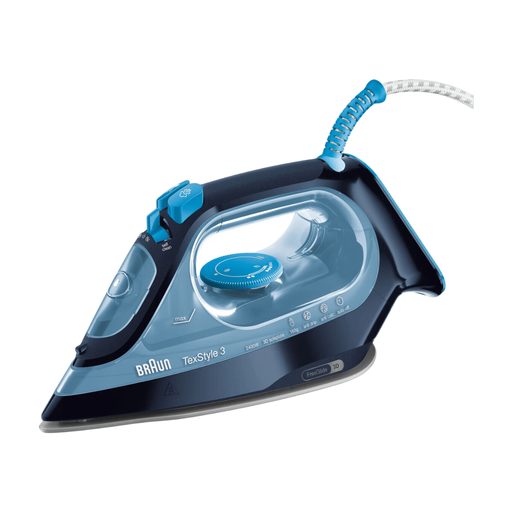
Braun TexStyle 3 SI3050 steam iron

Braun TexStyle 3 SI3050 steam iron

Suitable for ironing around seams and buttons, and for tackling creases with a steam boost.

The product description lists a ceramic soleplate, FreeGlide 3D, a precision tip and automatic shut-off. The stated steam boost is 170 g.

Joybuy
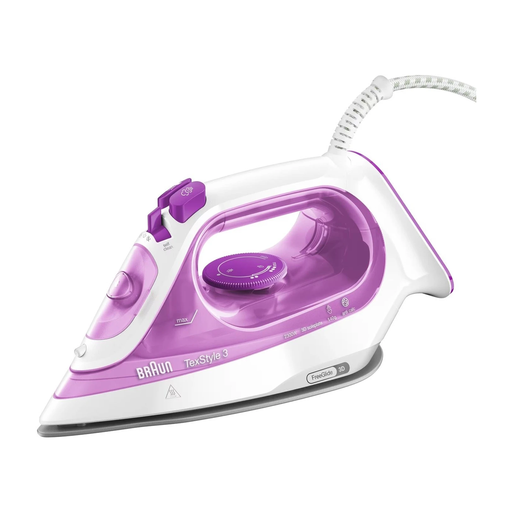
Braun TexStyle 3 SI3030 steam iron

Braun TexStyle 3 SI3030 steam iron

Suitable if you want to adjust the temperature to suit different care labels and iron around hems or seams.

Braun lists manual temperature control and a 270 ml tank for the SI3030. The product description also mentions self-cleaning and a precision tip.

Joybuy

Frequently asked questions

Can you always iron cotton shorts on the hottest setting?

No. Follow the ironing symbol on the specific pair of shorts, even if the fabric is described as cotton. The GINETEX table gives maximum soleplate temperatures of 110, 150 and 200 °C for one, two and three dots respectively; the symbol for 110 °C means you should iron without steam.

How can you stop your shorts staying damp after steaming?

If the care label allows steam, start by ironing with an appropriate amount of steam, then continue without steam until the fabric is dry. Leave the garment to cool while dry, and use an extra steam boost only on stubborn creases.

What water and maintenance does a steam iron need?

The Consumentenbond says steam irons and steam generators are designed for tap water, but follow the instructions for your model, especially if using softened or demineralised water. Avoid perfumed ironing water and additives; an anti-scale function doesn’t remove the need for regular maintenance.

Do I automatically get exactly two years of statutory warranty in the Netherlands?

No. The Dutch government states that the Netherlands has no fixed statutory warranty period: you’re entitled to a product that works as it should for as long as you can reasonably expect. If a product is faulty, the seller is your point of contact; a manufacturer’s warranty is in addition to your statutory rights.

What safety rules apply to an electric iron in the Netherlands?

Electrical appliances placed on the Dutch market must meet the relevant European product safety requirements. The Dutch government describes CE marking and the EU declaration of conformity as manufacturer obligations when an appliance meets the requirements. The European Low Voltage Directive covers equipment with 50–1000 V AC, among other things; a product listing alone doesn’t prove that an individual item complies.
