A washer-dryer could suit your needs if you can fit one appliance in both homes and the shirts’ care labels allow tumble drying. The key is to compare the drying capacity with the amount you want to wash and dry in one continuous cycle; it may be lower than the washing capacity. If you have the space and time to hang your clothes up, you can avoid using electricity to dry them. If you tumble-dry frequently, it’s also worth comparing the energy use of separate appliances, as Milieu Centraal advises.
Who is this choice relevant to?
Moving with limited space
You want to wash and perhaps dry your shirts, but first you need to check whether one appliance will fit in both your current and future home. The Consumers’ Association recommends taking the available space into account when choosing.
Moving with a tight drying deadline
You need your shirts to be dry before you leave. Check that the care label allows tumble drying and that the load is within the stated drying capacity. The Consumers’ Association highlights the difference between washing and drying capacities.
Careful shirt owner
You prioritise a suitable drying method, crease control and energy use over the convenience of automatic drying. Clevercare explains care symbols, while the Consumers’ Association assesses creasing and energy use as separate test criteria.
What should you consider when choosing?
Washer-dryer
A good fit if: you have a suitable space and the shirts’ care labels allow tumble drying.
Bear in mind: the drying capacity may be lower than the washing capacity, so you may need to use a smaller load.
Washing machine and air-drying
A good fit if: you have time and space to hang clothes up, or if the care label does not allow tumble drying.
Bear in mind: you’ll need to allow enough time for the shirts to dry completely.
Separate washing machine and tumble dryer
A good fit if: you have room for two appliances and expect to tumble-dry frequently after your move.
Bear in mind: you’ll need space for both appliances. Milieu Centraal recommends separate appliances over a washer-dryer because of their energy use for washing and drying.
Base your choice on four things: the available space in both homes, your drying deadline, the care label instructions and how often you plan to tumble-dry after your move.
| Concern |
What to check before buying |
Who is this most important for? |
| Will the appliance fit in both homes? |
Compare its dimensions with the spaces where you plan to install it and the narrowest part of the route; check the connections and installation instructions. |
If I’m moving between two rooms, I want to know in advance whether the machine will fit along the route and can be connected in its new position. Around 33% of consumers are most concerned about installation space. |
| Will the shirts be dry in time? |
Compare the washing capacity, drying capacity and programme duration for the same model; otherwise, plan for a smaller load or allow time to hang clothes up. |
If I need the shirts before I leave, I want to know whether the full drying cycle fits into my schedule. Around 27% of consumers prioritise having their clothes dry on time. |
| Is tumble drying suitable? |
Check the care label on each shirt, then compare suitable programmes and, where available, independent information about drying and creasing. |
If I want to take good care of my cotton shirts, I’d rather follow the care label than judge by the fabric alone. Around 20% of consumers are most concerned about shirt care. |
| How often will I tumble-dry? |
Compare energy use, water use and cycle duration on the same basis, and decide how often you’ll use the combined cycle. The EU energy label provides information for individual ways of using the appliance. |
If I’ll use the machine frequently after moving, I want to be able to compare the energy use of the cycle I usually run. Around 20% of consumers prioritise running costs. |
Buying pitfalls to avoid
-
Comparing only the washing capacity
A washer-dryer may dry less cotton than it can wash. A full washing-machine load may not fit into one continuous wash-and-dry cycle.
For automatic washing and drying, size the load according to the stated drying capacity. Allow extra time for drying or hang some of the washing up.
You may need an extra drying cycle or time to hang some of the load up.
-
Mistaking a steam function for a wash cycle
Steam refresh and washing are different functions. Having a steam function doesn’t mean a worn shirt has been washed.
Choose a suitable wash programme for shirts that need washing. Consider any steam function separately as a garment-care option.
-
Comparing washing figures only
Figures for washing alone don’t tell you how much energy or time a combined wash-and-dry cycle uses.
Compare the figures for the cycle you actually plan to use. The European Commission explains which cycle information is shown on the energy label.
-
Measuring the route and installation space only after buying
A machine that fits in the room must also fit along the moving route and be installed according to the instructions.
Measure both installation spaces and the narrowest part of the route before choosing a model. After the move, check the installation instructions, including guidance on transit bolts.
A late check could mean extra arrangements for transport and installation.
Brands to consider
Bosch
According to Bosch Netherlands, the Bosch WNG24406NL is a Serie 6 washer-dryer with a 9 kg washing capacity and a 6 kg drying capacity. This model may be worth considering if its capacity and dimensions suit your needs.
- Bosch Netherlands lists the model’s washing and drying capacities.
- These figures alone don’t tell you how its drying or crease results compare with other models.
LG
LG Netherlands lists a 9 kg washing capacity and a 6 kg drying capacity for the GD3R509S0, and names AI DD and Steam as features of this model.
- The stated capacities give you a clear starting point for comparing washing and drying loads.
- The listed features don’t prove that shirts will crease less; check the care label and programme instructions.
AEG
The model specifications for the AEG LWR76144 list an 11 kg capacity for washing cotton and a 7 kg capacity for drying cotton. AEG presents Steam Refresh and SpecialCare as features of this model.
- The stated cotton capacities may be useful if you need to dry a larger load.
- A steam refresh is not a full wash, and the capacities don’t prove better drying or crease results.
Samsung
Samsung Netherlands lists a 9 kg washing capacity and a 6 kg drying capacity for the WD90DG5B15BHEN. The stated external dimensions are 600 × 850 × 600 mm.
- The published dimensions give you a starting point for checking the available space.
- Also check the space needed for connections and opening the door using the installation information; specifications vary by model.
Washer-dryers on Joybuy
These washer-dryers are for anyone who wants to combine washing and drying in one appliance. Compare their drying capacity and dimensions with your load and moving space.
 No image available
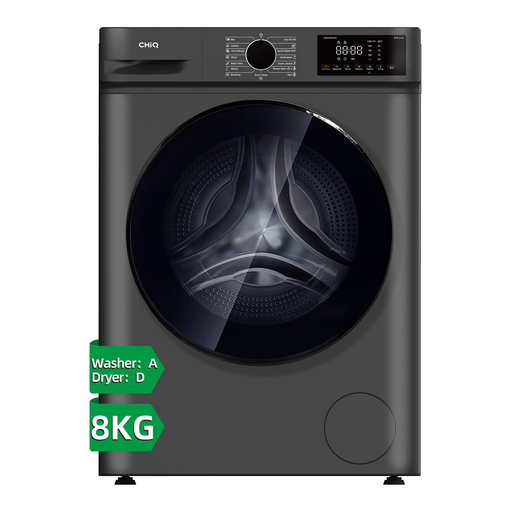
CHiQ JW85882HG washer-dryer, dark grey
A washer-dryer with an 8 kg washing capacity to compare with your planned load.
The product name lists 1400 rpm and a steam function. The stated dimensions are 600 × 520 × 847 mm; check the space required and the installation instructions.
View at Joybuy
 No image available
Midea MF205D80WB/W-NL washer-dryer
The stated 8 kg washing capacity and 6 kg drying capacity help you work out whether your load can go through a continuous cycle without transferring it. Bear in mind the lower drying capacity for this cycle.
The product description lists a cotton programme and dimensions of 59,5 × 85 × 49–54 cm. Check the installation space required.
View at Joybuy
 No image available
Bosch WNA13400EU washer-dryer
With an 8 kg washing capacity and a 5 kg drying capacity, the drying limit determines the load you can wash and dry in one continuous cycle.
The product description lists a 60-minute Wash&Dry programme and dimensions of 59,8 × 59 × 84,8 cm. Check that the programme duration and dimensions suit your schedule and space.
View at Joybuy
 No image available
Samsung WD90DB7B85GWU3 washer-dryer
The stated 9 kg washing capacity and 6 kg drying capacity are worth considering if you size the load for a combined cycle according to the drying capacity.
The product description lists dimensions of 60 × 60 × 85 cm and features such as AI Wash, QuickDrive and a steam programme. Check the model instructions and the space required.
View at Joybuy
 No image available
Hisense WD3S9043BW3 washer-dryer
The stated 9 kg washing capacity and 6 kg drying capacity make the drying limit an important consideration for a continuous cycle.
The product description lists dimensions of 59,5 × 55 × 84,5 cm. According to the description, the 60-minute Quick Wash & Dry programme is limited to a maximum of 1 kg.
View at Joybuy
Frequently asked questions
Can you put any cotton shirt straight into the tumble dryer after washing?
No, check the care label on each shirt individually. If tumble drying isn’t listed as a suitable treatment, follow the recommended drying method. The fact that a garment is made of cotton doesn’t, on its own, mean it can go in the tumble dryer.
What should you do when installing the machine and after moving?
Place the machine on a flat, stable surface and follow the manual for connecting and transporting it. Remove the transit bolts before use, and check again after the move that the machine has been installed correctly.
What cost and warranty details should you compare before ordering?
Compare energy and water figures for the same cycle, and check which delivery, installation or connection services are included with your purchase. For consumer purchases in the Netherlands, contact the retailer if the product develops a fault during normal use; ACM ConsuWijzer explains that the retailer must offer an appropriate solution. An extended warranty does not replace your statutory rights.
Does a washer-dryer sold in the Netherlands need an energy label?
Yes, the EU energy label applies to household appliances such as washer-dryers. The European Commission says it includes information such as the efficiency class, energy and water use, and cycle duration. Compare the figures for the way you plan to use the appliance.


