A washer-dryer is a good choice if you only have room for one appliance and the shirts you want to dry straight away fit within the drying capacity of the programme you choose. The Consumers' Association warns that a full cotton wash-and-dry cycle can take a long time, so check both the programme duration and the care symbols on the shirts. If you have room for two appliances and regularly dry several loads, compare a separate washing machine and tumble dryer too. Air-drying can help you avoid using electricity to dry your laundry, as Milieu Centraal explains.
Who is this choice relevant to?
Families with a full load of shirts
You collect shirts throughout the school week and want to know in advance how many can be washed and dried in one cycle. The Consumers' Association recommends comparing the washing and drying capacities separately.
Households with space for one appliance
You want to wash and, when needed, dry your clothes without making room for two separate appliances. Measure the space and check the connections. The Consumers' Association also highlights the importance of a flat, stable surface.
Shirt wearers looking to reduce creasing
You check the care label and choose between air-drying and a suitable drying programme. The Consumers' Association notes that drying in the smaller drum of a washer-dryer can lead to more creasing.
What should you consider when choosing?
Washer-dryer with a continuous programme
Suitable for: one appliance space and shirts that fit within the drying capacity.
Bear in mind: a cotton programme can take a long time, and the washing load weight is not automatically the same as the drying load weight.
Washing and air-drying
Suitable for: shirts whose care labels do not allow tumble-drying, or when you have the space and time to hang your washing out.
Bear in mind: you’ll need to take the shirts out of the machine and hang them up yourself after washing.
Separate washing machine and heat pump tumble dryer
Suitable for: space for two appliances and regularly washing and tumble-drying several loads.
Bear in mind: you’ll need space for two appliances.
Whichever option you choose, compare the load you actually want to dry, the care labels and the time you have available. The points below will help you decide which considerations matter most for your shirts.
| What to consider |
What should you check? |
Who is this most relevant to? |
| Weekly load you can dry |
Compare the weight of your usual load with both the washing capacity and the cotton drying capacity for the specific programme. |
I want to be able to dry the shirts straight after washing them. Around 33% of consumers prioritise the weekly load they can dry. |
| Garment care |
Check the washing and drying symbols on each shirt and only choose a programme that follows those instructions. |
I want to care for my shirts according to their labels, even if that means not tumble-drying them. Around 27% of consumers prioritise garment care. |
| Cycle duration |
Check how long the complete wash-and-dry cycle takes for the load you expect to wash, not just the duration of a washing programme. |
I want to know whether the shirts will be ready in time after a busy week. Around 20% of consumers prioritise cycle duration. |
| Space and energy use |
Measure the space and check the connections. On the EU label, compare the same operating mode, including washing and drying if you use both stages. |
I want to know whether one appliance will fit and how its full operating mode suits my routine. Around 20% of consumers prioritise space and energy use. |
Common mistakes when choosing
-
Assuming the washing capacity is the same as the capacity for a full wash-and-dry cycle
In the model examples listed, the cotton drying capacity is lower than the washing capacity. A full washing load may therefore be too large to dry completely in the same cycle.
Work out how many shirts you want to dry straight away and compare that with the capacity of the specific drying programme.
Some of the shirts may need to be air-dried separately or put through an extra drying cycle.
-
Confusing a short washing programme with a quick complete cycle
The Consumers' Association reports that the combined cotton wash-and-dry programme in particular can take a long time.
Check how long the full cycle takes for the load you plan to wash.
-
Looking only at energy figures for washing
The EU label gives figures for different operating modes. A figure for washing alone does not describe the complete wash-and-dry cycle.
Compare figures for the same mode and consider whether you could air-dry your shirts too.
-
Confusing a manufacturer's guarantee or service plan with all your statutory rights
According to the Government of the Netherlands, there is no fixed statutory guarantee period in the Netherlands. If a product is faulty, the retailer is your point of contact for a solution. A manufacturer's guarantee is separate.
Check what any additional cover includes and ask about extra costs before you buy.
Also check for any delivery and installation costs before you place your order.
Brands worth comparing
Hisense
The WD3S9043BW3 is an example of a washer-dryer for cotton laundry.
- The Consumers' Association lists a 9 kg washing capacity and a 6 kg drying capacity for cotton.
- These capacities alone say nothing about drying performance or whether the appliance is right for your shirts.
LG
The F4DR7596SYH is an example with separate capacity figures for cotton and synthetic laundry.
- The Consumers' Association lists a 9 kg washing capacity and a 6 kg drying capacity for cotton.
- For synthetic laundry, the Consumers' Association lists a drying capacity of 3,5 kg, so don’t use the cotton capacity as a limit for other shirts.
AEG
The LWR76144 is an example to compare if you want to wash and dry a larger load of cotton laundry.
- The Consumers' Association lists an 11 kg washing capacity and a 7 kg drying capacity for cotton.
- The stated capacity alone does not tell you whether the appliance will fit in your available space or how long a programme will take.
Bosch
The WNG254A7NL is an example to compare, with a relatively high stated washing capacity for cotton.
- The Consumers' Association lists a 10,5 kg washing capacity and a 6 kg drying capacity for cotton.
- For a continuous cycle, compare your load with the drying capacity.
Samsung
The WD90DG6B85BB is an example with separate capacity specifications for cotton and synthetic laundry.
- The Consumers' Association lists a 9 kg washing capacity and a 6 kg drying capacity for cotton.
- For synthetic laundry, the Consumers' Association lists a drying capacity of 4 kg. Don’t assume that other models have the same specifications.
Product options at Joybuy
This selection includes both washer-dryers and a separate washing machine with a heat pump tumble dryer. Compare them based on the space you need, their washing and drying capacities, and how you want to dry your shirts.
 No image available
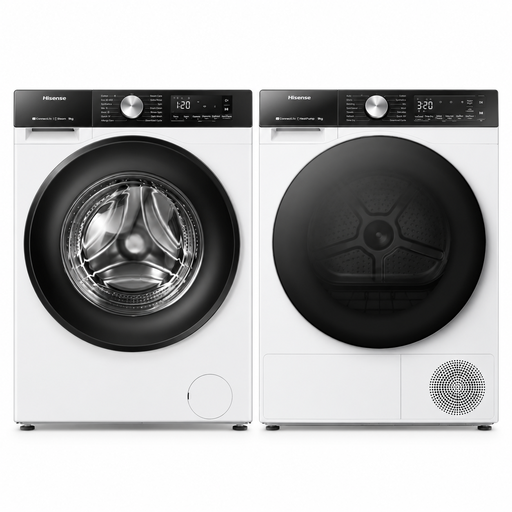
Hisense WF3S9043BW3 washing machine and DH5S902BW heat pump tumble dryer
This bundle is suited to households with space for two appliances, so you can start another wash while an earlier load is drying.
Washing capacity: 9 kg. Drying capacity: 9 kg. The bundle consists of two separate appliances.
View at Joybuy
 No image available
Midea MF205D80WB/W-NL washer-dryer
This washer-dryer is an option if you want to combine washing and drying in one appliance.
Washing capacity: 8 kg. Drying capacity: 6 kg. Bear the lower drying capacity in mind if you plan to run a continuous cycle.
View at Joybuy
 No image available
Bosch WNA13400EU washer-dryer
This combination appliance is designed for anyone who wants to wash and dry their laundry in one appliance.
Washing capacity: 8 kg. Drying capacity: 5 kg. For a continuous cycle, keep to the lower drying capacity.
View at Joybuy
 No image available
Samsung WD90DB7B85GWU3 washer-dryer
This freestanding washer-dryer is an option if you want to combine washing and drying in one appliance.
Washing capacity: 9 kg. Drying capacity: 6 kg. The drying capacity is the relevant limit for a full wash-and-dry cycle.
View at Joybuy
 No image available
Hisense WD5I8043BWF washer-dryer
This combination appliance is an option if you want to wash and dry your laundry in one appliance.
Washing capacity: 8 kg. Drying capacity: 6 kg. Bear the lower drying capacity in mind for a continuous cycle.
View at Joybuy
Frequently asked questions
Can every cotton school shirt go through a combined wash-and-dry programme?
No. Check the washing and drying symbols on each shirt. The care label gives details such as the maximum washing temperature, while the drying symbol shows whether tumble-drying is allowed and what instructions to follow.
Which figures on the energy label should you compare if you also tumble-dry?
Compare figures for the same operating mode, especially those for the full wash-and-dry cycle if you plan to use both stages. According to the European Commission, the EU label includes details such as energy use per 100 cycles, water use per cycle and programme duration.
What should you check when installing a washer-dryer?
Follow the instructions for the specific model. The Consumers' Association recommends, among other things, using a flat, stable surface, removing the transit bolts, connecting the water supply and drain correctly, levelling the appliance and using an earthed socket.
Are you automatically entitled to exactly two years of statutory guarantee in the Netherlands?
No. According to the Government of the Netherlands, there is no fixed statutory guarantee period in the Netherlands. You are entitled to a product that works properly for as long as you can reasonably expect it to. If a product is faulty, the retailer must provide a solution; a manufacturer's guarantee is separate.
Must a washer-dryer meet EU energy and ecodesign requirements?
Household washer-dryers covered by EU rules must meet mandatory ecodesign requirements and energy labelling rules. Check the label and details for the specific model; the general rule does not confirm that an individual listing has been labelled correctly.


