
If you often iron for short periods
You want to iron a few handkerchiefs regularly without having to get a large appliance ready each time. The Consumers’ Association recommends a standard steam iron if you don’t do much ironing.


For regularly ironing a few cotton handkerchiefs, a standard steam iron is often a practical choice. It’s smaller to store than a steam generator, and you can use steam to dampen cotton when needed. Choose a dry iron if you specifically want to iron without built-in steam. A steam generator is better suited to those who also regularly iron large piles or tackle stubborn creases.
You want to iron a few handkerchiefs regularly without having to get a large appliance ready each time. The Consumers’ Association recommends a standard steam iron if you don’t do much ironing.
You want to smooth out folded or creased cotton without getting it unnecessarily wet. The Consumers’ Association recommends choosing an iron with adjustable steam.
You want to be able to iron without steam after steaming, and to follow a care routine that suits your model. Follow the garment’s care label and the appliance’s instructions.
The Consumers’ Association recommends choosing an iron with adjustable steam, then switching off the steam and continuing to iron until the fabric is dry. Always check the care label on each handkerchief too.
Best for: regular short ironing sessions when you sometimes want to dampen cotton with steam before finishing with a dry iron.
Trade-off: the water tank is built into the iron and is smaller than the tank on a steam generator.
Best for: those who specifically want to iron without built-in steam and lightly dampen the fabric separately if needed.
Trade-off: there’s no built-in steam function to dampen cotton as you iron.
Best for: those who iron handkerchiefs as part of much larger piles or often tackle stubborn creases.
Trade-off: a generator is larger and harder to store, and generally takes longer to heat up than a standard steam iron.
| What to consider | What should you check? | Who should pay particular attention? |
|---|---|---|
| Getting started quickly and saving space | Compare the size, heat-up time and controls of the exact model. The wattage alone doesn’t tell you how quickly you can finish a short ironing session. | If I only iron a few handkerchiefs at a time, I want an appliance that’s easy to get out and put away. Around 36% of consumers prioritise speed and compactness. |
| Smoothing cotton handkerchiefs | Check whether the continuous steam is adjustable and look at the shape of the soleplate tip. Published steam figures aren’t measured ironing results. | When dealing with creases, I want to be able to dampen cotton precisely, without assuming that more steam is always better. Around 29% of consumers prioritise smoothing cotton. |
| Controlling moisture and finishing dry | Check whether you can switch off the steam and whether the temperature is suitable for the care label. | If I use steam, I want to be able to continue ironing without it and let the handkerchief cool down dry. Around 21% of consumers consider a dry, controlled finish most important. |
| Care and safe, repeated use | Read the model-specific instructions for water and descaling. Before making a specific purchase, also check the relevant product and safety information. | I want to know how to care for and use the appliance before ironing with it regularly. Around 14% of consumers give care and safe use top priority. |
If you only iron a few handkerchiefs at a time, you may not make much use of the capacity needed for large piles.
Before choosing a steam generator, compare how many items you iron in each session and how much storage space you have. The Consumers’ Association highlights size and storage space as factors to consider when choosing.
A separate generator takes up extra space and generally takes longer to heat up than a standard steam iron.
A published steam figure isn’t an independent test on cotton handkerchiefs. Too much moisture can leave the fabric and ironing board wet.
Check that the steam can be adjusted and switched off, so you can continue ironing without steam after dampening the fabric.
Care instructions vary by model. Using the wrong method can damage the appliance or leave marks on fabric.
Follow the instructions for the exact model when it comes to water and descaling. Tefal also recommends checking the model-specific instructions.
The TexStyle 3 range includes standard steam irons. The SI 3030 is worth considering if getting started quickly and precise ironing are important to you.
The 3000 Series includes standard steam irons. The DST3031/20 is one model to consider for smaller loads.
The Easygliss Plus FV5736 is a standard steam iron worth considering if adjustable steam and a precision tip are on your list.
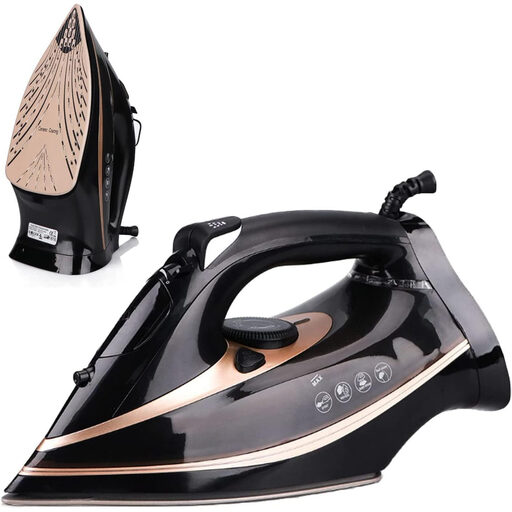
These product picks include standard steam irons and models with both steam and dry ironing functions, suited to short ironing sessions with cotton handkerchiefs.
 No image available
A standard steam iron to compare if you want to use steam when ironing cotton.
Ceramic soleplate; continuous steam 70 g/min; steam boost 120 g; 300 ml tank; self-cleaning function.
 No image available
This model offers both dry ironing and continuous steam, so you can compare the features.
Non-stick soleplate; five temperature settings; 350 ml tank; anti-drip system; self-cleaning function.
 No image available
The stated ironing function makes this model worth comparing if you’re looking for an appliance that steams and irons.
According to the product description, it’s ready to use in 60 seconds; ceramic soleplate; steam output of 20 g/min; steam lock.
 No image available
A model to compare if you want to combine steam and dry ironing with manual controls.
Removable 0,15 l tank; variable continuous steam; manual steam control and thermostat.
 No image available
An option to consider if you’re looking for a standard steam iron that can also be switched to dry ironing.
2000 W; variable steam and a no-steam setting; narrow soleplate tip; Calc-Clean feature.
Follow the handkerchief’s care label. Ironing symbols include maximum temperatures of 110 °C, 150 °C and 200 °C. The fact that it’s cotton isn’t a reason to exceed the stated maximum.
Don’t keep adding steam, and after dampening the fabric, continue ironing without steam if the controls allow. Let the handkerchief cool down dry.
According to the Consumers’ Association, tap water in the Netherlands is generally suitable. Follow the instructions for the exact model on water and descaling. Don’t use vinegar or descaler in a steam tank unless the instructions explicitly say to.
No. According to the Dutch Government, there is no fixed statutory guarantee period in the Netherlands. You’re entitled to a product that works properly for as long as you could reasonably expect it to. A manufacturer’s warranty is separate; if a product is faulty, the seller is your point of contact.
The relevant EU safety rules apply to electrical appliances placed on the Dutch market. For a compliant appliance, the manufacturer must apply the required CE marking and draw up an EU Declaration of Conformity. A statement on a retailer’s website does not, by itself, confirm that a specific item has been checked.