
Those who regularly iron cotton
You iron several cotton dresses or other sturdy garments in one session and don't want to keep refilling the water tank.


A steam generator is worth considering if you regularly iron several cotton dresses or other sturdy garments in one go. For a single dress, a regular steam iron may be more practical: the Consumers' Association points out that a steam generator is larger and heavier to store. When choosing, compare the continuous steam output, water tank, controls for different fabrics and descaling method. Manufacturer figures don't prove how smooth your dress will be.
You iron several cotton dresses or other sturdy garments in one session and don't want to keep refilling the water tank.
You want to freshen up one or a few dresses before going out, and value an appliance that's quick to get out and easy to put away.
You iron fabrics other than cotton too, and want to match the settings carefully to the garment care label.
Suitable for: mainly ironing one dress and having little storage space for the appliance.
Bear in mind: a steam generator may be worth considering for a larger ironing session.
Suitable for: regularly ironing several cotton garments one after another.
Bear in mind: according to the Consumers' Association, a steam generator takes up more space and is heavier to store than a regular steam iron.
| What to consider | What to look for | Who this is for |
|---|---|---|
| Creases in cotton | Compare the continuous steam output in g/min separately from the steam boost; they are different figures. | If I'm ironing several creased cotton dresses, I want to know what the appliance delivers throughout the ironing session. Around 33% of consumers put tackling creases in cotton first. |
| Short ironing sessions | Think about whether you usually iron one dress or several garments, and measure the available storage space. | For one dress before going out, I want an appliance that's easy to get out and put away again. Around 25% of consumers prioritise convenience for a quick job. |
| Fabrics and details | Check the garment care label and compare the controls and the shape of the soleplate tip. | If I iron fabrics other than cotton or narrow sections of dresses, I want to be able to adjust the settings and reach accordingly. Around 25% of consumers prioritise a variety of fabrics and tricky parts of garments. |
| Descaling | Check the care instructions for the exact model and see whether it needs any consumables. | With regular use, I want to know in advance how to descale the appliance according to the manual. Around 17% of consumers prioritise easy maintenance. |
Manufacturers list the steam boost and continuous steam output as separate product specifications. So a steam boost doesn't tell you how much steam the appliance delivers throughout an ironing session.
When ironing several cotton dresses, focus on the stated continuous output in g/min. Treat the steam boost as a separate specification.
According to the Consumers' Association, a steam generator takes up more space and is heavier to store than a regular steam iron.
Before you buy, think about how often you iron several garments one after another and where you'll store the appliance after use.
A commercial guarantee and your statutory rights against the seller are not the same thing.
Keep your proof of purchase and contact ACM ConsuWijzer if a product develops a fault sooner than you could reasonably expect under normal use.
The 3000 Series PSG3000/20 is a specific model to compare if you're considering a steam generator for cotton.
The Express Vision SV8151E0 is worth comparing if you're considering longer ironing sessions and descaling.
The CareStyle 7 Pro IS7286BK is worth considering if you iron different fabrics and want to compare models with several settings.
This selection includes steam generators for regular ironing and a regular steam iron as an option for a quick session.
 No image available
An option to compare if you iron cotton garments one after another.
Continuous steam: 120 g/min; steam boost: 350 g; water tank: 1,4 L; ceramic soleplate; 2400 W.
The steam boost and continuous steam are different measurements; the stated figures alone can't predict the results on your dress.
 No image available
An option to compare if you iron cotton and other fabrics suitable for ironing.
Continuous steam: 120 g/min; steam boost: 360 g; water tank: 1,3 L; SteamGlide soleplate; OptimalTEMP.
Even with an OptimalTEMP model, follow the garment care label.
 No image available
A regular steam iron to compare if you mainly iron one dress at a time.
Continuous steam: 40 g/min; steam boost: 180 g; water tank: 300 ml; ceramic soleplate; cotton setting.
This is a steam iron, not a steam generator.
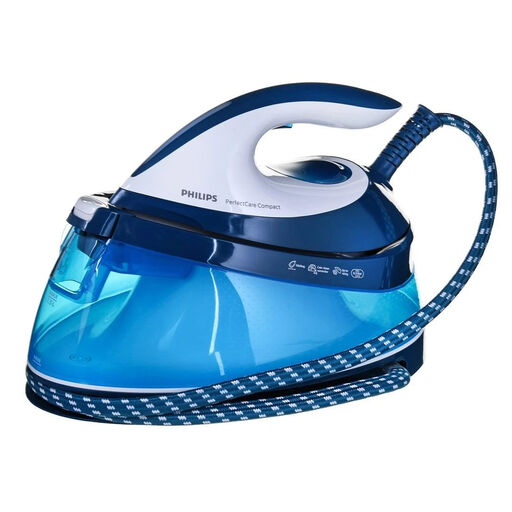 No image available
An option to compare if you iron cotton and a range of fabrics suitable for ironing.
Continuous steam: 120 g/min; steam boost: 400 g; water tank: 1,5 L; SteamGlide soleplate; OptimalTEMP.
Check the care label and the appliance instructions for every garment.
 No image available
An option to compare if a removable water tank and a stated self-cleaning function are important to you.
Stated steam output: 70 g; steam boost: 120 g; pressure: 6 bar; removable water tank: 1,8 L; 2400 W; eco setting.
The product specification doesn't give a time unit for the steam output, so don't compare this figure directly with values in g/min.
Not necessarily. The Consumers' Association says a steam generator is particularly useful for large ironing sessions and stubborn creases, but also points out that it takes up more space when stored. Weigh this against how often you iron several garments and how much room you have.
First, check that the setting is suitable for the fabric and that the appliance is producing steam. Philips describes steam as a way to help with fabrics including cotton; also follow the appliance instructions and the garment care label.
Follow the manual for the exact model, as descaling methods vary. An appliance may use a cartridge, cleaning programme or scale collector, for example; Tefal lists a removable scale collector for the SV8151E0.
The Netherlands Food and Consumer Product Safety Authority says CE marking is compulsory for electrical products covered by the Commodities Act Decree on Electrical Equipment. Check the marking and product information for the specific item; a general reference to a brand doesn't prove that every model offered complies.
For online purchases from a business, you generally have a 14-day cooling-off period, according to the Dutch government, although there are exceptions. Check which returns conditions apply to your purchase.