
If you have limited storage space
You share the utility room and want to let the appliance cool down and put it away after a short ironing session. The Consumers’ Association recommends a steam iron if you’re short on space.


If you usually iron just a few cotton dresses and need to put the appliance away after use, a standard steam iron is often a better fit for a shared space. A steam generator may suit larger ironing loads if you have room for the base unit. A garment steamer is mainly designed to freshen clothes while they’re hanging, rather than press them flat on an ironing board. Check the care label on each dress, and make sure you have a suitable place to use the appliance and let it cool down.
You share the utility room and want to let the appliance cool down and put it away after a short ironing session. The Consumers’ Association recommends a steam iron if you’re short on space.
You regularly iron a pile of dresses and want to refill the appliance less often. Compare information on smoothing cotton, and consider how much space a steam generator and its base unit will take up.
You want to touch up creases in a hanging dress and are happy to use a different method from pressing it flat with an iron soleplate.
Best suited to: ironing a few dresses and putting the appliance away after use.
Bear in mind: the water tank is smaller than that of a steam generator, and you move the iron itself over the fabric.
Best suited to: ironing lots of dresses regularly, with a suitable ironing board and a dedicated space for the base unit.
Bear in mind: the complete system is larger and needs more storage space.
Best suited to: quickly removing creases from a hanging dress without setting up an ironing board.
Bear in mind: steaming a dress on a hanger is different from pressing it flat on an ironing board with an iron soleplate.
Your choice will mainly depend on space, the finish you want on cotton, safe use and maintenance. The breakdown below can help you decide which factors matter most in your situation.
| What to consider | What to look for | Who should give this more weight? |
|---|---|---|
| Space and storage | Measure your work and storage areas, and decide where the appliance can cool down safely. | If you share the utility room, you’ll want to put the appliance away after use. Around 29% of consumers say space and storage are their main consideration. |
| Cotton and dress details | Check the care label and compare information on smoothing cotton, the soleplate and steam settings. | If you want to press dresses flat, including around seams and details, check specifically that the appliance is suitable for cotton. Around 36% of consumers prioritise the results on cotton. |
| Use and cooling down | Read the manual for the specific model and check where you’ll place it, the cord and whether it has an automatic shut-off function. | If other people also use the utility room, you’ll want a dedicated place to set the appliance down safely and let it cool. Around 21% of consumers prioritise safe use and storage. |
| Purchase and maintenance | Compare the cost of the appliance and any ironing board you may need. Follow the manual for your exact model when descaling. | If you want to keep the purchase and maintenance manageable, compare the space required and the maintenance steps too. Around 14% of consumers put purchase and maintenance at the top of their list. |
A garment steamer is designed for steaming clothes on a hanger; pressing them flat is done with an iron soleplate on an ironing board.
Choose a garment steamer for quickly removing creases. If you want to press the dress flat, look for an iron and a suitable ironing board.
You may still need an iron and ironing board to get the finish you want.
The base unit is larger than a standard steam iron and may be too large or heavy for the space you have available for use or storage.
Before buying, check the dimensions, where you’ll put the appliance and whether your ironing board can support the base unit.
You may need a larger ironing board or extra storage space.
Maintenance methods vary by appliance, and using the wrong one can damage the steam tank.
Follow the manual for your exact model rather than relying on general descaling advice.
Philips offers steam irons with an integrated water tank, as well as garment steamers for use without an ironing board.
According to Tefal, the Smart Protect Plus FV6870 is designed for ironing without manually selecting a temperature; the Ultragliss Anti-Calc Plus FV6830 has a removable limescale collector.
The TexStyle 7 Pro SI 7181 is worth considering if you often have to manoeuvre around buttons, pockets or other details when ironing dresses.
The Autosteam DW4020 is worth considering if automatic steam and temperature settings suit your preferences.
This selection includes standard steam irons and steam generators for anyone who wants to press cotton dresses flat. A standard steam iron is a good fit if storage space is limited; a steam generator needs more room for its base unit.
 No image available
A standard steam iron for pressing dresses flat when you want to put the appliance away after use.
Tank: 300 ml. Continuous steam: 40 g/min. Steam boost: 180 g.
The product description lists a ceramic soleplate and settings for cotton.
 No image available
A steam iron for pressing dresses flat and working around details.
Power: 2000 W. The product description lists a cotton setting, variable steam, a pointed tip and Calc-Clean maintenance.
Follow this model’s maintenance instructions.
 No image available
A steam generator to consider for larger ironing loads if you have room for the base unit.
Tank: 1,4 l. Power: 2400 W. Steam boost: 350 g.
The product description lists a ceramic soleplate, vertical steaming and automatic shut-off. Bear in mind that a steam generator needs more space.
 No image available
A steam generator for larger ironing loads, provided you have room for the base unit.
Tank: 1,8 l. The product description lists a Durilium soleplate and an anti-scale system.
Check the work and storage space you’ll need beforehand, and follow the maintenance instructions for the specific model.
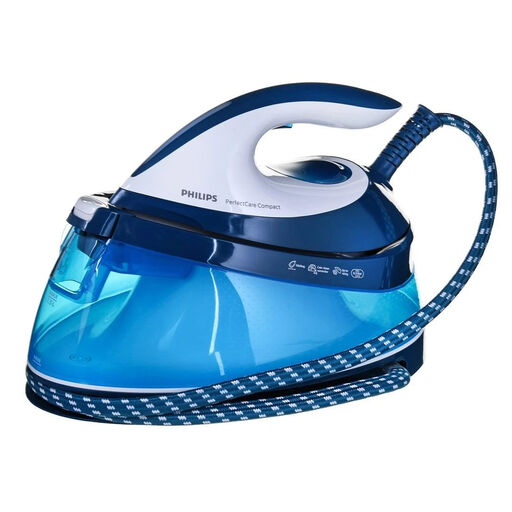 No image available
A steam generator to consider if you iron larger loads and have room for the base unit.
Tank: 1,5 l. Power: 2400 W. Steam boost: 400 g.
The product description lists a SteamGlide soleplate, automatic shut-off and Calc-Clean maintenance. A steam generator takes up more space than a standard steam iron.
No. Check the dress’s care label first. The symbols show what heat level is safe; a crossed-out iron symbol means you shouldn’t iron the dress. Set the appliance accordingly.
Make sure you have a stable work surface and a suitable place to let the appliance cool down, and read the manual for your exact model. If you have a steam generator, also check that your ironing board is suitable for its base unit. Automatic shut-off is an additional safety feature.
Follow the manual for your exact model, as maintenance methods vary between versions. Tefal describes different procedures for self-cleaning, an anti-scale rod and a removable limescale collector. The brand advises against using vinegar or descaling products when rinsing the steam tank.
No. According to the Dutch government, there is no fixed statutory warranty period in the Netherlands: you’re entitled to a product that works as it should, depending on what you could reasonably expect. If a product is faulty, the retailer is your point of contact; the manufacturer’s warranty is in addition to this.
Yes. The Netherlands Food and Consumer Product Safety Authority states that CE marking is compulsory for electrical products sold on the Dutch market. Household appliances within the applicable voltage range must also meet the requirements of the European Low Voltage Directive. A CE mark doesn’t replace safe use.