Which option is right for you?

If you iron a few aprons

If you occasionally iron a couple of cotton aprons, a standard steam iron may be all you need, without having to store a larger set-up. The Consumers’ Association notes that cotton can be harder to smooth out than lightweight synthetic fabrics.

If you iron a large pile

When you have lots of aprons or thicker fabrics to iron, refilling and storage become more important. The Consumers’ Association describes the larger water tank of a steam generator as an advantage for bigger ironing loads, although the overall set-up is larger and heavier.

If you iron seams and details

If you want to work carefully around ties, seams and pockets, look at the shape of the soleplate tip and set the heat according to the care label. Braun describes the TexStyle 3 SI 3030 as having a precision tip.

What should you look for when buying?

Adjustable steam iron

Suitable if: you occasionally iron a few aprons flat and want to adjust the temperature and steam to suit the care label.

Consider: cotton can be harder to smooth out than lightweight synthetic fabric, so look for reviews of its performance on cotton rather than focusing only on the stated power rating.

Steam generator

Suitable if: you iron lots of aprons or other heavy fabrics in one go during a change of season.

Consider: the larger water tank can be useful for big ironing loads, but the complete set-up takes up more room and is heavier to store.

Garment steamer

Suitable if: you mainly want to quickly freshen an apron on a hanger and don’t need sharp creases.

Consider: you can use it without an ironing board, but it doesn’t offer the hot soleplate and horizontal pressure of an iron.

What to consider What should you check? Who is this important for?
Creases in cotton Check the care label and, where possible, compare reviews of ironing results on cotton. A stated steam boost is not the same as a measured result. If I mainly want a smooth, flat cotton surface, I look at performance on cotton and adjustable heat and steam. Around 40% of consumers put smoothing out creases first.
Size of the pile Balance the number of aprons you iron in each session against the water tank, refilling and the space needed for the whole appliance. If I have a large pile, I want to iron several aprons one after another and have somewhere to store the set-up. Around 30% of consumers prioritise the amount of ironing.
Seams, ties and pockets Look at the shape of the soleplate tip and check the care label for the whole apron before setting the temperature. If I want to work precisely around seams and pockets, access to details matters. Around 20% of consumers say detail work is their main consideration.
Maintenance after storage Find the descaling method for the exact model and follow the relevant instructions. If you rarely use an iron between seasons, you’ll want to know how to maintain it. Around 10% of consumers prioritise maintenance.

Common buying mistakes

  • Assuming a high steam output means great results on cotton

    A stated figure describes an appliance feature; it doesn’t automatically show how smooth it will leave cotton. The Consumers’ Association assesses ironing results by fabric type.

    Where possible, compare results on cotton and distinguish between continuous steam and a short burst of steam.

  • Choosing a steam generator straight away for a few aprons

    The larger water tank is most useful for bigger ironing loads. A steam generator also takes up more room as a complete set-up and is heavier to store.

    Count how many aprons you usually iron in one session and decide in advance where you can store the appliance.

  • Prioritising the cotton label over the care label

    Not every finished apron can be ironed at the same temperature. Excessive heat can damage or leave a sheen on the fabric.

    Check the apron’s care instructions before setting the heat and steam.

Brands to compare

Philips

Philips offers both steam irons and steam generators in its 3000 Series. These are different types of appliance, suited to different-sized ironing loads.

  • The product information for the DST3031/20 steam iron lists a 300 ml water tank.
  • Follow the descaling procedure for the exact type of appliance. Instructions for a steam iron do not automatically apply to a steam generator.

Braun

The TexStyle 3 SI 3030 is an adjustable steam iron with a precision tip, as described by Braun. This is worth considering if you work around details.

  • Braun lists a 270 ml water tank and a self-cleaning function.
  • The stated 45 g/min applies to turbo mode; it is not the continuous steam output.

Tefal

The Ultragliss Anti-Calc Plus FV6840 is a steam iron with a removable scale collector.

  • For this model, Tefal lists continuous steam of up to 50 g/min and a maximum steam boost of 260 g.
  • Claims about glide, durability or speed don’t prove how well a particular cotton apron will iron.

Rowenta

Rowenta provides information about parts for ranges including Autosteam, Focus and Steamforce.

  • The parts information may help if you’re looking for a suitable maintenance part for an exact model.
  • The product ranges listed don’t confirm that every part is available or fits every model.

Steam irons at Joybuy

This selection features adjustable steam irons for ironing cotton aprons flat, with creases and details in mind.
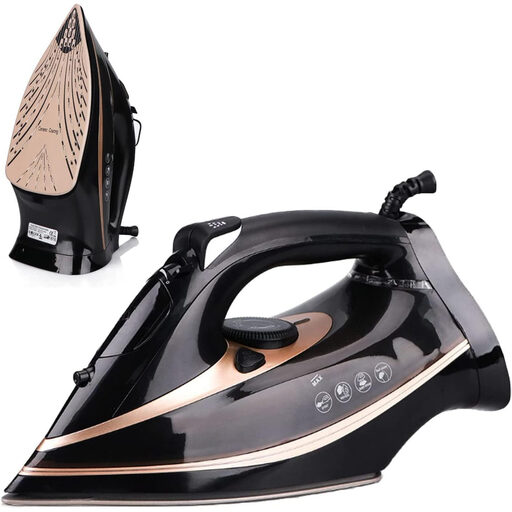
Steam iron with ceramic soleplate

2600 W steam iron with ceramic soleplate

The adjustable temperature and steam are useful if you want to match the settings to an apron’s care label.

Ceramic soleplate; 70 g/min steam; 120 g steam boost; 300 ml water tank; self-cleaning.

View at Joybuy

Handheld steam iron with non-stick soleplate

2400 W handheld steam iron with non-stick soleplate

The listed temperature settings and precision tip are useful for aprons with different care instructions and details that are easy to reach.

Five temperature settings; 350 ml water tank; non-stick soleplate; anti-drip system.

View at Joybuy

Philips 3000 Series steam iron DST3031/20

Philips 3000 Series steam iron DST3031/20

The temperature dial and adjustable steam are useful if you want to match the heat to the care label and apply extra steam to specific areas.

Continuous steam: 40 g/min; steam boost: 180 g; water tank: 300 ml; ceramic soleplate; automatic shut-off.

View at Joybuy

Philips 1000 Series steam iron DST1030/20

Philips 1000 Series steam iron DST1030/20

Manual temperature and steam controls are useful when you need to follow different care instructions.

Power: 2000 W; water tank: 0.15 litres; narrow soleplate tip; Calc-Clean.

View at Joybuy
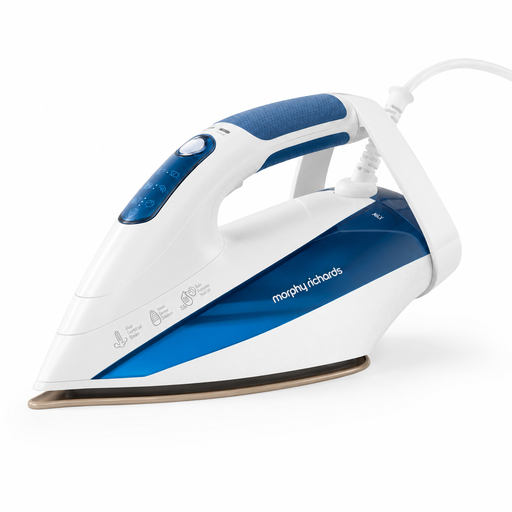
Morphy Richards MDH-IRB4E steam iron

Morphy Richards MDH-IRB4E steam iron

The range of steam settings and precision tip are useful if you want to tackle creases as well as seams and other details.

Power: 2400–2800 W; steam: 50 g/min; water tank: 350 ml; six steam settings; anti-drip system; self-cleaning.

View at Joybuy

Frequently asked questions

What temperature should you use to iron a cotton apron?

Follow the apron’s care label, not just the general fibre name. The Consumers’ Association distinguishes between ironing symbols for a maximum of 110 °C, 150 °C and 200 °C, and warns that excessive heat can damage fabric.

How can you remove creases without making the apron too wet?

If the care label allows it, iron the fabric while it’s still slightly damp. Direct extra steam or the spray function at stubborn creases, then finish by ironing dry without steam. Repeated steaming can make the fabric or ironing board too wet.

How should you maintain a steam iron that you rarely use?

Find and follow the descaling instructions for the exact model. Philips gives separate procedures for steam irons and steam generators; these instructions don’t automatically apply to appliances from other brands.

What can you do if your iron develops a fault after purchase?

In the Netherlands, you’re entitled to a product that is fit for purpose, and there is no fixed statutory guarantee period. According to the Dutch government, the seller is your point of contact if something goes wrong. Normal wear and tear or damage caused by your own actions isn’t automatically covered by free repairs.

What product safety rules apply to electrical appliances?

Electrical appliances must meet the applicable European safety requirements. According to Ondernemersplein and the Netherlands Food and Consumer Product Safety Authority, manufacturers of appliances covered by CE requirements must apply the required CE marking and draw up an EU declaration of conformity. A product listing alone does not confirm that a particular model meets these requirements.
