What should you look for when ironing cotton aprons?
Start with the care label. Then choose mainly according to whether you only iron a few aprons or regularly tackle larger loads of washing too.
Standard steam iron
Best suited to: ironing just a few aprons and keeping storage and work-space requirements to a minimum.
The trade-off: it’s more compact, but usually has a smaller tank than a steam generator.
Steam generator
Best suited to: aprons being part of regular, large ironing loads with stubborn creases.
The trade-off: the separate tank holds more water, but the base takes up extra space.
Handheld garment steamer
Best suited to: quickly freshening up an apron when you don’t need a sharply pressed finish.
The trade-off: Philips states that a garment steamer won’t give the same results as an iron, especially on thick cotton.
| What to consider |
What to look for |
Who is this important for? |
| Quick apron ironing session |
Compare the size, adjustable steam and the option to finish without steam. |
If I’m only ironing a few aprons before visitors arrive, I want an appliance that’s easy to handle and store. For around 50% of consumers, a few aprons are their main ironing need. |
| Long ironing sessions |
Compare continuous steam output in g/min and tank capacity; consider a steam boost as a separate feature. |
When aprons are part of large, regular loads of washing, I focus on continuous steam and fewer refills. Large ironing sessions are the main priority for around 30% of consumers. |
| Care label and details |
Check the care label for the whole apron and make sure any print or delicate areas can withstand direct contact with the soleplate. |
If the care label is restrictive or the apron has a print, I want to know first which temperature and steam settings are allowed. Around 20% of consumers prioritise protecting these details. |
Joybuy products for aprons and larger ironing sessions
These products include standard steam irons for quick apron sessions and a steam generator for larger ironing loads. Compare their features with your care label and available storage space; product specifications are not an independent performance test. Appliances marketed in the Netherlands are subject to applicable European product safety requirements. Ondernemersplein states that, after assessing a compliant appliance, the manufacturer affixes the CE mark and draws up an EU Declaration of Conformity. Check the documentation for the specific appliance.
 No image available
Tefal Easygliss Plus FV5736
May suit quick apron sessions when you want to adjust the steam and temperature to the fabric.
The product description lists a 200 ml tank, adjustable steam, adjustable temperature and a precision tip.
It also lists continuous steam output, a steam boost and automatic shut-off.
View at Joybuy
 No image available
Philips 1000 Series DST1030/20
May suit you if you want to adjust the temperature and steam to the care label, with the option to iron without steam too.
The product description lists a narrow tip, variable steam and continuous steam output of 20 g/min.
According to the description, the temperature and steam settings also include steam-free ironing; the model has 2000 W of power.
View at Joybuy
 No image available
Braun FreeStyle 5 SI5037
May suit aprons with creases and hard-to-reach areas, provided the other settings are suitable for the care label.
The product description lists a precision tip, a ceramic soleplate and a 300 ml tank.
It also lists continuous steam, an extra steam boost, an open handle and automatic shut-off.
View at Joybuy
 No image available
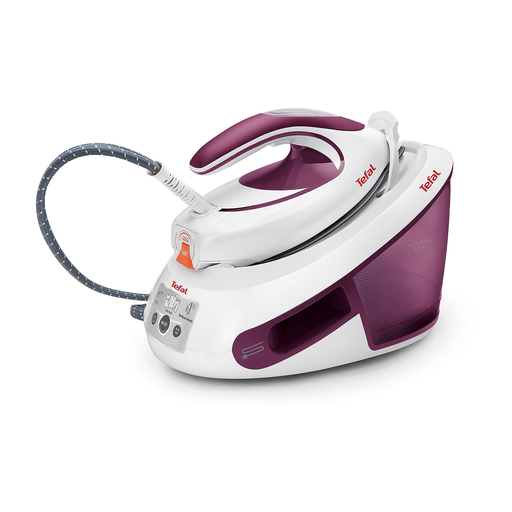
Tefal Express Anti-Calc SV8054
May suit you if you want to use different fabric settings and value a larger tank.
The product name lists 2800 W of power. The product description specifies a 1,8 l tank, variable steam control and temperature settings suited to the fabric.
It also lists a precision tip and a self-cleaning anti-scale function.
View at Joybuy
 No image available
Philips 3000 Series PSG3000/20
May suit regular, larger ironing sessions; a steam generator usually needs more storage space than a standard steam iron.
The product description lists 120 g/min of continuous steam, a removable 1,4 l tank and a ceramic soleplate.
The product name lists 2400 W of power and a 350 g steam boost. The description mentions temperature settings to suit the care label.
View at Joybuy
Frequently asked questions
What temperature should you use for a cotton apron?
Follow the apron’s care label rather than relying on the fibre name alone. The GINETEX table gives maximum soleplate temperatures of 200 °C, 150 °C and 110 °C for the relevant ironing symbols; the symbol for 110 °C means you should iron without steam. Take care with prints and other delicate details too.
Does a steam iron need descaling?
Follow the instructions for your exact model, as maintenance requirements vary between appliances. Tefal warns that you shouldn’t use vinegar or descaling products in the tank of its steam generators, as they could damage it.
What if a new iron breaks quickly during normal use?
According to ACM ConsuWijzer, if a product breaks sooner than you could reasonably expect, the retailer must put things right free of charge. This could mean a repair, replacement or, where appropriate, a refund. A manufacturer’s warranty does not replace this statutory right.
What product safety rules apply to an electric iron in the Netherlands?
The responsible parties must comply with the applicable European requirements. Ondernemersplein states that, after assessing a compliant appliance, the manufacturer affixes the CE mark and draws up an EU Declaration of Conformity. Check the documentation for the specific appliance; a general product listing alone doesn’t prove that an individual item meets the requirements.


