
Household with a few aprons
You iron a few cotton aprons from time to time and don't want to store a large appliance. The Consumentenbond considers a standard steam iron suitable for small batches of laundry and limited storage space.


If you iron just a few cotton aprons at a time, a standard steam iron is often the more practical choice to start with: according to the Consumentenbond, this type suits smaller ironing loads and limited storage space. For longer sessions, a steam generator may be a better fit if you have room for the larger appliance. For every apron, follow the care label: GINETEX advises setting the maximum ironing temperature according to the label, not just the fibre.
You iron a few cotton aprons from time to time and don't want to store a large appliance. The Consumentenbond considers a standard steam iron suitable for small batches of laundry and limited storage space.
You iron aprons along with a larger pile of laundry and take longer sessions and refilling into account. The Consumentenbond suggests considering a steam generator if you regularly iron larger loads in one go.
Your apron may have a print, appliqué or other delicate finish. GINETEX advises choosing the ironing temperature according to the care label, rather than relying solely on the type of fibre.
First, think about how many aprons you usually iron in one go and how much space you have. Then choose an appliance with settings that suit the care label.
Suitable for: a few aprons at a time or limited storage space.
Trade-off: its built-in water tank is smaller than the separate tank on a steam generator, so you may need to refill it during longer sessions.
Suitable for: regularly ironing larger loads in one go, if you have room for an appliance with a separate tank.
Trade-off: the separate tank and steam hose take up more space. A higher stated steam output doesn't prove that a particular apron will be smoothed more quickly.
| What to consider | What should you check? | Who should pay particular attention? |
|---|---|---|
| Creases and details | Read the care label and compare continuous steam and steam boost as separate manufacturer specifications. Also check how easily the soleplate moves around ties and pockets. | If my main aim is to tackle creases and work around ties or pockets, I look at the finish and ease of handling. Around 40% of consumers say smoothing creases is their main priority. |
| Longer sessions | Work out how many aprons you iron in one go and compare the built-in or separate tank, along with the storage space required. | When I iron a larger household load in one session, I take refilling and storage space into account. Around 30% of consumers say longer sessions are their main priority. |
| Delicate details | Check the care label for the whole apron and set the appliance accordingly. GINETEX bases the maximum temperature on the label, not just the fibre. | If my apron has a print or appliqué, I want to adapt the treatment to its most delicate part. Around 20% of consumers say these details are their main priority. |
| Limescale and maintenance | Check the manual for the exact model for guidance on water and descaling. | If I want to plan maintenance easily, I check the instructions for the model I've chosen. Around 10% of consumers say maintenance is their main priority. |
The recommended ironing treatment depends on more than the main fibre. A print or finish may mean you need to use a lower setting.
Read the care label before setting the temperature and follow its instructions.
An unsuitable setting could damage the print or finish.
Manufacturers specify these figures separately. A steam boost doesn't describe the continuous steam output during a longer ironing session.
Compare the figures separately, and only between models for which the relevant specifications are available.
The stated steam output alone doesn't tell you how quickly a particular apron will be smoothed. A steam generator also has a separate tank and steam hose.
First, consider the size of your usual ironing session and how much space you have for the appliance.
Allow for the extra storage space needed for the separate tank and steam hose.
Hard water can cause limescale build-up and problems with a steam iron. An anti-limescale feature doesn't replace the maintenance instructions.
Before buying, check the manual for the exact model for guidance on water and descaling.
Allow time for maintenance specific to the model.
The features listed apply to the specific models and product ranges below; they aren't a general assessment of each brand.
Offers standard steam irons, such as the Express Steam FV2838, and steam generators, such as the Express Vision SV8152.
The TexStyle 7 Pro SI 7160 is a standard steam iron.
Its products include the Azur 8000 Series iron DST8070/80 and the PerfectCare steam generator PSG7200/20.
The Steamforce DW9240D1 is a standard steam iron with steam functions.
This selection includes standard steam irons for smaller ironing sessions and steam generators for larger loads. Available storage space remains an important consideration.
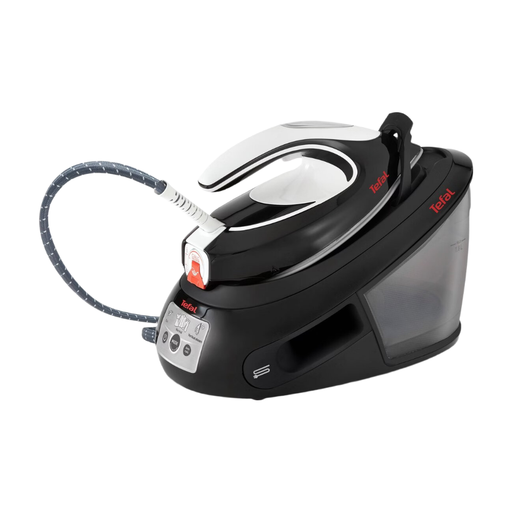 Image unavailable
A steam generator to consider for longer ironing sessions; allow for the extra storage space it needs.
The product information lists 120 g/min of continuous steam, a 450 g/min steam boost, and automatic temperature and steam settings.
 Image unavailable
A steam generator to consider if you iron aprons along with a larger pile of laundry; make room for the appliance.
The product information lists 120 g/min of continuous steam, a 350 g steam boost, a removable 1.4-litre tank and up to an hour of use in ECO mode.
 Image unavailable
A standard steam iron to consider if you iron just a few aprons from time to time or have limited storage space.
The product information lists 45 g/min of continuous steam, a 220 g/min steam boost and a 200 ml water tank.
 Image unavailable
A steam generator to compare if you have longer ironing sessions; bear in mind the storage space it needs.
The product information lists 120 g/min of continuous steam, a 380 g/min steam boost and an 1800 ml tank.
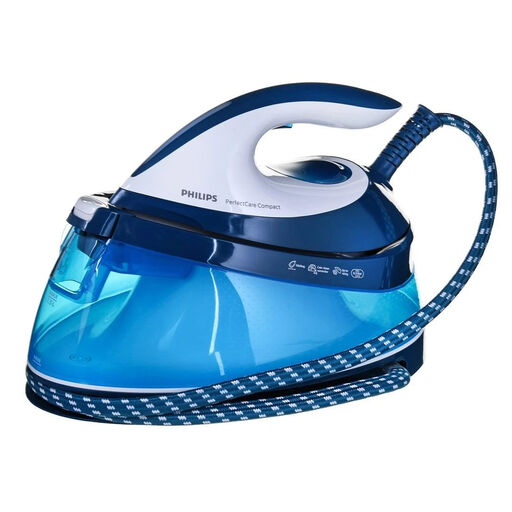 Image unavailable
A steam generator to consider if you iron aprons as part of a larger load; make room for the appliance and its storage.
The product information lists 120 g/min of continuous steam, a 400 g steam boost, a 1.5-litre tank and up to 1.5 hours of use.
No. Choose the permitted ironing treatment according to the care label for the whole apron, not just the cotton fibre. GINETEX points out that finishes and appliqués matter too.
Follow the manual for the exact model. The Consumentenbond says tap water can be used and suggests mixing it with distilled or demineralised water in hard-water areas. Manufacturers may have different recommendations about softened water.
Report the problem to the retailer. According to the Rijksoverheid, your legal right to a product that works properly still applies after a commercial guarantee has expired; what you're entitled to depends on the circumstances.
Not always. According to the Rijksoverheid, many distance purchases come with a 14-day cooling-off period; check whether your purchase is covered by the rules.
According to the Rijksoverheid, electrical appliances placed on the market in the EU must carry a CE marking. Check the marking on the appliance itself: a description in an online shop doesn't, by itself, prove that all safety requirements have been met.