
Vandaag of morgen in huis

Kwaliteit gegarandeerd

Welkomstaanbiedingen ontgrendelen: GRATIS bezorging | Tot 80% korting | Gratis 30 dagen JoyPlus-proefperiode
Download de app
A Corsair PC fan can improve your desktop, but only if its size, connections and airflow suit your case. Many buyers focus mainly on RGB lighting and maximum speed. As a result, important factors such as static pressure, noise levels and controller compatibility are often overlooked.
For gamers, PC builders and hardware enthusiasts, there are three common pitfalls:
Below, we explain what to look for and which Corsair models suit different use cases.
A 120 mm PC fan is highly versatile. This size fits many mid-tower cases at the front, rear and top, as well as 120 mm radiators. Always check your case’s exact mounting positions.
A 140 mm PC fan can move more air at a lower speed when used with a suitable mounting opening. This may be useful if you have a spacious case and want to run your fans at lower speeds. For example, the Corsair iCUE LINK RX140 RGB has a range of 300 to 1700 RPM and a stated maximum airflow of 94.7 CFM according to the product information.
Do not just look at the diameter; thickness matters too. The standard size is approximately 25 mm, but always check the available space around a radiator, CPU cooler or cramped case.
Airflow, usually measured in CFM, indicates how much air a fan can move under specified conditions. This is particularly relevant for open case positions.
Static pressure, measured in mmH₂O, is important when air has to pass through a radiator, dust filter or dense ventilation grille. For example, the Corsair iCUE LINK LX120-R RGB lists a maximum of 3.8 mmH₂O and up to 70 CFM. This makes this type of radiator fan suitable for situations where airflow resistance is a factor.
For a standard case, a balanced setup is preferable:
A PWM case fan generally uses a 4-pin connection for precise speed control via the motherboard or a fan controller. This allows you to set a fan curve in the BIOS or software.
RGB lighting uses a separate connection or ecosystem. An ARGB computer fan with a 5V connection is not automatically the same as a Corsair iCUE LINK fan. With iCUE LINK models, multiple fans are connected through an interconnected system. Some versions require a hub. For example, the LX120-R RGB product information states that connection to an iCUE LINK hub is required and that the hub may be sold separately.
Before buying, check the following:
More RGB does not automatically mean better cooling. Choose the correct technical connection and placement first; lighting is an additional feature.
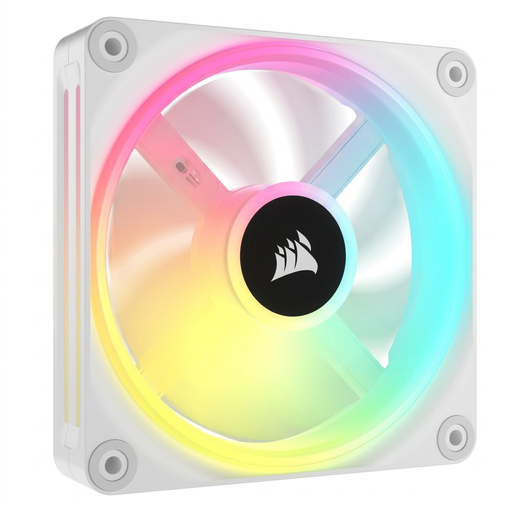
Why this suits the profile: A single 120 mm fan is practical when you want to replace one worn or missing case fan without immediately buying a complete pack.
The product information lists a 4-pin PWM connection, so you are not limited to a fixed speed. However, check your motherboard’s RGB connection beforehand.
120 mm size, PWM control, maximum 63.1 CFM and 34 individually addressable LEDs according to the product specifications.
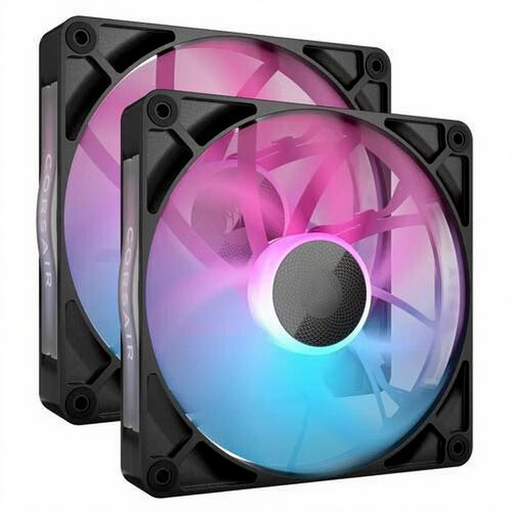
Why this suits the profile: This 140 mm pack is ideal for a spacious build where you want to equip two positions with airflow and RGB lighting at the same time.
The set contains two fans, so you do not need to combine as many individual models. However, check that your case supports 140 mm positions and iCUE-compatible cabling.
300–1700 RPM, PWM support, magnetic levitation bearings and maximum 94.7 CFM according to the product description.
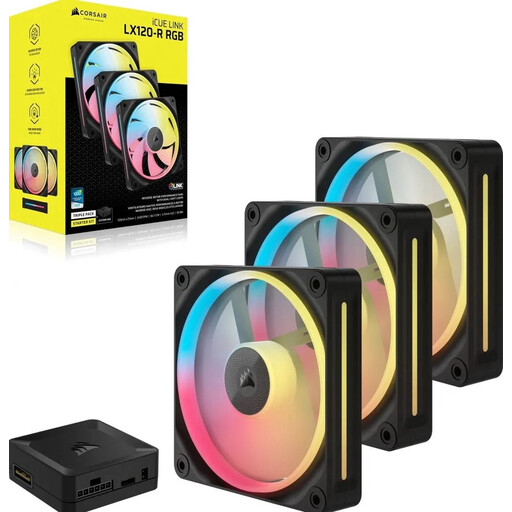
Why this suits the profile: Suitable for a gaming PC with multiple mounting positions or radiator cooling, when you want to install three linked fans.
This model combines PWM control with a stated static pressure of 3.8 mmH₂O. Before buying, check whether a suitable iCUE LINK hub is available or needs to be purchased separately.
Up to 2400 RPM, maximum 70 CFM, 18 RGB LEDs and a stated noise level of 35.1 dB at full speed.
We have put together a complete, up-to-date list of products that fully meet these strict selection criteria and the applicable European safety regulations.
Switch off the computer completely and unplug it from the mains before installing or removing a fan. Pay attention to the airflow direction. The arrow on the frame shows where the air is travelling.
Connect the PWM cable to a suitable header and check that the RGB cables cannot get caught in the blades. Then set a suitable fan curve in the BIOS or Corsair iCUE software. A fan does not need to run constantly at maximum speed; this generally increases noise levels and power consumption.
Clean the blades and dust filters regularly using compressed air or a soft brush. Do not use water on the fan itself. A sudden rattling noise, strong vibrations or a fan that struggles to start may indicate a problem with the bearing, mounting or cabling.
No. Check the mounting holes and available space. A 120 mm model will not fit every 140 mm position, and vice versa. Also check your PC case’s maximum radiator and fan support.
This depends on the specific model and product bundle. The product information for the iCUE LINK LX120-R RGB mentions an iCUE LINK hub. Therefore, check which cables and controller are included before placing your order.
A PC fan generally uses little power, but its exact consumption depends on the model, speed and number of fans. PWM control can help keep the speed lower when maximum airflow is not required. For a fair comparison, check the stated current draw rather than looking only at the maximum RPM figure.
