
Vandaag of morgen in huis

Kwaliteit gegarandeerd

Welkomstaanbiedingen ontgrendelen: GRATIS bezorging | Tot 80% korting | Gratis 30 dagen JoyPlus-proefperiode
Download de app
A Corsair PC case fan can improve airflow, keep noise levels down and give your PC a smart RGB look. But it’s not a good idea to choose based on brand, lighting or a high maximum RPM figure alone. The right fan depends mainly on the space available, the connection and what you need it to do.
A 140mm PC fan often moves more air at a similar speed, but not every case has suitable mounting points. Check your case manual before buying. Also consider the thickness: a standard fan is often about 25 mm thick, while some MAX models are 30 mm. This can cause problems with RAM, radiator brackets or motherboard coolers.
A quoted noise level of, for example, 10 dB usually applies at a low speed. At maximum load, the noise level can be considerably higher. Check the full range, such as 10–36 dB, and use a PWM profile to make the fan spin faster only when temperatures rise.
A standard PWM case fan usually uses a 4-pin connector on the motherboard. RGB may also need a separate 5V or Corsair connector. A Corsair iCUE LINK fan works within the iCUE LINK system and may require a compatible hub and cables. Before buying, check whether the required hub, adapter or cable is included.
For case airflow, you can generally use fans at the front or bottom as intakes, and at the rear or top as exhausts. Check the arrows on the frame to see which way the air will flow.
Airflow, measured in CFM or m³/h, indicates how much air the fan can move according to the product information. Static pressure, measured in mmH₂O, is more relevant when air has to pass through a radiator, dust filter or restrictive front panel.
A radiator fan therefore needs more than a high airflow figure. Airflow may be more important in a case with an open mesh design, while static pressure matters more with water cooling or a restrictive dust filter.
PWM allows the motherboard or a controller to regulate the fan speed more precisely. This helps a quiet PC fan run gently while you’re doing office work, then speed up when you’re gaming or rendering.
The figures quoted are product specifications taken from the available product information. Actual performance depends on factors such as installation, the case, temperature, dust levels and the fan curve you set.
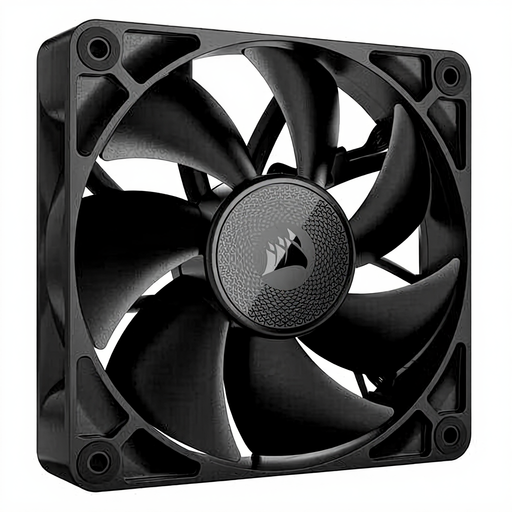
Why it suits this user: This 120mm case fan is a straightforward choice if you want to add a single fan to an existing PC and don’t need RGB. According to the product information, its speed ranges from 400 to 2100 RPM and it has PWM control.
The 120mm size fits many cases. Check the available mounting space and make sure your motherboard has a compatible connector before you buy.
1 piece; black design; PWM; up to 2100 RPM according to the product description.
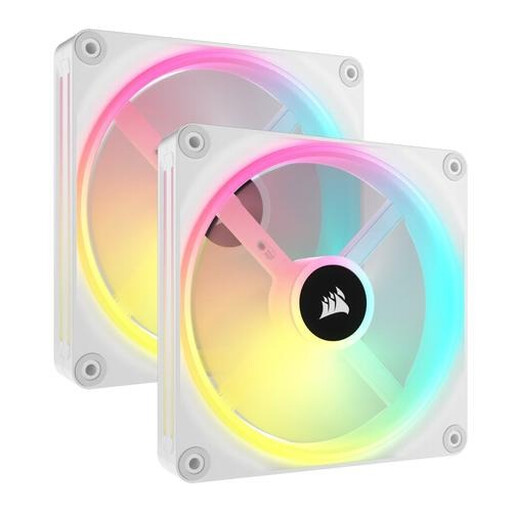
Why it suits this user: If you’re looking for a coordinated look and two larger RGB fans, this set is a great starting point for a white build. The product information lists PWM, 34 individually addressable LEDs per fan, and support for case and radiator cooling.
The set includes two fans, so you don’t need to combine two separate models. Just check that your case has 140mm mounting points.
2 pieces; 140mm; PWM; RGB with 34 individually addressable LEDs per fan, according to the product information.
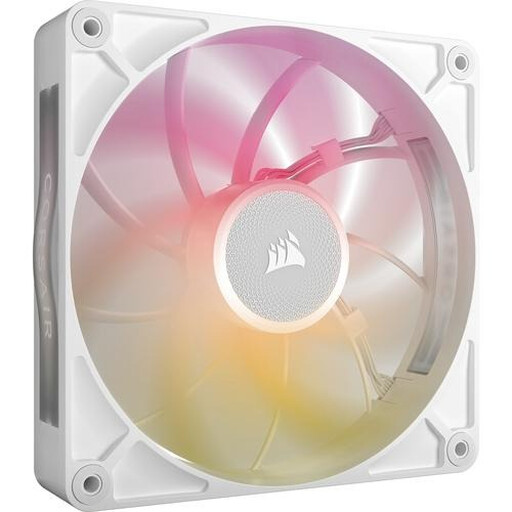
Why it suits this user: This 140mm fan is designed for users who want to combine high airflow, RGB and an iCUE LINK setup. According to the product information, it is 30 mm thick, has a speed range of 300–1600 RPM and delivers up to 102,9 CFM.
The specifications clearly state the extra thickness. Measure the available space around your radiator, memory and case panel before ordering.
140mm; 30 mm thick; PWM; RGB; up to 102,9 CFM according to the product description.
Shut down your PC completely and unplug it from the mains before installing a fan. Secure the fan firmly, but don’t overtighten the screws. Keep cables away from the blades and check the direction of airflow.
Use compressed air or a soft brush for maintenance. Don’t clean the fan with water. Dust on the blades and filters can reduce airflow and create extra noise. If you’re using an iCUE LINK setup, check the connection order, hub limits and included cables against the manual.
We’ve put together a complete, up-to-date list of products that meet these strict selection criteria and the applicable European safety regulations.
Not necessarily. A 140mm fan can move enough air at a lower speed, but the noise you hear depends on the model, fan curve, installation and case. Always compare the full dB range.
That depends on the model and configuration you choose. Products in the iCUE LINK series are designed to be used within the Corsair iCUE LINK system. Check whether a hub and the right cables are included before ordering.
Power consumption varies by model and speed. RGB LEDs add to power use, but the overall difference depends mainly on the number of fans, their speed and how long they’re in use. PWM control lets you limit the speed when your PC is under a light load.
