If you have a large family, first decide between regular cornflakes, flakes containing a proportion of wholegrain, and a breakfast cereal described as a wholegrain product: these terms don’t mean the same thing. According to the Netherlands Food and Consumer Product Safety Authority, a product may only be described as a wholegrain product if its cereal ingredient consists of 100% wholemeal flour. Then compare fibre and sugars per 100 g, pack size and any ingredients that matter to your family.
Who is this comparison useful for?
Families looking to make wholegrain a regular choice
You want to know whether a breakfast cereal is actually described as a wholegrain product. Then you can compare fibre and sugars per 100 g and check which ingredients matter to the people eating at home.
Families who regularly buy large packs
You want to weigh the net contents against how much your family uses. A larger pack is most practical when everyone at home enjoys the product and you can store it somewhere dry.
Families with different tastes or ingredient restrictions
You’re looking for a breakfast cereal everyone at home will eat, while also checking the ingredients, any sweeteners and the allergens highlighted on the pack.
What should you look for when choosing?
First decide whether the wholegrain claim is essential for your family. Then compare the nutritional information for similar products per 100 g, and check the pack size and ingredients before buying a larger pack.
| What to consider |
What to check |
Who it matters to |
| Wholegrain and fibre |
Check the wholegrain claim and compare fibre per 100 g. According to the Netherlands Food and Consumer Product Safety Authority, a product described as a wholegrain product must have a cereal ingredient consisting of 100% wholemeal flour. |
If I want wholegrain to be a regular choice, I want to know the difference between a wholegrain product and flakes containing only a proportion of wholegrain. This is the top priority for around 42% of consumers. |
| Pack size and consumption |
Check the net contents and consider how much your family uses and how the pack can be kept dry. |
If we often eat breakfast cereal at home, I want to choose a pack that suits how much we use. This is the most important consideration for around 33% of consumers. |
| Taste and ingredients |
Compare sugars per 100 g and read the ingredients list for sweeteners and highlighted allergens. |
If tastes differ or someone needs to avoid certain ingredients, I want to know what’s in the flakes before choosing a pack for everyone. Around 25% of consumers give this the highest priority. |
Common mistakes
-
Assuming cornflakes are wholegrain
The shape of a breakfast cereal doesn’t tell you whether it’s described as a wholegrain product. Kellogg’s lists maize as the first ingredient in Corn Flakes; that alone doesn’t mean it’s a wholegrain product.
Look for the exact product description on the pack, then read the ingredients list. According to the Netherlands Food and Consumer Product Safety Authority, a food described as a wholegrain product must have a cereal ingredient consisting of 100% wholemeal flour.
-
Relying on just one claim on the front of the pack
A statement about fibre or added sugars won’t tell you what other ingredients or allergens a product contains. For example, Jumbo lists maltitol, wheat and barley in its Special Flakes.
Compare the nutritional information per 100 g and read the full ingredients list, especially if someone in your family needs to avoid certain ingredients.
Brands to compare
These brands and supermarket ranges include regular cornflakes, flakes containing wholegrain and other breakfast cereals, which don’t automatically belong in the same category. So always compare the specific product.
Kellogg’s
Kellogg’s sells both classic Corn Flakes and Special K Original with wholegrain wheat, as well as a separate All-Bran range.
- According to Kellogg’s, Special K Original contains 37% wholegrain wheat, alongside rice and barley.
- Don’t assume every product from the brand has the same cereal mix; check the ingredients and nutritional information for each variety.
Jumbo
Jumbo Special Flakes is a supermarket own-brand product you can compare with other flakes.
- Jumbo lists 53% wholegrain wheat and 35% rice in its Special Flakes.
- The ingredients list also includes maltitol, with wheat and barley highlighted; check whether this combination suits your family.
Albert Heijn
The range includes AH Bran flakes wholegrain and regular AH Cornflakes as different types of product.
- Albert Heijn lists AH Bran flakes wholegrain in a 500 g pack.
- For the variety you choose, check the ingredients, fibre, sugars and allergens on the current pack.
Golden Bridge
Golden Bridge 7-grain wholegrain breakfast cereal is an alternative for families looking for more than just flakes.
- ALDI lists this 7-grain product in a 500 g pack.
- Check the grains, nutritional information and allergens on the pack before comparing it with flakes.
Lidl
Lidl lists a 7-grain breakfast cereal with wholegrain cereals; it isn’t necessarily the same type of product as cornflakes.
- Lidl lists a pack size of 300 g and says the product is only available in store.
- Check the ingredients and nutritional information on the pack in store to compare its contents.
Joybuy products to consider alongside flakes
If you’re considering a different type of cereal alongside flakes for your family’s breakfast, you can compare this product against the criteria above. It isn’t a cornflake or flake product.
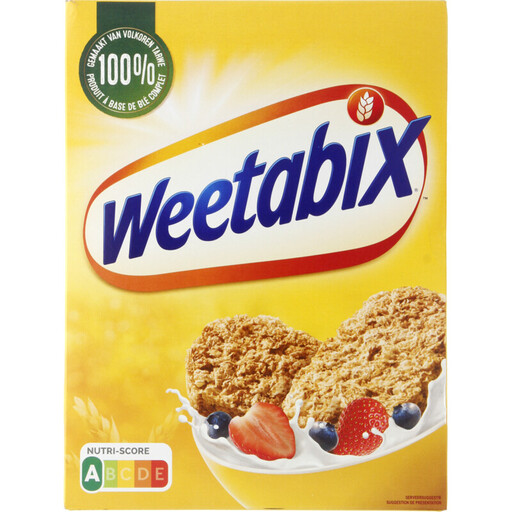 No image available
Weetabix Breakfast Cereal 430 g
An option if your family is also considering breakfast cereals that aren’t flakes.
Pack size: 430 g. Check the ingredients, allergens and nutritional information per 100 g for the pack you choose.
View at Joybuy
Frequently asked questions
When can a breakfast cereal be called wholegrain in the Netherlands?
According to the Netherlands Food and Consumer Product Safety Authority, a food may only be described as a wholegrain product if its cereal ingredient consists of 100% wholemeal flour. If the pack says a product is made with wholegrain cereals, also check the stated proportion and the other cereals in the ingredients list.
How do I compare the nutritional information for different flakes?
Compare similar products per 100 g rather than looking only at the values per portion. The Netherlands Nutrition Centre recommends comparing sugars and fibre in breakfast cereals on the same basis.
Is ‘no added sugars’ enough to help me choose a breakfast cereal?
No, that claim doesn’t describe the product’s full composition. Check the total sugars, fibre, ingredients and any sweeteners too; Jumbo Special Flakes, for example, lists maltitol.
Where can I check which allergens are in breakfast cereals?
Read the highlighted allergens in the ingredients list on the pack you buy. Check this information again next time you buy the product, especially if someone in your household needs to avoid a particular ingredient.


