
Households that eat cornflakes regularly
If you eat cornflakes several mornings a week, a 500 g pack could be worth considering, depending on how much you get through. A larger pack is most practical when you can store it properly once opened.


For weekday breakfasts, choose a larger pack of cornflakes if you’ll use it up while it’s still at its best and can store it properly. If you don’t eat much, 375 g may be more practical than 500 g. Also compare the ingredients, nutritional information and allergens for each product: pack weight tells you nothing about what’s in it.
If you eat cornflakes several mornings a week, a 500 g pack could be worth considering, depending on how much you get through. A larger pack is most practical when you can store it properly once opened.
For these shoppers, ingredients, fibre, sugars, any wholegrain claims and allergens are all important. Compare the current labels on the specific products, rather than looking at pack weight alone.
If a pack will be open for a long time or is difficult to seal properly, a smaller pack may be a better fit for how you use it.
First, work out how much cornflakes your household gets through and how much space you have to store an opened pack properly. Then compare the labels on the packs that suit your needs.
| What to consider | What to check when buying | Who it matters to |
|---|---|---|
| Pack size for regular use | Compare the pack weight with how much your household actually eats; packs are available in sizes including 375 g and 500 g. | If cornflakes are on the table several weekday mornings, I want a pack size that suits that routine. For around 34% of consumers, finding the right pack size comes first. |
| Ingredients and nutritional information | Read the ingredients, nutritional values per 100 g, fibre and sugars, as well as the allergen information on the pack you choose. | When comparing packs, I want to know what each product contains before deciding based on size. For around 33% of consumers, the label is the first thing they look at. |
| Storage when consumption is low | Choose a pack size you can use up, and store an opened pack somewhere cool, dry and dark, with the pack sealed tightly. | If I take a long time to finish a pack or have little storage space, I want to avoid the flakes going soft. For around 33% of consumers, a manageable pack size matters most. |
Ingredients and nutritional values vary from one product to another. A large pack won’t tell you whether its contents are wholegrain or how much fibre and sugar they contain.
Check for any wholegrain claims and compare the nutritional information on the current pack.
An opened pack that isn’t stored with the seal closed properly may lose quality before you’ve finished it.
Choose a pack size that suits how much you eat, and store breakfast cereals somewhere cool, dry and dark, with the pack sealed tightly, as recommended by the Netherlands Nutrition Centre.
Soft or stale flakes may end up going to waste.
The name of a cornflakes product is no substitute for checking the allergen information for that specific variety.
If you need to avoid certain allergens, read the current allergen information on the exact pack you’re buying. The Netherlands Food and Consumer Product Safety Authority says allergens must be clearly listed on the labels of prepacked foods.
These brands give you a starting point when comparing pack sizes. For your final choice, always check the information on the specific pack.
ALDI’s own brand sells Cornflakes in a 500 g pack.
Jumbo Cornflakes is listed in a 500 g pack.
AH Cornflakes is listed in a 500 g pack.
Kellogg's Corn Flakes is listed in a 375 g pack, among other sizes.
Lidl lists cornflakes in its Dutch range.
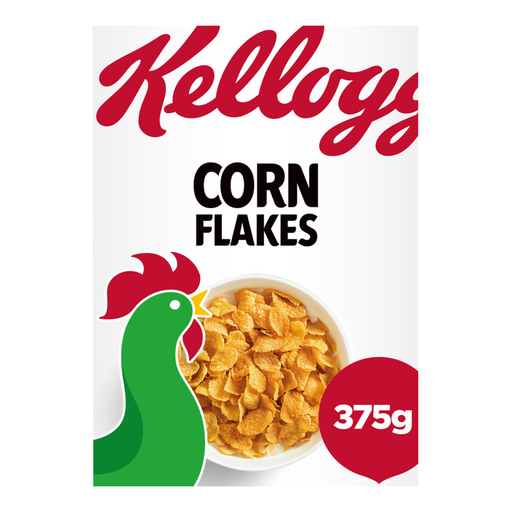
This 375 g pack of Kellogg's is an option if you’re looking for a smaller pack for weekday breakfasts and the size suits how much you eat.
 No image available
A 375 g pack may suit you if you wouldn’t get through a larger pack in time.
Pack size: 375 g. Check the current packaging for ingredients, nutritional information and allergens.
A larger pack is practical if your household will use it up while it’s still at its best. If you can’t store an opened pack properly or don’t eat much cornflakes, a smaller pack may be a better fit.
Compare the ingredients and nutritional information on the specific packs, including fibre and sugars per 100 g. Also check for any wholegrain claims and look at the allergen information if it’s relevant to your household.
Allergen information should be shown on the label of prepacked cornflakes. The Netherlands Food and Consumer Product Safety Authority says allergens must be clearly listed on prepacked foods, so check the information on the exact pack you choose.
Store breakfast cereals somewhere cool, dry and dark, with the pack sealed tightly, as recommended by the Netherlands Nutrition Centre. Follow the storage instructions on the pack too. If you take a while to finish it, choose a pack size you can use up while it’s still at its best.