
Families with someone who has coeliac disease
Want to choose cornflakes for a shared breakfast while making sure their gluten-free supply doesn’t come into contact with regular cereals.


If you’re buying cornflakes for someone with coeliac disease, don’t choose a bigger box just because of its size: check the gluten-free label and the current ingredient information first. For a shared family breakfast, several packs of the same gluten-free cornflakes, such as a multipack, could be an alternative to one large standard box. Keep the opened pack separate from cereals containing gluten.
Want to choose cornflakes for a shared breakfast while making sure their gluten-free supply doesn’t come into contact with regular cereals.
Need enough packs for several breakfasts. A multipack of individually packed gluten-free cereal may be more practical than buying one small pack at a time.
Want to add variety with oats, but need to distinguish regular oats from oats explicitly labelled gluten-free and take individual tolerance into account.
For a shared breakfast with someone who has coeliac disease, a gluten-free label is essential for every product. Then compare the pack sizes and, if it matters to your choice, the nutritional information.
| What to consider | What to check | Most relevant to |
|---|---|---|
| Gluten-free label | Read the label, ingredients and allergen information on the current pack; the name ‘cornflakes’ alone isn’t enough. | When I’m buying breakfast for someone with coeliac disease, I first want to be sure which pack meets the gluten-free requirement. For around 46% of these consumers, this check comes first. |
| Family supply | Check the amount in each pack and whether a multipack contains the same gluten-free cornflakes. AH lists its gluten-free cornflakes in a 200 g pack and also offers multipacks. | For a breakfast we share, I want to have enough packs at home without switching to regular cornflakes. For around 36% of these consumers, this is the first practical consideration. |
| Nutritional information and oats | Compare the nutritional values per 100 g on the pack. For oat products, check the gluten-free label separately. | I want to add variety and compare the nutritional information of suitable products without assuming that regular oats are gluten-free too. Around 18% of these consumers focus on this first. |
The fact that cornflakes are made from maize doesn’t confirm that the packaged product is suitable for someone with coeliac disease.
Check the gluten-free label and read the current ingredient and allergen information when you buy.
A bigger pack won’t solve the problem of keeping enough in stock if the cornflakes haven’t been confirmed as gluten-free.
Only compare pack sizes across products that meet the gluten-free requirement. You could also look at multipacks of the same product.
A product page doesn’t guarantee that a pack will still be available next time you shop. Jumbo says its Lekker Vrij van Gluten Cornflakes are no longer in its online range.
Check what’s available when you buy, and don’t automatically replace an unavailable product with regular cornflakes.
At a shared breakfast table, crumbs from regular cereals can get into gluten-free cornflakes via a spoon or bowl.
Use clean, separate serving utensils and keep the gluten-free pack and serving area separate.
Albert Heijn lists AH Glutenvrij Cornflakes in a 200 g pack and also refers to multipacks.
Jumbo has a product page for its 200 g Lekker Vrij van Gluten Cornflakes.
The product listing for Consenza Pure & Free Cornflakes describes a 250 g gluten-free pack.
ALDI Netherlands lists gluten-free muesli and porridge oats in its breakfast cereal range.
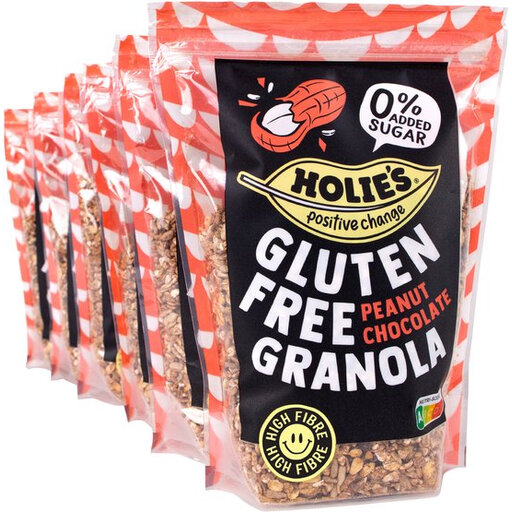
If you’re looking to stock up for several breakfasts, you could also consider gluten-free granola in a multipack. The granola below is a different product category from cornflakes; if you have coeliac disease, check the current packaging and bear in mind that it contains oats.
 No image available
This six-pack is an option if you want to stock up on granola for several breakfasts; it isn’t cornflakes.
Each pack contains 330 g. This granola contains oats and peanuts: check the current gluten-free label and the ingredient and allergen information on the pack.
Not simply because they’re made from maize. Before choosing them for someone with coeliac disease, check the gluten-free label and the current ingredient and allergen information on the pack.
According to the Dutch Coeliac Society, a product can be called gluten-free if it contains less than 20 mg of gluten per kg of product. Even when you buy it again, check the label and ingredients on the pack.
Keep the gluten-free cornflakes in their own pack and use clean, separate serving utensils. Make sure crumbs from regular cereals don’t get into the gluten-free bowl or pack.
An oat product is a different choice from cornflakes and isn’t automatically gluten-free. If you have coeliac disease, only choose a product confirmed as gluten-free. The Dutch Coeliac Society also points out that some people with coeliac disease can’t tolerate even pure oats.