
Vandaag of morgen in huis

Kwaliteit gegarandeerd

Welkomstaanbiedingen ontgrendelen: GRATIS bezorging | Tot 80% korting | Gratis 30 dagen JoyPlus-proefperiode
Download de app
A cordless stick vacuum is handy for everyday dirt, crumbs, pet hair and dust in hard-to-reach places. But a high wattage or eye-catching touchscreen doesn’t automatically mean a model is right for your home. Households with pets, carpets or long hair can run into practical problems in particular.
Motor power, measured in watts, tells you how much electrical power the motor uses. It doesn’t directly tell you how much dirt the vacuum picks up. So check the stated suction power too, which may be given in air watts (AW) or kilopascals (kPa). These figures aren’t directly comparable, but they give you more context than wattage alone.
A cordless stick vacuum with powerful suction can be useful for carpets and pet hair, but it will often drain the battery more quickly on its highest setting. Always check the runtime for each setting.
A claim such as ‘up to 60 minutes’ is usually based on eco or the lowest setting, without intensive use of a powered brush. In practice, runtime is shorter on carpets or in turbo mode.
Look out for the following:
A vacuum with long battery life is particularly useful if you want to clean several rooms in one go. A shorter runtime may be enough for an apartment, while a large house or multiple floors calls for more flexibility.
Long hair and pets can quickly clog a standard roller brush. This can reduce airflow, leaving you to remove hair by hand. Look for an anti-tangle brush or a roller brush designed to help prevent hair from wrapping around it.
Also check whether you can access the roller brush without tools. A cordless stick vacuum for pet owners should not only pick up hair, but also be easy to maintain.
A soft roller brush is often a good choice for hard floors such as PVC, laminate and tiles. For deep-pile or dense carpets, you’ll usually need more suction power and a powered brush. A model for carpets and hard floors with several settings gives you more control over noise, battery use and cleaning results.
For models with high kPa or AW ratings, consider how these features work together:
A vacuum cleaner with a HEPA filter can filter fine particles from the exhaust air, according to the product specifications. However, the term HEPA doesn’t mean every filter performs in exactly the same way. Check whether the filter is washable, replaceable or suitable for dry cleaning only.
Washable parts must be completely dry before you put them back. A damp filter can affect airflow and damage the appliance. Don’t vacuum liquids, wet dirt, hot ash or sharp objects unless the instructions explicitly allow it. This is generally not permitted for this type of product.
A cordless vacuum with LED lights can make dust and hair more visible in dark areas. That’s useful under sofas and cupboards, but lights are no substitute for a good brush or enough suction power.
A stick vacuum with a touchscreen or display may show the battery status, selected setting and maintenance alerts. This makes it easier to see what’s going on, but check that the screen is easy to read while you’re using the vacuum. Consider the accessories too: a crevice tool, upholstery brush and powered mini brush can make a big difference when cleaning furniture, stairs or a car interior.
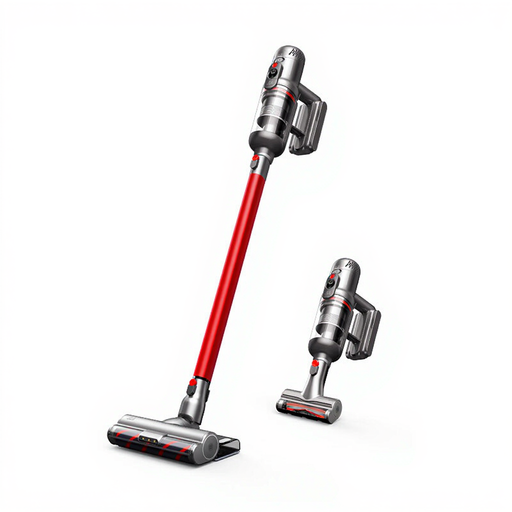
Why it suits this profile: This model offers a straightforward introduction to cordless cleaning, with a handy design, LED screen and accessories for floors, furniture and the car.
The product information lists both 415 watts and 120 AW, as well as two speeds. This means you don’t have to rely on motor power alone when choosing a vacuum.
Up to 60 minutes’ runtime according to the product information, LED lights and a battery-powered handheld vacuum for smaller areas.
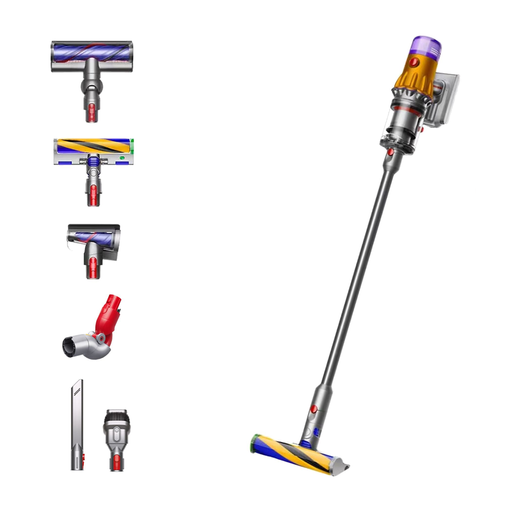
Why it suits this profile: A good choice if you value dust detection, multiple settings and a compact stick vacuum for different floor types.
The stated runtime is broken down by setting: up to 60 minutes on the lowest setting and 10 minutes on the highest, according to the specifications.
150 AW, laser detection according to the product information, an LCD screen and a stated noise level of 73 dB.
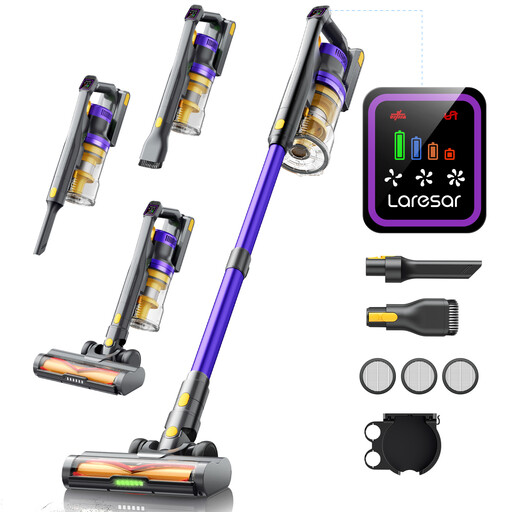
Why it suits this profile: A practical choice for households with pets, carpets and several cleaning jobs to tackle in one session.
The three settings make it clear that 55 kPa applies to MAX mode. The product information lists runtimes of around 15, 30 and 50 minutes, depending on the setting selected.
V-shaped anti-tangle brush, green lights, touchscreen, HEPA filtration and a dust container with a stated capacity of 0.6 to 1 litre.
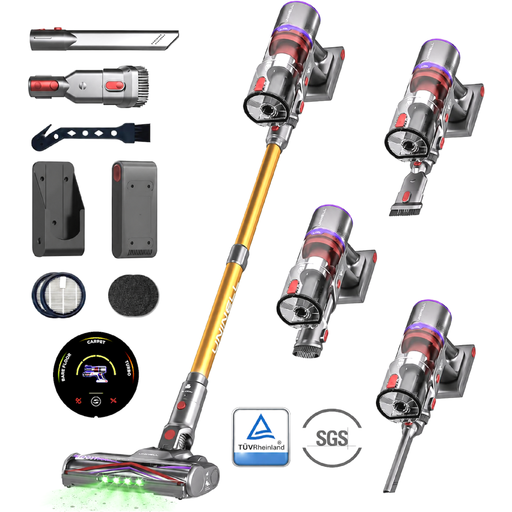
Why it suits this profile: The combination of an anti-tangle brush, removable battery, lights and touchscreen controls makes it well suited to intensive daily use.
The stated 65 minutes is a maximum. According to the product information, the battery indicator and battery management make power use easier to monitor.
Peak suction power of 60 kPa according to the product information, seven filtration stages, four green LED lights and a floor head that reclines to 180°.
We’ve put together a complete, up-to-date list of products that meet these strict selection criteria and current European safety regulations.
Your cordless stick vacuum will keep working well if you stay on top of maintenance. Empty the dust container after a cleaning session when it’s nearly full. Check the brush for hair and threads, and clean the filters according to the instructions. Washable filters must be completely dry before you put them back.
Only use the supplied or recommended charger. Store the appliance indoors and don’t charge the battery outside the temperature limits stated in the instructions. Switch off the vacuum before cleaning the brush, filters or container.
Yes, as long as the model has a powered carpet brush and a suitable suction setting. For deep-pile carpets, it’s worth checking the product information to see which surfaces are recommended. Bear in mind that turbo mode drains the battery more quickly.
That depends on the battery, the setting you choose, the brush and the floor type. The maximum runtime given is often for eco mode. So check the runtime for each setting and whether the battery is replaceable. With regular maintenance, the battery may remain usable for longer, but its capacity will decrease over time.
The main costs are electricity, filters, replacement brush parts if needed, and a new battery when required. A battery of a few hundred watt-hours uses relatively little electricity per charge. The total cost mainly depends on how often you charge it and which replacement parts are available.
