
Vandaag of morgen in huis

Kwaliteit gegarandeerd

Welkomstaanbiedingen ontgrendelen: GRATIS bezorging | Tot 80% korting | Gratis 30 dagen JoyPlus-proefperiode
Download de app
A cordless drill may seem straightforward to choose at first glance. However, models vary considerably in power, battery platform, chuck and included accessories. As a result, a cheap kit can prove expensive if you later need to buy batteries, a charger or suitable drill bits.
For DIY enthusiasts, homeowners and hobbyists, three pitfalls are particularly important:
For general household use, a 12V cordless drill driver is often sufficient for furniture, shelves and light assembly work. An 18V cordless drill generally offers more reserve power for larger screws and holes in wood. Models rated at 20V, 21V or 24V may also be suitable, but do not compare them solely by the number on the label.
Pay attention to the following details:
A high Nm rating is not automatically necessary. For assembly work, a lower adjustable torque can actually be more convenient, as it helps prevent damage to screw heads or materials.
A cordless drill is only ready to use straight away if the battery and charger are included, or if you already own a compatible battery. Therefore, check the following:
For example, according to the product information, Bosch models within the Power for All 18V system can be used with other devices in that system. Einhell states similar interchangeability within the Power X-Change platform. Only use batteries and chargers that the manufacturer confirms are compatible.
Accessories are useful, but consider their quality and relevance. A kit with 78 pieces may sound comprehensive, but a smaller set containing the right wood and metal drill bits and screwdriver bits may be more practical.
A 13 mm keyless chuck accommodates standard drill bits and makes changing them easy. Compact models sometimes have a 10 mm chuck. This may be sufficient for light jobs, but it limits your choice of larger drill bits.
Choose the function according to the material:
A hammer function makes a machine more versatile, but it does not replace a rotary hammer for heavy concrete work. Also check the stated maximum drilling diameter for each material.
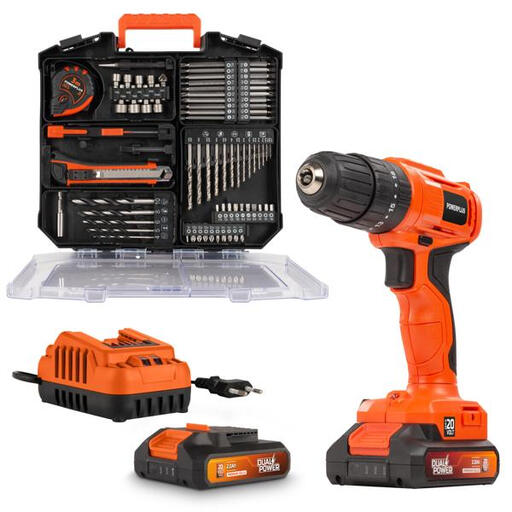
Why it suits this profile: This kit includes two 2.0 Ah batteries, a charger and accessories. That means you can get started straight away with driving screws, drilling and light hammer drilling.
The product information clearly states that the batteries and charger are included. It also specifies two speeds and 18 torque settings.
20V, maximum torque of 30 Nm, keyless chuck, quick-stop function and overload protection according to the product description.
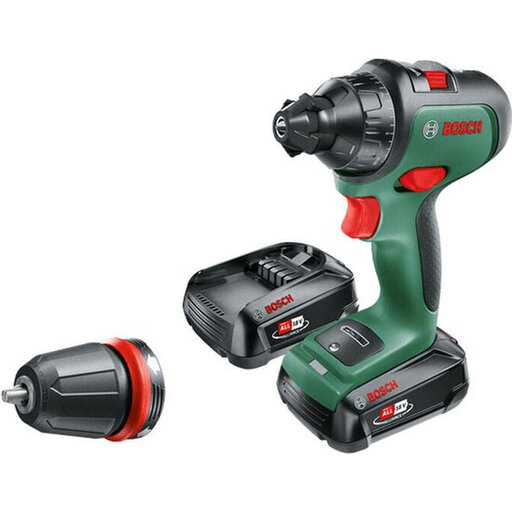
Why it suits this profile: This model is designed for users looking for a compact machine for regular screwdriving and drilling in wood, plastic and metal.
The kit specifies two 18V 2.5 Ah Li-ion batteries and a charger. This means it is not a ‘Solo’ model for which you would later need to buy a starter kit.
Brushless EC motor, 13 mm chuck, magnetic bit holder and automatic speed adjustment according to the product information.
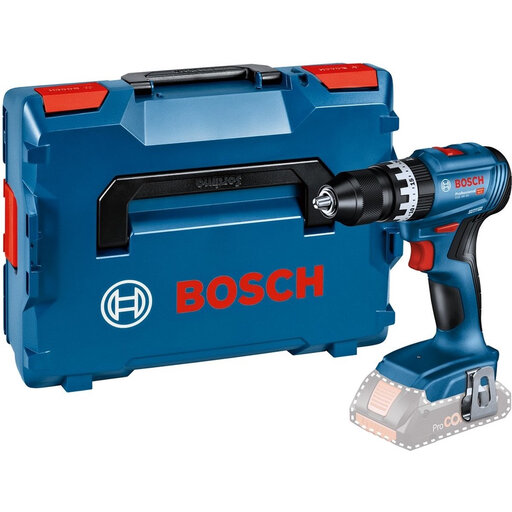
Why it suits this profile: The stated specifications are suited to users who regularly drill and drive screws and need a compact 18V machine with a hammer function.
The product page distinguishes between the machine and the accessories: this version is supplied without a battery or charger. This prevents any misunderstanding at the time of purchase.
18V, maximum torque of 45 Nm, 13 mm metal chuck, two gears and a stated maximum drilling diameter of 10 mm in masonry.
Before drilling, always check whether there are pipes or cables behind the wall. When working with masonry, use a suitable masonry bit and only switch on the hammer function when the material and drill bit are suitable for it. Wear eye and hearing protection, and hold the workpiece securely.
Also consider the weight. A lightweight cordless drill is comfortable to use when assembling items above shoulder height, while a heavier 18V model can offer greater stability for larger jobs. A brushless cordless drill may be worth considering if you use it regularly, but compare the motor technology alongside the battery price, warranty and availability of replacement parts.
We have put together a complete, up-to-date list of products that fully meet these strict selection criteria and the applicable European safety regulations.
It can be, provided the manufacturer lists these applications and you use the right drill bits. Check the maximum drilling diameter, speed and torque. A suitable metal drill bit is needed for thin metal; do not apply unnecessary pressure to the machine.
The operating time depends on the battery capacity, material, drill diameter and load. A 2.5 Ah battery generally offers more capacity than a 1.5 Ah battery, but the actual runtime varies depending on the application. With two batteries, you can continue working while the other one is charging.
A hammer function can be useful for occasional holes in brickwork. For drilling lots of holes, hard concrete or chiselling work, a rotary hammer with an SDS-plus fitting is more suitable. So first choose the material and the job, and only then consider the additional function.
