
Vandaag of morgen in huis

Kwaliteit gegarandeerd

Welkomstaanbiedingen ontgrendelen: GRATIS bezorging | Tot 80% korting | Gratis 30 dagen JoyPlus-proefperiode
Download de app
A cordless car polisher gives you the freedom to move around without an extension lead. That is useful when working on the drive, in a garage or on location. However, not every cordless polisher is suitable for every job. A high speed, an extensive list of accessories or a large battery does not, by itself, say much about the final result.
The key question is therefore not just how much a car polisher costs, but also how well the machine suits your paintwork, working area and frequency of use.
A speed of 5.500 or 7.000 rpm sounds impressive, but it does not tell you everything about how the machine performs. Pad size, orbital throw, pressure on the paintwork and motor control also play a role. A high speed can also be awkward on delicate areas or for beginners.
So look for an adjustable speed and a soft start. For applying wax and sealants, a low setting is generally more practical than the highest setting.
A 5 Ah battery basically has more capacity than a 2 Ah battery within the same voltage class, but runtime also depends on load, speed and surface. Manufacturers’ runtime figures are often based on specific conditions. Treat any stated operating time as an indication, not a guarantee for every polishing session.
Also check whether a battery and charger are included. The Einhell CE-CB 18/254 Li Solo is compatible with the Power X-Change 18V platform, but according to the product information, the fast charger is not included.
A large polishing disc works efficiently on broad body panels, but is less easy to use around mirrors, badges, wheel rims and bumpers. A mini polisher is designed for small areas and detailing work. If you want one machine for an entire car as well as small corners, interchangeable drives or several backing plates may be useful.
A random orbital polisher, also known as a DA polisher, moves the pad in an orbit as well as rotating it. This spreads the movement over a larger area and is often easier for beginners to handle. A rotary polisher rotates around a single fixed point. It is suitable for targeted work, but requires greater control over pressure, speed and heat.
For regular waxing, light maintenance and general paint care, a random orbital model is often practical. For narrow sections and localised correction, a rotary drive can be useful.
Do not compare only the highest rpm figure. Pay attention to the range and the number of settings. A machine with six or eight settings gives you more control when using different products. Use a low speed to spread wax or polish, and only increase it when the pad, product and paintwork allow it.
The abbreviation rpm means revolutions per minute. Mini machines may have a higher speed because of their smaller pad. This means the figures for a large car waxing machine and a detailing polisher are not directly comparable.
A 125 mm disc is a common size for many body panels. The Einhell uses a 254 mm polishing disc, making it particularly suitable for larger surfaces. Mini models with 25, 50 or 75 mm backing plates are more convenient for detailing work.
Also check:
A CE marking indicates that the manufacturer declares the product complies with relevant European product requirements. It is not an independent assessment of polishing performance, battery life or durability.
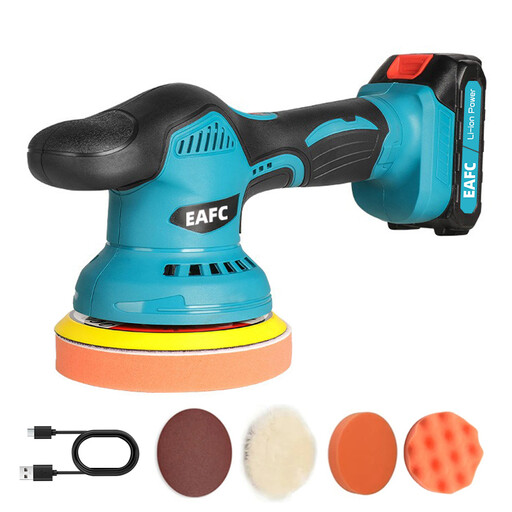
Why it suits this profile: The 125mm disc, eight speed settings and included accessories provide an accessible starting point for waxing and light polishing work on the car.
The adjustable speed prevents you from having to work with just one high setting. However, check the exact battery capacity and charging method in the listing beforehand.
125mm disc, speed of 2800–5500 rpm, and several pads, sheets of sandpaper and a Type-C cable according to the product description.

Why it suits this profile: If you regularly maintain an entire car, two 5000 mAh batteries and an LCD speed display provide more information while you work.
The dual-battery setup reduces interruptions for charging. The stated runtime of around 60 minutes is a product specification and may vary depending on the load.
125mm pad, six speed settings, LCD display and two 5Ah batteries according to the product information.
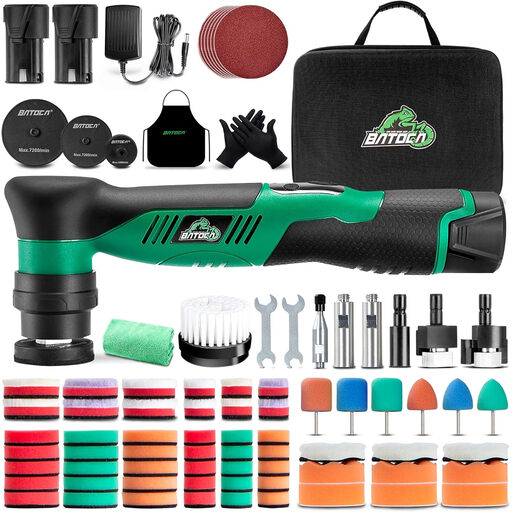
Why it suits this profile: The combination of rotary and random orbital operation is designed for badges, headlights, wheels, edges and other hard-to-reach areas.
The smaller plates mean you do not have to use a large pad for detailing work. The two 12V and 2,0Ah batteries are interchangeable according to the product description.
Three functions, six speed settings from 2000–5500 rpm, and 25, 50 and 75 mm backing plates according to the product information.
Wash and dry the car thoroughly first. Remove sand, tar and dirt before placing a pad against the paintwork. Then work in small sections and check the result regularly. Apply polish or wax to the pad or surface first, and start at a low speed.
Use a clean pad for every step. A pad with dried-on product or dirt can cause streaks. Also avoid sharp edges and plastic parts if you are not yet experienced with a rotary polisher. Always consult the user manual for both the machine and the polishing product.
If you mainly want to apply wax, you do not necessarily need a heavy-duty machine. If you are correcting paintwork, you should pay close attention to control, pad selection, cooling and the available speed control.
We have put together a complete, up-to-date list of products that fully meet these strict selection criteria and the applicable European safety regulations.
It can be, particularly when the machine offers a random orbital movement, several low-speed settings and a soft start. Always begin on a small, inconspicuous area and practise using light pressure. A rotary setting generally requires more control.
This varies depending on battery capacity, speed, pressure and load. Two batteries allow you to work for longer, but check whether the charger is included and how long charging takes. Treat stated runtimes as a guideline rather than a fixed expectation.
Yes, many models are designed for this purpose. Use a suitable soft pad and a low speed. A car waxing machine does not need to have the same features as a machine for paint correction, so decide in advance whether you only want to apply wax or also use polish and remove light surface contamination.
