
Vandaag of morgen in huis

Kwaliteit gegarandeerd

Welkomstaanbiedingen ontgrendelen: GRATIS bezorging | Tot 80% korting | Gratis 30 dagen JoyPlus-proefperiode
Download de app
A cordless vacuum cleaner is handy for crumbs, pet hair and everyday dust without having to search for a socket each time. However, a high suction power rating does not tell you everything. A model may look powerful on paper, but be less convenient in practice because of a short battery life, a brush that clogs quickly or an awkward dust container.
This buying guide will help you choose a stick vacuum cleaner or cordless vacuum based on verifiable product specifications. We focus on use in UK households, including hard floors, carpets, furniture, stairs, cars and pets.
Manufacturers often list high suction power in Pa or kPa. This is a useful technical indication, but it is not the only factor. Your actual cleaning experience also depends on the floor brush, airflow, seals, filter and selected mode.
A powerful cordless vacuum cleaner will generally use its battery more quickly on the highest setting. Always check whether the stated operating time applies to the lowest setting or an intensive mode.
For a pet vacuum cleaner, the floor brush is at least as important as the motor. Long dog and cat hair can wrap around the roller. This reduces performance and can make maintenance more difficult.
An anti-tangle brush or V-shaped brush can help reduce the risk of hair build-up. This does not mean cleaning is unnecessary: check the roller regularly and remove trapped hair according to the instructions.
A filter gradually fills with fine dust. A blocked filter can reduce airflow and suction power. Washable filters must be completely dry before you put them back. A damp filter can damage the motor.
Pay attention to the battery too: a stated runtime of, for example, 50 or 60 minutes usually applies to an energy-saving setting. In turbo mode, operating time can be considerably shorter. A removable battery is useful if you want to use a spare battery later, provided one is available.
Do not compare only the highest Pa figure. Also consider:
For a flat with mainly laminate or tiled floors, a medium setting is often sufficient for everyday dust. If you have deep-pile carpet, cat litter or lots of pet hair, a more powerful mode and a suitable brush can be useful.
Look at the balance between operating time and charging time. A model with 45 minutes of runtime may be suitable for an average cleaning session, while a large house may benefit from a replaceable battery or a longer stated runtime.
A wall mount saves space, but requires installation. A freestanding vacuum cleaner can be put down between tasks without leaning it against a wall. Check that the appliance stands securely and that the charging solution suits your layout.
According to the product description, a HEPA vacuum cleaner can filter fine particles from the air it expels. Check the exact filter information, such as the number of filter layers, whether the filters can be washed and how often they are recommended for replacement. Claims about filter efficiency come from the brand’s product information; do not treat them as a medical guarantee.
A larger dust container means it needs emptying less often. For households with pets, a capacity of around 0.7 litres or more is practical, while a compact cordless handheld vacuum cleaner is ideal for quick clean-ups in the car or on the sofa.
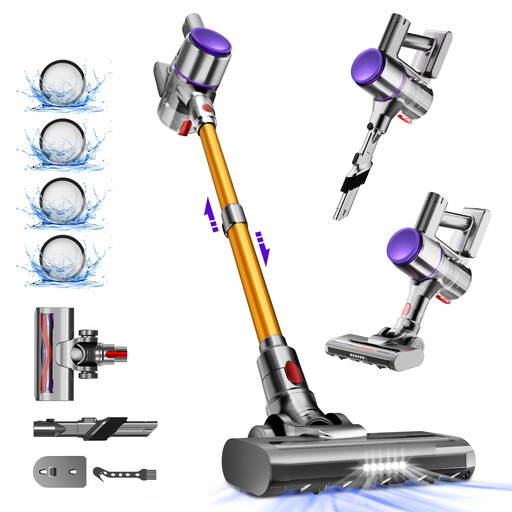
Why it suits this profile: This model combines two suction settings with a stated operating time of up to 50 minutes. It is therefore suitable for everyday vacuuming in a home with hard floors, carpets and pets.
The product information lists not only a maximum suction power of 45,000 Pa, but also the runtime for each setting. The V-shaped brush is designed to help limit hair build-up.
1.6-litre dust container, four washable HEPA filters, LED lighting and a removable battery according to the product description.
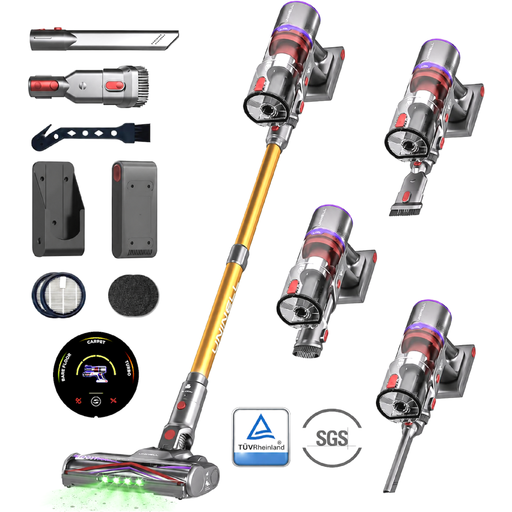
Why it suits this profile: The combination of a touchscreen, long stated runtime and flexible movement is well suited to households that regularly clean several rooms, pieces of furniture and different floor types.
The specifications mention an anti-tangle brush, maintenance alerts on the display and seven filtration stages. The stated 65 minutes is the maximum runtime and may vary by setting.
Up to 60,000 Pa according to the product information, 180° lay-flat cleaning, LED lighting and conversion to a handheld vacuum cleaner.
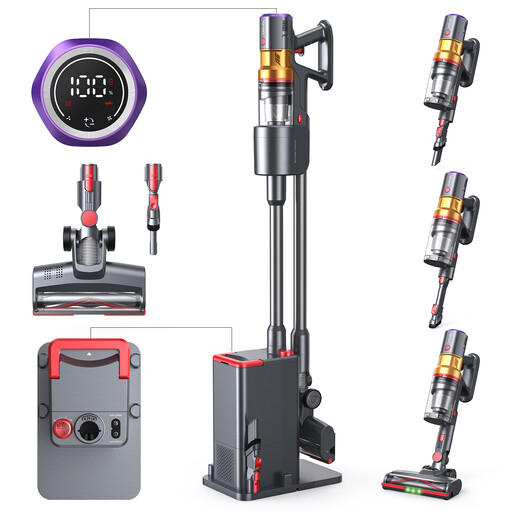
Why it suits this profile: The self-emptying charging base is practical for large households and pet owners who vacuum frequently and want to empty the dust container manually as little as possible.
According to the product information, the V-shaped brush is designed to limit hair tangling. The base automatically empties the dust container when the appliance is placed on it.
27,000 Pa, multi-stage HEPA filtration, freestanding design and green LED lighting according to the product specifications.
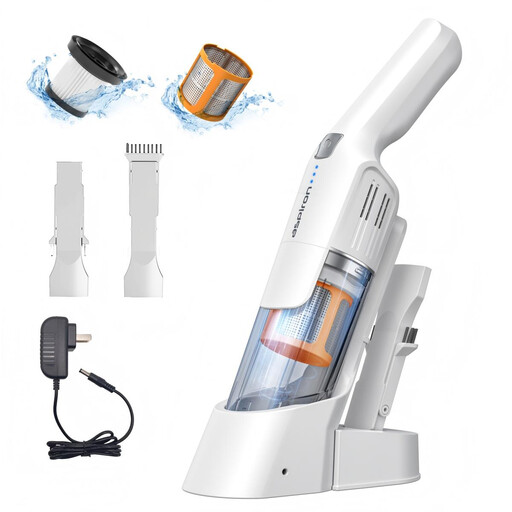
Why it suits this profile: This compact model is designed for crumbs, sofas, desks, stairs and car interiors. It complements a larger vacuum cleaner rather than replacing it for every cleaning task.
The product description makes its intended use clear: targeted cleaning rather than vacuuming an entire home for an extended period. The 500 ml dust container and washable filters are practical maintenance features you can verify.
Two speeds, up to 24 kPa according to the product information, HEPA filter, charging station and accessories for crevices and upholstery.
We have put together a complete, up-to-date list of products that fully meet these strict selection criteria and the applicable European safety regulations.
If you mainly want to clean automatically, you could also consider a robot vacuum cleaner with mopping function. This type of robot works differently from a stick vacuum cleaner: it is useful for scheduled maintenance cleaning, but requires clear pathways and may be less suitable for stairs, sofas and cars.
The operating time per charge varies by model and suction setting. Manufacturers often state the maximum runtime in eco mode. Turbo mode uses more energy and reduces operating time. To help extend the battery’s lifespan, avoid using the highest setting continuously and charge the battery according to the instructions.
It can be, particularly when the model has a motorised anti-tangle brush and is suitable for carpets. Also check the dust container, filter and replacement parts. A brush that is less prone to trapping hair reduces maintenance, but does not eliminate the need for regular cleaning.
The electricity cost of charging is usually limited, but remember to factor in filters, brush components, a possible spare battery and dust bags for a self-emptying base. So do not compare only the purchase price. Also check which parts are available and how often maintenance is required according to the product manual.
