
Vandaag of morgen in huis

Kwaliteit gegarandeerd

Welkomstaanbiedingen ontgrendelen: GRATIS bezorging | Tot 80% korting | Gratis 30 dagen JoyPlus-proefperiode
Download de app
A cordless vacuum cleaner makes everyday cleaning easier: there’s no cord to get caught behind furniture and no need for a socket on every floor. But not every model is suited to the same task. A compact cordless handheld vacuum cleaner for the car has different features from a stick vacuum cleaner for carpets, hard floors and pet hair.
So don’t focus solely on terms such as “powerful” or a high Pascal rating. Practical performance also depends on the brush, battery, airflow, filtration and maintenance.
Manufacturers often quote a high figure in Pa or kPa. This measures suction pressure, but it doesn’t tell you everything about how well dirt is picked up in everyday use. A well-designed floor brush, unrestricted airflow and a suitable suction setting are just as important.
Check that the cordless vacuum cleaner is suitable for your type of flooring. For carpets, a motorised brush and a higher setting are useful. On hard floors, a softer brush with lighting may be more practical.
“Up to 50 or 60 minutes” usually refers to a low-power setting without intensive use of the motorised brush. Runtime often drops significantly in turbo mode, so check the runtime for each setting and the charging time.
A removable battery is useful for larger homes. If the battery is built in, it’s more important to know how long a full charging cycle takes and whether a charger is included.
An anti-tangle brush can help stop hair from wrapping around the roller as quickly. However, you’ll still need to check the brush from time to time. Long hair, threads and pet hair can build up, especially at the ends.
Also check whether you can remove the brush without tools. A vacuum cleaner for pet hair that’s difficult to clean may become less effective over time.
Choose a model with at least two settings if you want to deal with both crumbs and stubborn dirt. An automatic setting can adjust the power, but check whether there’s a manual mode too. For a vacuum cleaner for carpets and hard floors, a motorised floor brush and a separate setting for each surface are practical advantages.
An LED or green light on the floor head illuminates dark spots under sofas and cupboards. This helps make dust and hair easier to see, but it doesn’t guarantee that every particle will be picked up.
A vacuum cleaner with a HEPA filter can help trap fine particles in the air it releases. Check the exact filtration system and maintenance instructions. A filter must be completely dry before you put it back. A damp filter can restrict airflow and damage components.
Claims such as “up to 99.99%” are verifiable only when accompanied by a specific test method. According to Monsga’s own research, the UV5 product information states that it filters up to 99.99% of particles down to 0.3 microns. Treat this as a product specification under certain test conditions, not as a general guarantee for your home.
A lightweight model is handy for stairs, ceilings and quick clean-ups. A larger dust container means less frequent emptying, but it can make the appliance heavier. A self-standing vacuum cleaner is practical if you’re often interrupted while cleaning. A wall mount saves space, but requires drilling or a suitable place to attach it.
For a car or desk, a compact handheld vacuum cleaner usually makes more sense than a full-size stick vacuum cleaner. Check the dust container capacity, accessories and USB-C or other charging options.
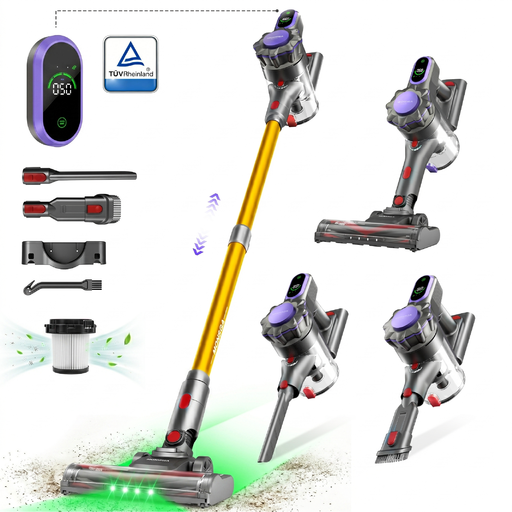
Why it suits this type of user: This model combines a stick vacuum cleaner with practical handheld features for everyday use, so you don’t have to switch straight to the highest power setting.
The product information lists separate settings for hard floors and carpets, an anti-tangle brush and a removable battery. The quoted runtime of up to 55 minutes applies to the floor setting.
550 W brushless motor, 0.7-litre dust container, LED display, washable filters and a self-standing design.
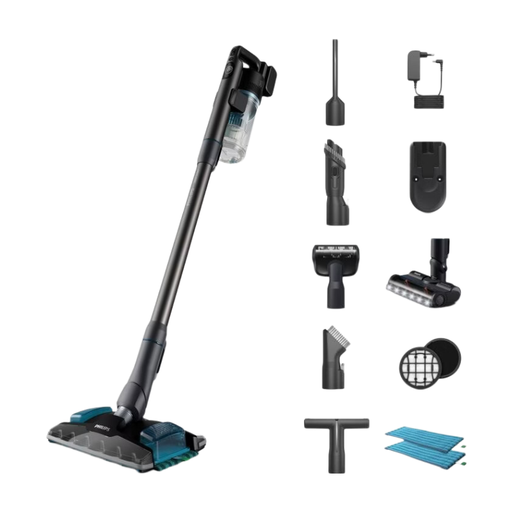
Why it suits this type of user: Suitable for households that want to mop hard floors as well as vacuum, and value a comprehensive range of accessories.
The product page distinguishes between up to 80 minutes on the low setting and 30 minutes in turbo mode with the motorised nozzle. This makes the quoted battery life easier to put into perspective.
2-in-1 stick and handheld vacuum cleaner, mopping function, LED lighting, wall mount and 0.6-litre dust container.
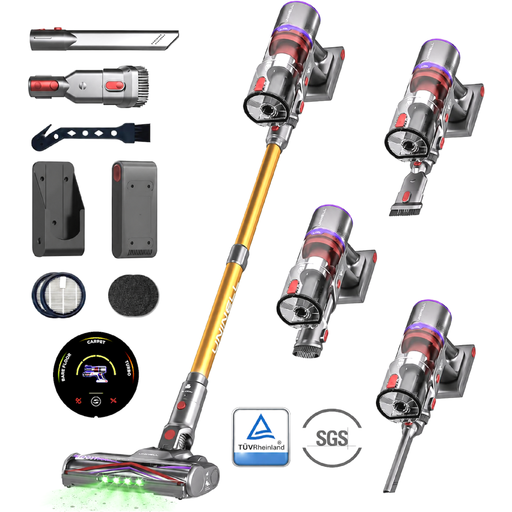
Why it suits this type of user: An option for larger households, homes with carpets and pet owners who need long runtime and dedicated maintenance features.
The product information lists up to 65 minutes of runtime, an anti-tangle brush and a touchscreen displaying information such as battery status and maintenance alerts.
Peak suction power of 60 kPa according to the product information, seven filtration stages, four green LED lights and cleaning with the vacuum laid flat at 180°.
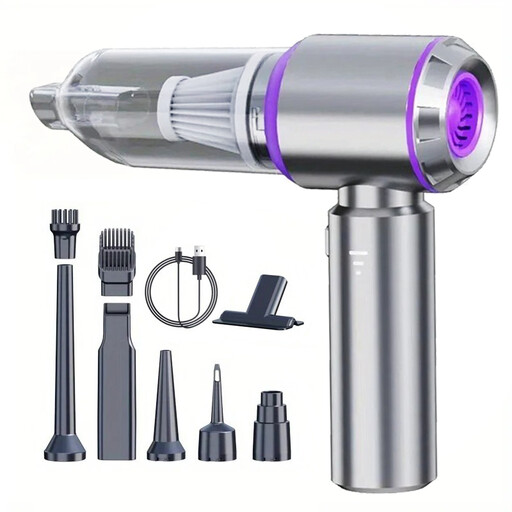
Why it suits this type of user: This cordless handheld vacuum cleaner is designed for car interiors, desks, keyboards, crevices and small cleaning jobs around the home.
Its compact size means it isn’t a replacement for a full-size stick vacuum cleaner. That makes it a suitable choice for targeted cleaning, rather than one with unrealistic expectations.
16,000 Pa according to the product information, USB-C charging, 6000 mAh battery and four functions: vacuuming, blowing, inflating and removing air from bags.
We’ve put together a complete, up-to-date list of products that meet these strict selection criteria and the applicable European safety regulations.
It depends on the setting you choose, the floor brush and the age of the battery. The lowest setting usually gives you the longest runtime. For cleaning an entire home, a model with a removable battery or a spare battery is useful. Charge the battery according to the manual and use only the charger supplied or recommended.
Yes, but choose a model with a motorised anti-tangle brush, sufficient power and a brush that’s easy to clean. Check the roller brush and filters regularly. Pet hair on hard floors usually requires less power than hair embedded deep in a carpet.
The main running costs are electricity, replacement filters if needed, brush components and, eventually, the battery. Washable filters can reduce the need for disposable parts, but they must be completely dry before you put them back. A model with an automatic emptying function may need extra dust bags for the base station.
