
Vandaag of morgen in huis

Kwaliteit gegarandeerd

Welkomstaanbiedingen ontgrendelen: GRATIS bezorging | Tot 80% korting | Gratis 30 dagen JoyPlus-proefperiode
Download de app
A cordless vacuum cleaner makes everyday cleaning easier: there’s no cord to catch on furniture and no need to switch sockets between rooms. Yet many purchases disappoint. A model may have impressive suction power on paper, but run out of battery quickly, feel heavy or collect hair around the brush in practice.
For homes with pets, the combination of suction power, battery life, brush design and maintenance is particularly important. Read on to find out what to look for in a stick or cordless vacuum cleaner for hard floors, carpets, furniture and your car.
Brands often quote figures in Pa or kPa. That number doesn’t tell you everything about cleaning performance. The brush, airflow, seal and power setting also play a part. What’s more, the maximum figure usually applies only to the highest setting, which uses more energy and can significantly reduce battery life.
So check whether there are several settings and how long the appliance runs in its everyday mode. A powerful cordless vacuum cleaner is only practical if it lasts long enough, too.
“Up to 65 minutes” usually doesn’t mean you can vacuum for 65 minutes with a motorised brush on the highest setting. Run time varies depending on the mode, floor and accessory. Also check:
A cordless vacuum cleaner with long battery life is most useful when the stated run time is clearly linked to a particular mode.
An anti-tangle brush helps reduce hair wrapping around the roller, but it doesn’t eliminate the need for cleaning altogether. Long hair, threads and pet hair can still build up around the sides or in the air inlet. Check whether the brush is easy to remove and whether a cleaning tool is included.
For a vacuum cleaner that handles both carpets and hard floors, a motorised floor brush is more useful than a high motor power rating alone. Soft rollers are often suited to smooth floors, while a brush with firm strips or bristles can loosen dirt from low-pile carpets.
Look for a combination of:
Product claims such as a particular pick-up rate or reduced hair wrapping come from the manufacturer. Treat them as product specifications under the stated test conditions, not as a guarantee for every floor or home.
A lightweight stick vacuum cleaner is more comfortable to use on stairs, ceilings and furniture. Check the weight of the complete appliance with its tube and floor brush, not just the motor unit. A self-standing vacuum cleaner is handy if you want to pause while tidying without having to find a wall or charging dock.
A removable battery also offers more flexibility. You can charge it separately and potentially replace it, but always check that spare parts are actually available.
According to its product specifications, a HEPA-filter vacuum cleaner can filter fine particles. The precise performance varies by model and use. Check the number of filtration stages, the maintenance instructions and whether the filters are washable or replaceable.
Don’t use the appliance without the filter correctly in place. Clean the dust container and filters regularly, and let washed parts dry completely before putting them back. This helps reduce blockages and loss of suction power.
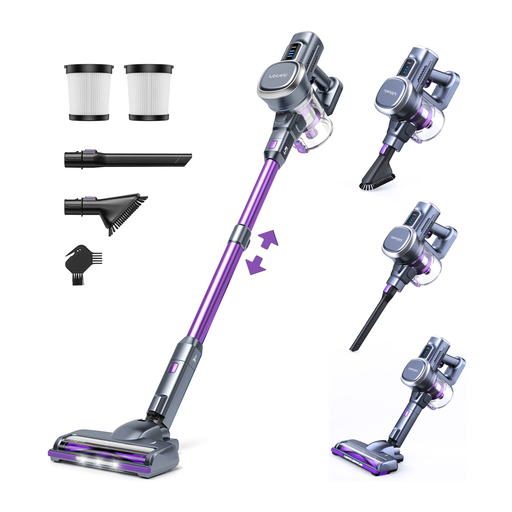
Why it suits this type of user: This model combines a weight of 2.2 kg with three power settings and a self-standing design. It’s a good fit for everyday cleaning without complicated controls.
The product specifications mention a V-shaped brush designed to prevent hair wrapping, and distinguish between Eco, Mid and Max modes. This makes it easier to understand what the battery life means for different uses.
Up to 50 minutes of stated run time, maximum suction power of 25 kPa and a HEPA filter included.
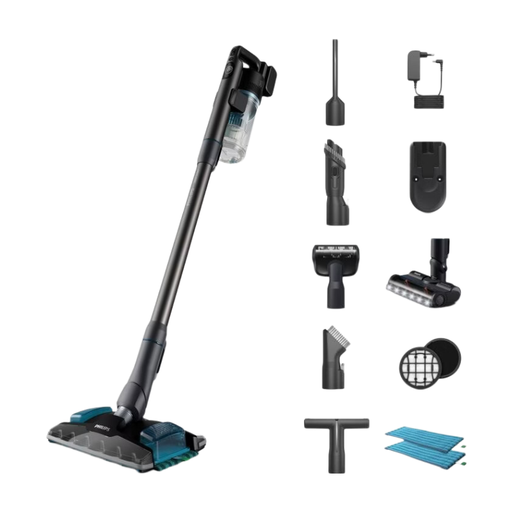
Why it suits this type of user: This is a versatile 2-in-1 stick vacuum cleaner with a mopping function for hard floors. It’s well suited to homes where you want to tackle several cleaning tasks with one appliance.
The product specifications state the run time separately for low and turbo modes. The water tank, microfibre pads and dust container are also clearly described.
Up to 80 minutes on low mode, up to 30 minutes in turbo mode, LED lighting and conversion to a handheld vacuum cleaner.
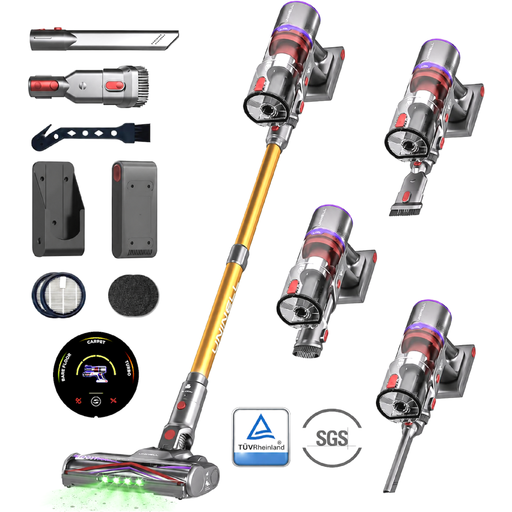
Why it suits this type of user: This model is designed for homes with carpets, hard floors and pets. Its stated long battery life and accessories support cleaning across several rooms.
The manufacturer says the brush has an anti-tangle design and that a full charge takes around four hours. The stated 65 minutes is the maximum run time; actual run time depends on the setting you choose.
According to the product specifications: 60 kPa peak suction power, seven filtration stages, an LED touchscreen and conversion to a handheld vacuum cleaner.
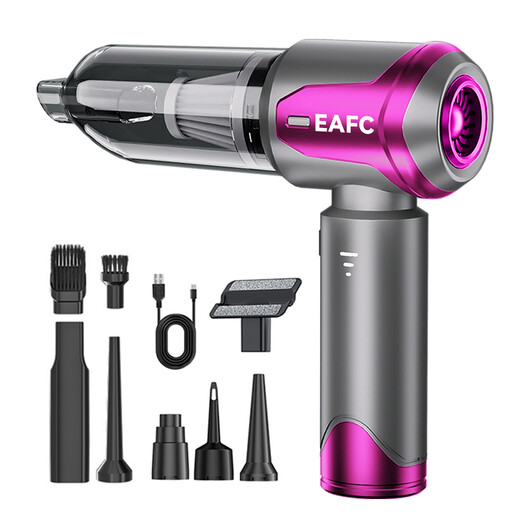
Why it suits this type of user: This compact handheld vacuum cleaner is designed for car interiors, sofas, crevices and small surfaces. It’s an addition to a regular vacuum cleaner, rather than necessarily a replacement for cleaning your whole home.
Its compact design means you don’t have to get out a large stick vacuum cleaner for crumbs or crevices. The manufacturer lists a rechargeable battery and washable HEPA filter; let the filter dry completely before using it again.
According to the product specifications: 16,000 Pa suction power, USB-C charging and four functions with several attachments.
We’ve put together a full, up-to-date list of products that meet these strict selection criteria and comply with current European safety regulations.
It depends on the setting you choose, the floor brush and the age of the battery. According to the product specifications, the maximum run time for the models in this selection ranges from around 40 to 80 minutes. Run time is usually shorter in turbo mode. Regularly cleaning the filter and brush helps maintain airflow, but won’t automatically extend the battery’s technical lifespan.
Yes, as long as the model has a motorised brush and a suitable power setting. An anti-tangle brush can help reduce hair wrapping. For thick or deep-pile carpets, it’s worth checking the product description for explicit confirmation that the model is suitable. Remove any hair that has built up in the brush after use.
The main running costs are electricity, any replacement filters or brushes, and eventually a new battery. Longer battery life doesn’t automatically mean lower costs. So check the price and availability of replacement parts in advance, and charge the battery according to the instructions provided.
