
Vandaag of morgen in huis

Kwaliteit gegarandeerd

Welkomstaanbiedingen ontgrendelen: GRATIS bezorging | Tot 80% korting | Gratis 30 dagen JoyPlus-proefperiode
Download de app
A cordless vacuum cleaner makes everyday cleaning easier: it is quick to grab, does not need a power socket and moves smoothly around furniture. However, a high suction-power figure on the packaging does not tell you everything. Households with carpets, children or pets can easily waste money on a model with a short run time, a brush that is difficult to clean or filters that become saturated quickly.
This buying guide will help you assess the most important specifications and choose a stick vacuum cleaner that suits your home, floors and cleaning routine.
A claim such as 55 or 65 kPa sounds impressive, but this is usually a maximum value measured under specific conditions. Actual cleaning performance also depends on the floor head, airflow, sealing and selected mode. A powerful vacuum cleaner with an awkward brush may be less practical on carpet than a model with a lower stated suction power and a well-designed nozzle.
Always compare several features together:
A stated run time is often measured in eco mode. In maximum mode, the battery may run out much faster. Check whether the battery is removable, how long charging takes and whether you can use a spare battery. For a larger home, a cordless stick vacuum cleaner with long battery life is particularly useful when the run time is also sufficient in normal mode.
An anti-tangle brush reduces hair collecting around the roller, but does not eliminate the need for maintenance. Long hair and pet hair can still build up around the edges or in the air channels. A HEPA-filter vacuum cleaner also needs to be emptied regularly, washed according to the instructions and dried completely before you put the filter back.
Also pay attention to the specific claim being made. “Up to 99.99% filtration” is not a universal guarantee for every home or usage situation. According to the brand’s own research or product information, such a percentage may have been established using a particular test method. Treat it as a product specification, not a medical or health claim.
A vacuum cleaner for carpets and hard floors should preferably have a motorised brush with adjustable or automatically adaptive operation. Soft rollers are often suitable for delicate hard floors, while a brush with more grip can lift dirt from low-pile carpet.
LED lighting on the floor head helps make dust and hair visible in dark corners. According to product information from some brands, green lighting can make fine dust easier to spot. It is mainly a tool for helping you clean more precisely, not proof that the vacuum cleaner will pick up every particle.
Look beyond the word HEPA. Check:
A large container is useful in a home with pets, but can make the appliance heavier. A compact container is easier to manoeuvre, but needs emptying more often.
Low weight is important for stairs, furniture and car interiors. A self-standing vacuum cleaner can be put down temporarily without leaning it against a wall. A telescopic tube helps users of different heights. An LED-display vacuum cleaner can show information about the battery level, suction mode and maintenance. This is practical, provided the controls remain clear without complicated menus.
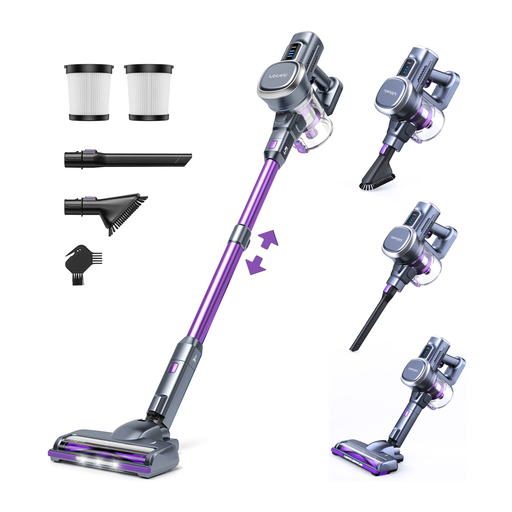
Why it suits this profile: This model combines a weight of around 2.2 kg with three suction modes and a stated run time of up to 50 minutes. This makes it suitable for everyday cleaning in flats and family homes.
The three modes mean you do not always have to work at maximum power. According to the product information, the V-shaped brush is designed to help limit hair build-up.
Self-standing design, removable battery, stated suction power of 25 kPa and a HEPA filter.
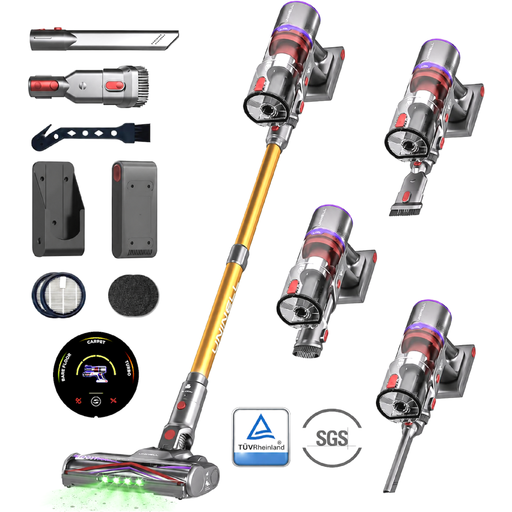
Why it suits this profile: The UV5 is aimed at households with multiple floor types and pets. The product information states a run time of up to 65 minutes, a touchscreen and the ability to clean flat under low furniture.
The stated 7-stage filtration, anti-tangle brush and maintenance alerts make upkeep easier to manage. However, check the run time for each mode.
Up to 60 kPa according to the product information, 180° flat-reach function, LED lighting and conversion to a handheld vacuum cleaner.
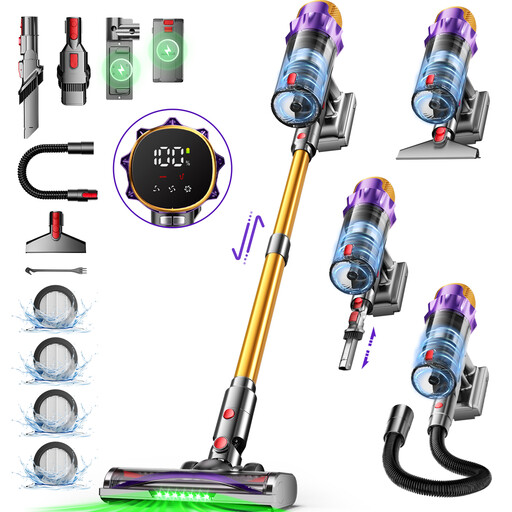
Why it suits this profile: This model is an interesting option for larger homes and intensive cleaning. According to the product information, the run time is up to 70 minutes in eco mode and 40 to 50 minutes in powerful mode.
The removable battery and two charging options help minimise interruptions. The V-shaped brush and supplied pet-hair brush are practical for households with cats or dogs.
1.8-litre dust container, three suction modes, LED floor brush and four washable HEPA filters according to the product information.
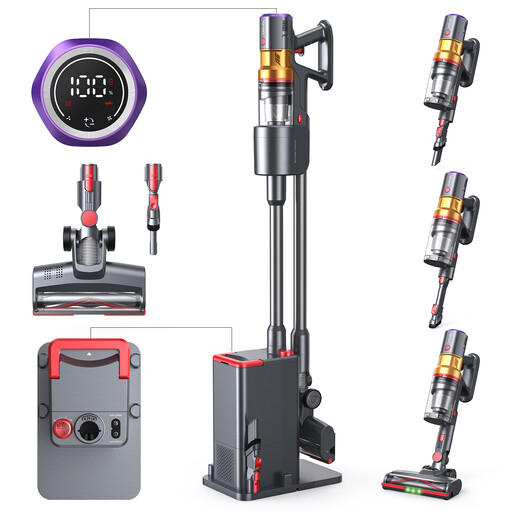
Why it suits this profile: This self-standing vacuum cleaner with emptying station is suitable for users who want less manual maintenance and do not want to install a wall mount.
The self-emptying dock reduces how often you need to empty the dust container directly. The anti-tangle brush still requires periodic checking.
Stated suction power of 27 kPa, self-emptying charging station, self-standing design and green LED lighting.
We have put together a complete, up-to-date list of products that fully meet these strict selection criteria and the applicable European safety regulations.
This depends on the selected mode, the floor and the age of the battery. Eco mode usually provides the longest run time. For larger homes, a removable battery is useful because you can recharge it or use an additional battery if necessary. Always follow the manufacturer’s charging and storage instructions.
Yes, provided the floor head is designed for this purpose. Choose a model with a motorised brush, an anti-tangle function and a pet-hair accessory. Check the brush edges and air channels after use. No brush can completely prevent hair from building up in all circumstances.
The main running costs are electricity, filters, brushes and, potentially, a replacement battery. A model with washable filters can help reduce replacement costs, but the filters must still be maintained correctly and put back only when completely dry. With a self-emptying dock, dust bags or collection bags may also be an ongoing expense.
