
Vandaag of morgen in huis

Kwaliteit gegarandeerd

Welkomstaanbiedingen ontgrendelen: GRATIS bezorging | Tot 80% korting | Gratis 30 dagen JoyPlus-proefperiode
Download de app
A cordless vacuum cleaner makes quick cleaning easier. You can grab the appliance without looking for a socket, and often use the same stick vacuum for the sofa, stairs or car. However, a high suction-power figure on the packaging does not guarantee that a model will suit your home. Battery life may disappoint, accessories may be limited and the filter requires regular maintenance.
This buying guide helps households compare a cordless stick vacuum cleaner objectively. Pay particular attention to the following pitfalls.
A manufacturer may state “up to 70 minutes”, for example. This is usually the runtime in eco or low-power mode, without placing the motorised brush under maximum load. In turbo mode, the operating time can be significantly shorter.
Therefore, always check:
A cordless vacuum cleaner with 60 minutes of runtime is not automatically more suitable than a model with 40 minutes. A shorter runtime may be sufficient for a flat, while a large house or a household with pets requires more capacity.
Specifications such as 30, 55 or 65 kPa describe a measured suction-pressure value. In practice, performance also depends on the floor brush, airflow, seals and the way the appliance measures this value. It is therefore best to compare kPa figures within the same product range and also look at the brush technology.
A powerful stick vacuum cleaner for carpets, for example, needs a motorised brush that loosens hairs from the surface. On wooden floors, a soft roller or adjustable suction head is more important for limiting scratches and preventing the vacuum from sticking to the floor.
A stick vacuum cleaner with a HEPA filter can filter fine particles according to the product specifications, but the filter must be fitted and maintained correctly. A saturated or damp filter can restrict airflow. Washable filters must be completely dry before you put them back.
Also pay attention to the difference between:
When a brand states a percentage, such as 99.99%, present it as a claim from the brand’s product description, not as a universally guaranteed result in every home.
For quick daily cleaning, low weight, a wall mount and a short start-up time are often more important than the highest motor setting. A removable battery is useful if you want to clean for longer or use a spare battery later. Also take into account charging times of several hours.
An appliance that cannot be used while charging is normal for many cordless vacuum cleaners. Plan to charge it after use and place the charging station in a dry, well-ventilated location.
A small container is lightweight but needs to be emptied more often. For families or pet owners, a capacity of around 1.5 to 1.8 litres is practical. A container holding 0.5 to 0.8 litres is better suited to compact appliances and quick clean-ups.
Check how the container opens. A one-button mechanism means you do not have to touch the dirt by hand. Always switch the appliance off before removing the container, brush or filter.
A stick vacuum cleaner with LED lighting makes dust under furniture and in dark corners easier to see. However, LED lights are no substitute for a good brush. For pet hair, useful features include an anti-tangle roller, a motorised pet-hair brush and an easy way to remove tangled hair.
A 2-in-1 stick vacuum cleaner can be converted into a handheld vacuum cleaner. Check which accessories are actually included: a crevice tool, furniture brush, soft brush, extension hose and pet-hair brush each serve a different purpose.
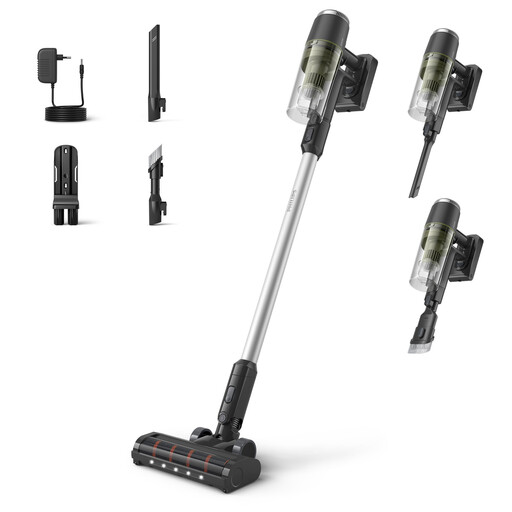
Why it suits this profile: This model is designed for everyday vacuuming on hard floors, carpets and wooden floors. Its two speeds, LED lighting and weight of 1.29 kg make it suitable for quick cleaning sessions.
In addition to a runtime of up to 60 minutes, the product information specifies two speeds and a charging time of around 5 hours. This makes it clearer what the maximum battery life refers to.
Up to 60 minutes’ runtime, LED-lit suction head, wall-mounted charging station and conversion to a handheld vacuum cleaner.
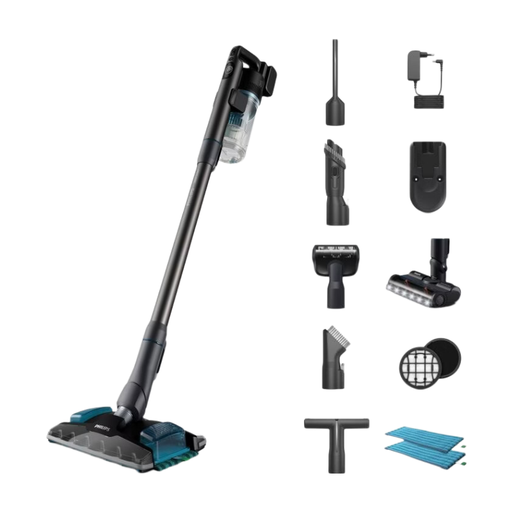
Why it suits this profile: This model combines dry vacuuming with an integrated mopping function for hard floors. It is designed for users who want one appliance for floors, furniture, stairs and the car.
The specifications distinguish between a maximum of 80 minutes on the low setting and around 30 minutes in turbo mode with the motorised suction head. They also state that this model does not have a HEPA filter.
0.6-litre dust container, 2-in-1 function, mopping accessories, LED lighting and wall mount.
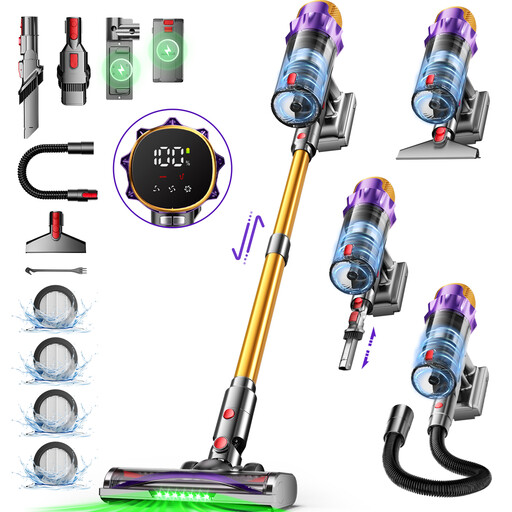
Why it suits this profile: The combination of a removable battery, pet-hair brush, anti-tangle brush, extension hose and large dust container is well suited to households with pets, carpets and multiple cleaning tasks.
According to the product description, the model provides up to 70 minutes in eco mode and 40–50 minutes on the powerful setting. The filter and brush components are also described as maintenance items.
1.8-litre container, four washable HEPA filters, LED display, three suction settings and removable battery.
For crumbs, furniture or the car interior only, a separate handheld vacuum cleaner may be more practical. The Aspiron AS-CA038 has a 500 ml container, two settings, a HEPA filter according to the product information and a runtime of up to around 25 minutes on the standard setting. It is a targeted solution, not a replacement for a full-size floor vacuum cleaner.
We have put together a complete, up-to-date list of products that fully meet these strict selection criteria and the applicable European safety regulations.
That depends on the floor area, flooring and setting selected. Compare the battery life in normal and turbo modes. For a large house, a removable battery, short charging time or spare battery can be useful features.
Battery life depends on usage, charging habits and maintenance. Use the original charger, avoid extreme temperatures and follow the instructions in the manual. A replaceable battery can extend the appliance’s practical service life.
In addition to the purchase price, you should consider the electricity used for charging, replacement filters, brushes and possibly a new battery. A model with washable filters and a removable battery may have different long-term maintenance costs from an appliance with non-replaceable parts. Check in advance which components are available and how often the manufacturer recommends maintenance.
