
Same-day & Next-day Delivery

Quality Guaranteed

Unlock Your Welcome Offers: FREE Delivery | Up to 80% OFF | Free 30-day JoyPlus trial
Download the APP
A cordless stick vacuum is handy for everyday dirt, crumbs and pet hair. It’s quick to grab, there’s no cord to snag on furniture, and you can often use it to clean sofas, stairs and the car, too. However, not every model is right for every home.
Marketing claims can sometimes make specifications tricky to compare. For example, a high kPa figure doesn’t tell you everything about how well a vacuum cleans in practice. And a long battery life often only applies in the lowest power mode. This buying guide explains which features really matter and which pitfalls are best avoided.
A figure such as 45,000, 55,000 or 65,000 Pa sounds impressive, but always check:
A stick vacuum with high suction power can be useful for ingrained dirt and pet hair, but a good floor brush and an unclogged filter are just as important.
“Up to 50 or 70 minutes” usually refers to runtime in the lowest power mode, without motorised attachments. Runtime is often considerably shorter in the most powerful mode. So compare:
A vacuum with a removable battery is useful if you want to clean several rooms in one go or charge the battery separately from the appliance.
A stick vacuum with a HEPA filter still needs maintenance. A full dust container, a filter put back while still wet or a clogged brush can reduce airflow. Product claims about filter efficiency come from the brand’s product description and depend on the test method and correct use.
Check whether filters are washable or replaceable, and whether replacement parts are available. Only reuse a filter once it is completely dry.
For a home with carpets and hard floors, at least two suction modes are useful. A lower mode is suitable for everyday dust and usually extends battery life. A higher mode is designed for more stubborn dirt, such as dog and cat hair embedded in carpets.
Look out for an anti-tangle brush, too. According to the product description, a V-shaped brush can guide hair towards the suction opening, so less hair gets caught around the roller. You’ll still need to check and clean the brush regularly.
A multi-layer filtration system can reduce the amount of fine dust released back into the air. When a brand quotes a figure such as 99.99%, present it as a claim from that brand’s product description, not as a general guarantee for every use.
A dust container of around 1.6 to 1.8 litres is practical for larger households, as you’ll need to stop less often. A smaller container is lighter and better suited to a compact stick vacuum for quick clean-ups.
A good set of accessories makes the appliance more versatile. Check that the packaging actually includes:
An LED display helps you estimate how much battery life is left. The LED light on the brush makes dust under sofas and cupboards easier to see, but it doesn’t automatically improve suction performance.
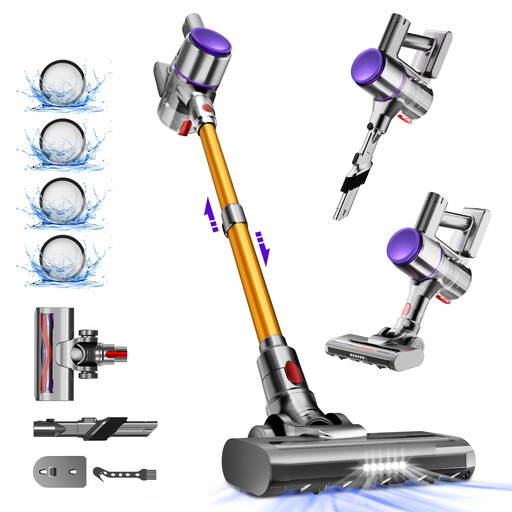
Why it suits this type of user: An accessible choice for everyday dust, crumbs and pet hair on hard floors and carpets. The two modes let you balance battery life and power.
The product description gives separate runtimes for each mode, so the stated 50 minutes can be understood in context. It also lists four washable HEPA filters.
Up to 45,000 Pa according to the product information, a removable battery, a V-shaped anti-tangle brush, LED lighting and a 1.6-litre dust container.
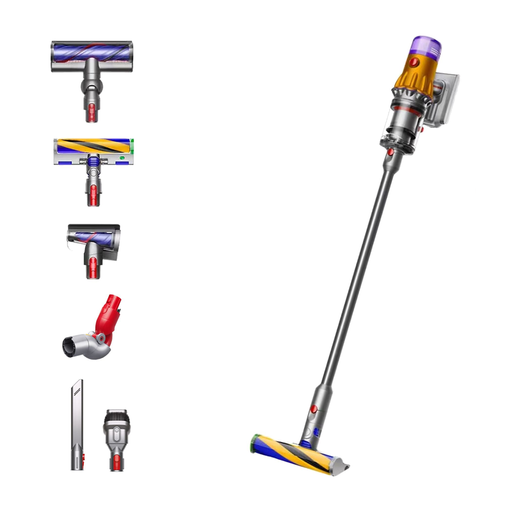
Why it suits this type of user: A good choice if you value a compact design, different cleaning modes and helpful information while you clean.
The product information distinguishes between runtime in the lowest and highest modes. This makes it clear that 60 minutes and 10 minutes apply to different settings.
Three modes, a stated runtime of up to 60 minutes, a click-in battery and a dust sensor with a screen, according to the product description.
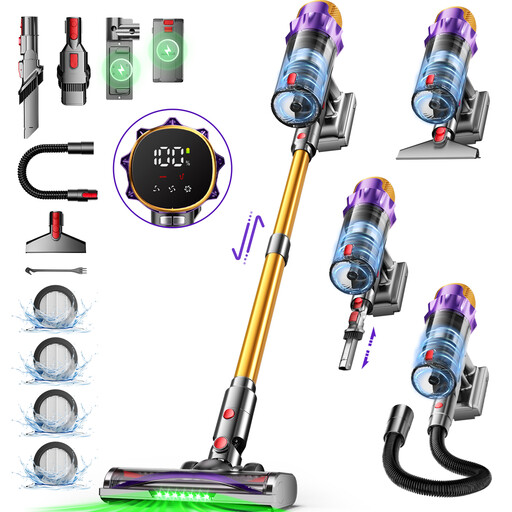
Why it suits this type of user: A well-equipped option for households with pets, several rooms and carpets, as well as hard-to-reach areas such as car interiors and high corners.
The specifications list both eco and power modes, a removable battery and a one-metre hose. This helps put the stated 70 minutes into context.
Up to 65,000 Pa according to the product description, a 1.8-litre dust container, an anti-tangle brush, a pet brush, an LED light and three suction modes.
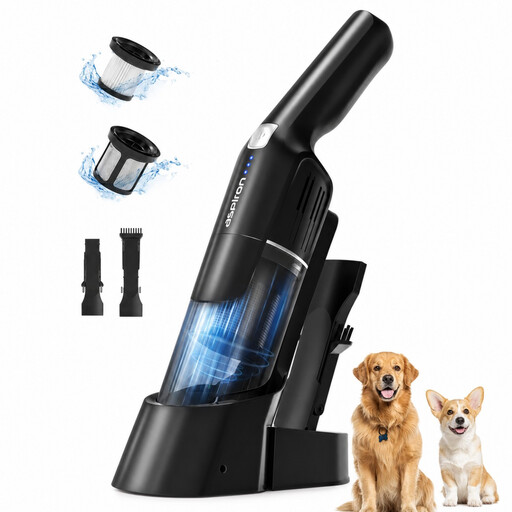
Why it suits this type of user: Handy as an extra vacuum for crumbs, light pet hair, the sofa or the car, without needing to get out a full-size stick vacuum.
The compact specifications make it clear that this model is designed for targeted cleaning, rather than vacuuming an entire home for an extended period.
Up to 24 kPa according to the product information, a 500 ml dust container, two modes, a HEPA filter and a charging station.
We’ve put together a complete, up-to-date list of products that meet these strict selection criteria and the applicable European safety regulations.
Your cordless vacuum will perform better for longer if you keep up with maintenance:
With a lithium-ion battery, look out for heat, damage and unusual smells. If in doubt, stop using it and follow the manufacturer’s safety information.
Yes, provided the model has a motorised floor brush and, ideally, an anti-tangle brush. A separate pet brush is useful for sofas and pet beds. After each clean, check whether hair has wound around the brush shaft.
It depends on the suction mode, floor type and age of the battery. The maximum runtime quoted usually applies to a low-power mode. A removable battery can extend the vacuum’s practical lifespan, as it’s easier to replace a worn battery when a compatible one is available.
The main running costs are electricity, filters, brushes and, if needed, a replacement battery. A longer battery life doesn’t automatically mean lower costs. Pay particular attention to the price and availability of genuine parts, charging time and maintenance instructions.
