
Vandaag of morgen in huis

Kwaliteit gegarandeerd

Welkomstaanbiedingen ontgrendelen: GRATIS bezorging | Tot 80% korting | Gratis 30 dagen JoyPlus-proefperiode
Download de app
A cordless stick vacuum cleaner may seem easy to compare on paper. However, marketing claims about suction power, battery life and filtration can give you the wrong impression. A high kPa figure, for example, doesn’t tell you everything about cleaning performance. And a long runtime may only apply to the lowest setting, while carpets need more power.
For households in the Netherlands, there are three pitfalls in particular to watch out for:
For hard floors, low-pile carpets and pet hair, motor power isn’t the only thing that matters. Also look for:
A powerful stick vacuum cleaner rated at, for example, 27 to 30 kPa may be suitable for everyday dirt, but its actual performance also depends on the air channels, brush contact and how dirty the filter is. Figures given by brands are product specifications, not a universal way to compare models.
An anti-tangle brush is particularly useful in homes with long hair or pets. Even so, check the brush roll regularly, as hair can gather around the ends.
A cordless vacuum cleaner is handy for quick cleaning sessions, but runtime varies depending on the setting. So check:
A quoted battery life of 45 or 60 minutes usually doesn’t mean you can use maximum suction power for that long. For a flat, 30 to 45 minutes may be enough. In a larger home or one with lots of carpet, a spare battery or a model with an efficient standard setting may be more practical.
A stick vacuum cleaner with a HEPA filter can capture fine dust across several filter layers. Check the exact product information: some brands state a filter class, while others only mention a multi-stage filtration system. A claim such as “99,99%” should be read as a claim from the brand’s product description, not as a general guarantee for every home or usage situation.
Also check:
Only use a cordless stick vacuum cleaner on dry surfaces unless the manufacturer explicitly states that it has a wet-cleaning function. Do not vacuum liquids, hot ash, sharp objects or flammable substances.
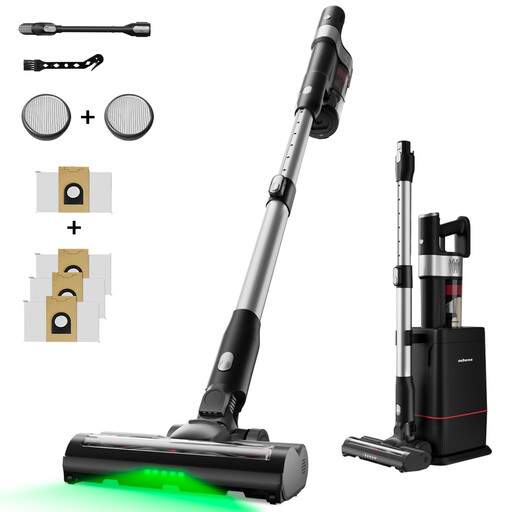
Why it suits this type of user: This model combines a relatively straightforward set of features with suitability for carpets and hard floors. Its stated runtime is up to 35 minutes.
The product information lists the 28 kPa suction power, battery life and filtration system separately. This lets you check each detail instead of relying on a general marketing claim.
Reclines to 180°, green LED lighting and a self-cleaning docking station, according to the product description.
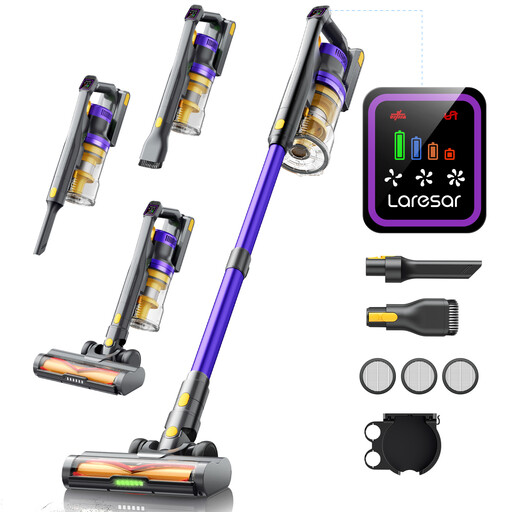
Why it suits this type of user: This model is aimed at larger households and users who want to switch between settings for hard floors, carpets and concentrated areas of dirt.
The product description lists several settings with different runtimes. This means the maximum setting isn’t automatically the practical choice for cleaning your whole home.
According to the product information: up to 55 kPa, up to 60 minutes of use on a low setting, green dust-detection lighting and an anti-tangle V-shaped brush.
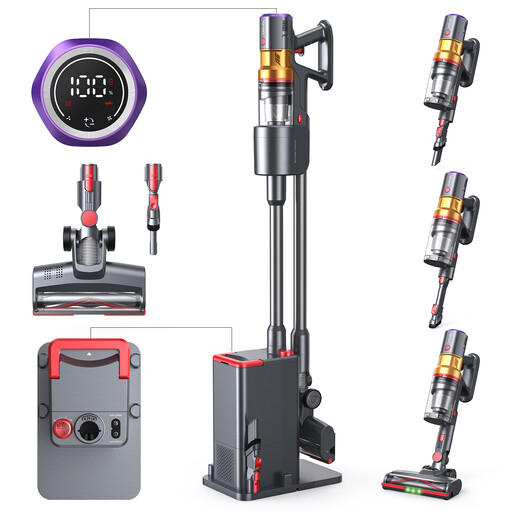
Why it suits this type of user: Homes with dogs, cats or lots of long hair can benefit from the combination of an anti-tangle brush, self-emptying charging station and freestanding design.
According to the product description, the brush is designed to limit hair build-up. The emptying station means less manual emptying, but you’ll still need to check the bag and brush.
27 kPa according to the specifications, multi-stage HEPA filtration, green LED lighting and a freestanding base with automatic emptying.
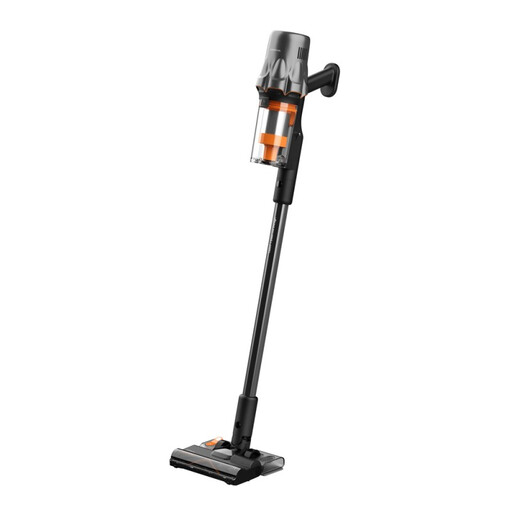
Why it suits this type of user: This model is designed for anyone looking for a longer runtime, multiple settings and a combination of vacuuming and mopping.
The stated runtime and suction power are listed alongside each other in the specifications. When using the wet-cleaning function, always check the manual and don’t use it on surfaces it isn’t designed for.
According to the product description: up to 60 minutes, four power settings, green dust detection and a 6-stage filtration system.
We’ve put together a complete, up-to-date list of products that meet these strict selection criteria and the current European safety requirements.
It varies by model and power setting. Manufacturers often quote the maximum runtime in eco mode. In turbo mode, the runtime can be considerably shorter. For everyday use, it’s therefore more useful to check the runtime on the standard setting and the charging time.
A HEPA filter can help trap fine dust in the filtration system, but the result depends on the overall design, seal and maintenance. Check whether the filter is washable or replaceable, and let a washed filter dry completely before putting it back.
As well as the purchase price, the main costs to consider are electricity, filter replacements, brush components and any dust bags for an emptying station. A model with automatic emptying can save time, but may involve ongoing costs for bags. So compare not only suction power, but also maintenance and the availability of replacement parts.
