
Vandaag of morgen in huis

Kwaliteit gegarandeerd

Welkomstaanbiedingen ontgrendelen: GRATIS bezorging | Tot 80% korting | Gratis 30 dagen JoyPlus-proefperiode
Download de app
A cordless stick vacuum cleaner is handy for picking up crumbs, pet hair and everyday dirt without having to move a cable around. However, not every model is suitable for a whole house. A short battery life, small dust container or brush that gets clogged with hair can quickly make it frustrating to use.
So don’t focus only on claims such as “powerful” or “long battery life”. Look at measurable specifications, the types of flooring in your home and the accessories actually included.
Manufacturers use terms such as Pa, kPa, AW and motor power in watts. These values aren’t measured in the same way, so a higher figure doesn’t automatically mean better performance on your floors.
Also check whether the figure refers to the maximum turbo setting. This setting usually drains the battery faster than eco or standard mode. For everyday use, the brush, airflow and floor setting are just as important as the stated power.
“Up to 60 minutes” usually means the vacuum cleaner is used on a low setting, and sometimes without a motorised brush. Using a cordless stick vacuum cleaner on carpet or in turbo mode can significantly reduce the runtime.
When comparing models, check:
According to the product information, a vacuum cleaner with a HEPA filter can help filter fine particles, but the filter needs to be maintained correctly. Replacing it while damp can cause damage. Check whether the filter is washable, how long it needs to dry and whether replacement filters are available.
An anti-tangle brush is useful in homes with pets. However, even this type of brush needs regular checks. Long hairs can wrap around the roller and reduce airflow.
For a flat or a quick clean, 25 to 35 minutes may be enough. For a larger home, a longer runtime or a removable battery is more practical. Consider the weight of the complete vacuum cleaner, including the tube and floor brush. A model may seem light on paper, but still feel heavy while you’re vacuuming because of where the motor is positioned.
Noise levels are generally given in dB. Only compare readings taken under similar conditions. A low noise level can be welcome in a household with children or pets, but it doesn’t tell you anything about suction performance.
A container of around 0.3 litres is compact, but needs emptying more often. For homes with pets or larger properties, 0.8 litres or more may be more convenient. Also look for:
A claim such as “99.9% filtration” should be read as a product specification based on the manufacturer’s test conditions. According to Rowenta’s own information, the Xforce Flex 12.60 filters up to 99.9% of fine particles, allergens and dust mites. This is not a medical guarantee of the air quality in your home.
A stick vacuum cleaner with LED lighting can make dust more visible under sofas and in dark corners. This is particularly useful on hard floors. For carpets, a motorised brush and a suitable floor setting are more important.
A good 2-in-1 stick vacuum cleaner converts into a handheld vacuum cleaner for furniture, stairs and car interiors. Check in advance whether the accessories you want are included. A crevice tool, upholstery brush and small turbo brush are more useful than a large accessory pack you’ll never use.
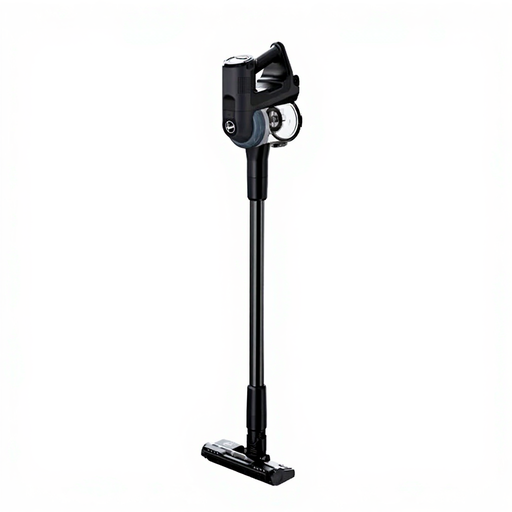
Why it suits this user profile: This cordless, bagless model is designed for everyday use on floors, carpets and upholstery. Its straightforward controls make it a good choice if you’re buying a cordless vacuum cleaner for the first time.
The product information doesn’t make exaggerated claims about battery life or specific filtration percentages. That means you know to check the missing details before placing your order.
It has a bagless design and compact storage, and is suitable for floors, carpets, upholstery and pet hair, according to the product description.
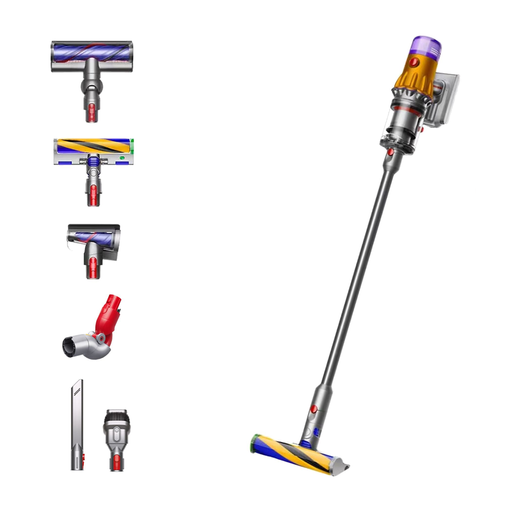
Why it suits this user profile: This model combines stated suction power of up to 150 AW with a laser function, LCD screen and several power settings. It’s a good fit for users who want plenty of ways to customise their cleaning.
The product information gives a runtime of 60 minutes on the lowest setting and around 10 minutes on the highest setting. This makes the difference between everyday use and turbo cleaning clear.
73 dB according to the product specifications, a 0.35-litre dust container and a removable battery; according to the description, an additional battery is available separately.
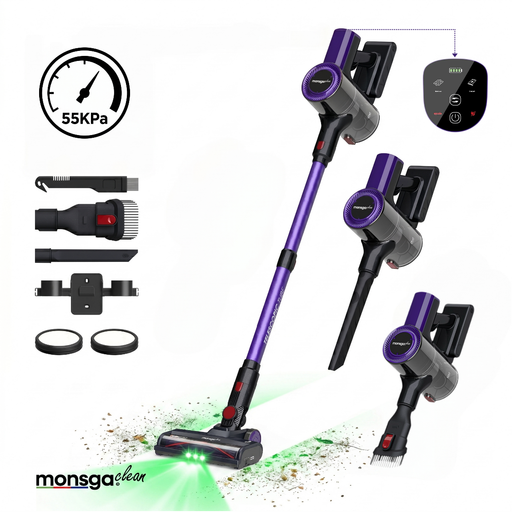
Why it suits this user profile: The combination of a large dust container, anti-tangle brush, green LED lighting and accessories is designed for homes with pets, carpets and a range of cleaning needs.
The stated battery life of up to 45 minutes is linked to a 2,200mAh battery and the selected mode. The 1.8-litre dust container also means you’ll need to empty it less often during a cleaning session.
The product description lists a 55,000Pa motor, anti-tangle V-brush, green LED light and an 8-in-1 configuration.
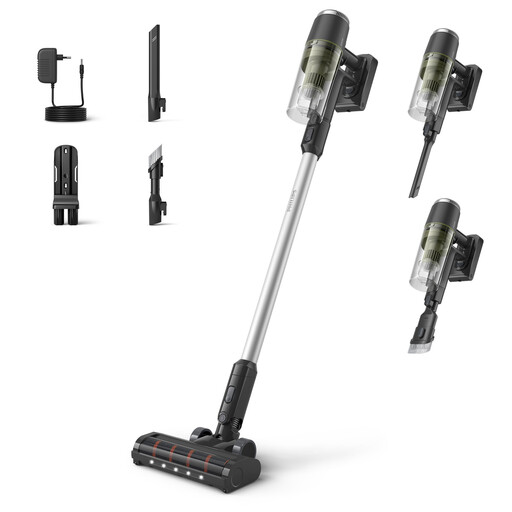
Why it suits this user profile: This model is designed for hard floors, carpets and upholstery, and can be converted into a handheld vacuum cleaner. The LED lighting on the nozzle is handy under furniture.
The information states a maximum runtime of 60 minutes, two speeds and a charging time of around 5 hours. This makes it easy to check the balance between runtime and charging.
The product weighs 1.29 kg according to the specifications and has LED lighting and a wall-mounted charging station; the dust container is bagless.
We’ve put together a complete, up-to-date list of products that meet these strict selection criteria and the applicable European safety regulations.
It depends on the mode you use, the floor brush and the age of the battery. Manufacturers often give a maximum figure for the lowest setting. For a realistic estimate, check the turbo setting and the runtime with the motorised brush. A removable battery can extend the life of the appliance if a replacement is available.
Yes, many models are designed for both, but performance varies. For carpets, choose a motorised brush and adjustable suction power. A soft brush is useful for delicate hard floors. Also check that the floor brush doesn’t quickly get clogged with hair and whether a separate upholstery or crevice tool is included.
The main running costs are electricity, filters, brushes and, potentially, a replacement battery. The electricity used per charge is generally limited, but batteries and filters can add to the cost over time. Check the availability and price of spare parts, the warranty terms and the maintenance instructions before you buy.
