
Livraison le jour même et le lendemain

Qualité garantie

Débloquez vos offres de bienvenue: Livraison GRATUITE | Jusqu'à -80 % | 30 jours d'essai gratuits à JoyPlus
Téléchargez l'application
A cordless stick vacuum cleaner is ideal for quickly clearing up crumbs, dust and pet hair. You won't have to deal with a cable, and many models can be converted into a handheld vacuum cleaner with a single click. However, a high suction power figure on the packaging doesn't tell you everything. The right choice depends on your floors, pets, cleaning routine and how you maintain the appliance.
Manufacturers often quote a high value in pascals, such as 45,000 or 65,000 Pa. This is a technical measurement of pressure, not a complete measure of cleaning performance. The floor head, airflow, seals and selected suction setting also play a part.
So look at the combination of:
A powerful stick vacuum cleaner may perform well on its highest setting, but this will usually drain the battery more quickly.
A cordless vacuum cleaner with a long battery life may, for example, run for 50 to 70 minutes in eco or low mode. With intensive use and a motorised brush, the operating time is generally shorter. Always check whether the manufacturer states the runtime for each setting.
A removable battery is practical if you can buy a spare battery or charge it outside the appliance. Also check the charging time and whether a charger is included.
According to the product description, a HEPA filter vacuum cleaner can help filter fine dust particles, but its effectiveness depends on correct fitting, sealing and cleaning. Claims such as “99.99% filtration” are product claims; according to the brand's own research, they may only apply under specific test conditions. Do not therefore regard them as medical or health claims.
A clogged filter reduces airflow and can lower suction power. Check whether the filters are washable, how many spare filters are included and how long they need to dry before being refitted.
For a home with tiles, laminate or parquet flooring, a smoothly rotating floor brush is useful. If you also have carpets, it is better to choose a motorised turbo brush with a suitable roller brush. A stick vacuum cleaner for carpets and hard floors should be able to switch between these surfaces without the brush getting caught.
LED lights on the floor head can help reveal dust and hair beneath sofas and cupboards. This is a convenience feature, not a guarantee that all dirt will be picked up.
A 0.5-litre container is suitable for small cleaning jobs, but it can fill up quickly if you have a lot of pet hair. Models with capacities of 1.5 to 1.8 litres need emptying less often. Also look for a click-release mechanism that lets you open the container above the bin without extensive contact with the dirt.
A lightweight appliance is more comfortable to use on stairs, furniture and ceilings. A telescopic tube allows you to adjust the working height. For awkward areas, a crevice tool, upholstery brush, flexible hose and small pet-hair brush are useful.
A 2-in-1 stick vacuum cleaner that can also be used as a handheld vacuum is suitable for sofas, car interiors, skirting boards and stair treads. However, check that the handheld unit does not become too heavy when you use it for longer periods.
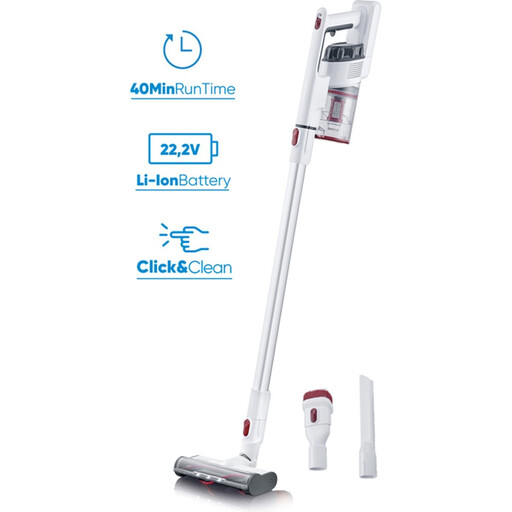
Why it suits this profile: Weighing 1.5 kg, this model is lightweight and suitable for everyday vacuuming on hard floors and low-pile carpets. The handheld unit is practical for furniture, stairs and crumbs.
The stated runtime of up to 40 minutes is combined with a turbo brush and LED lighting. The specifications also state a charging time of approximately 5 hours, so you can take this into account in advance.
Up to 40 minutes' runtime, 2-in-1 design, 0.5-litre container and a weight of 1.5 kg.
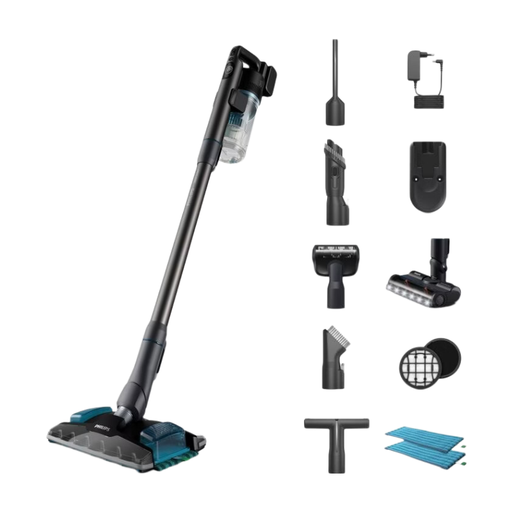
Why it suits this profile: The combination of vacuuming, a detachable handheld unit and a mopping function suits households looking to handle several tasks with one appliance.
The product information states the runtime for each setting: up to 80 minutes on low and around 30 minutes in turbo mode with a motorised floor head. This makes the difference between everyday and intensive use clear.
Up to 80 minutes' runtime, mopping function, LED lighting, handheld unit and a removable battery.
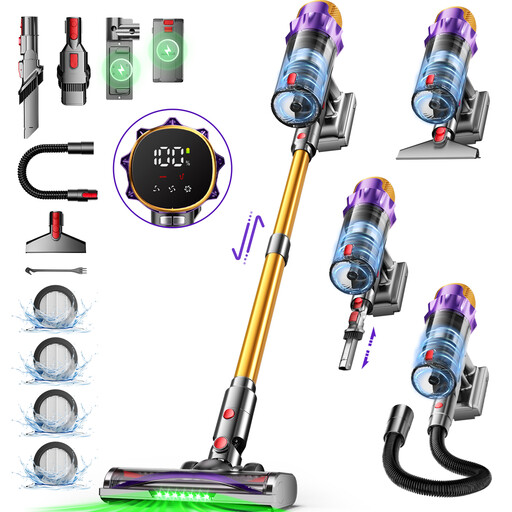
Why it suits this profile: This model is designed for larger homes and households with pets. Its long runtime, large dust container, flexible hose and pet-hair brush are intended for more extensive use.
The manufacturer states the battery life separately for each use case: up to 70 minutes in eco mode and 40 to 50 minutes on the powerful setting. The product details also include maintenance alerts on the display and an anti-tangle brush.
Up to a 1.8-litre dust container, three suction settings, pet-hair brush, flexible hose and removable battery.
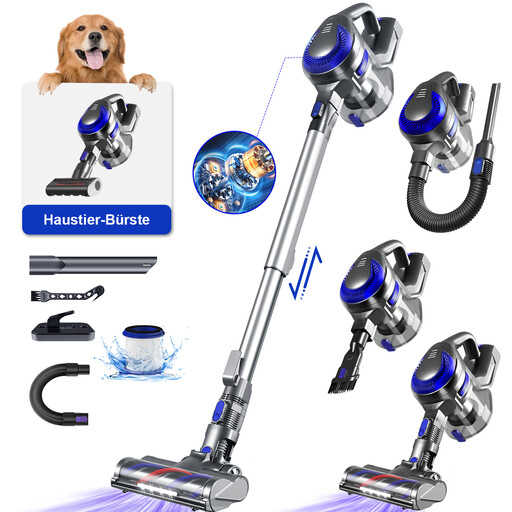
Why it suits this profile: The separate pet-hair brush, anti-tangle floor brush and extendable hose are useful for sofas, beds, floors and tight spaces.
The product description mentions a 5-stage filter, washable HEPA filter and a 1.6-litre container. This makes maintenance and emptying straightforward to assess.
Up to 55 minutes according to the product information, 1.6-litre container, pet-hair brush and telescopic tube.
We've put together a complete, up-to-date list of products that fully meet these strict selection criteria and the applicable European safety regulations.
A cordless vacuum cleaner will remain useful if you keep up with its maintenance:
A battery's service life depends on usage, charging cycles and storage temperature. A model with a removable battery may be more practical in the long term, but check in advance whether a replacement battery is available.
Yes, if the model has a motorised brush, anti-tangle function or separate pet-hair brush. Also check the filter and container. Pet hair can quickly fill a small container, so a larger dust container may be more convenient for everyday use.
This varies by model and suction setting. The stated maximum runtime usually applies to the low setting. The powerful setting with a motorised brush uses more energy. Therefore, look at the runtime for each setting and the charging time, rather than just one maximum figure.
Energy consumption depends on the charging power, charging frequency and selected setting. A stick vacuum cleaner does not use mains electricity while cleaning, but its battery does need to be recharged. A shorter cleaning session on the low setting generally requires less charging energy than prolonged use at maximum power.
