
当日/次日达

品质保障

开启新人专享福利: 全场免邮 | 低至 2 折 | 免费试用 30 天 JoyPlus 会员
下载 Joybuy
A cordless stick vacuum is handy for crumbs, pet hair and everyday dust, but not every model is right for every home. A high pascal rating, long battery life or eye-catching LED display doesn’t tell the whole story. The brush, filter, battery and accessories all play a major part in how well the vacuum works in practice.
Households with carpets, pets or multiple floors are especially likely to encounter the same problems. That’s why it’s worth checking these three common pitfalls before you buy.
Brands often advertise high suction power in Pa or kPa. This is a technical measure of the pressure the motor can generate, but it doesn’t automatically tell you how well the vacuum picks up hair from carpets. The floor head, airflow and seal also play a part.
So don’t just look for “powerful suction”. Check whether:
Manufacturers often quote the maximum run time in eco mode. In turbo mode, the battery can run down considerably faster. For example, the Philips XC8055/01 is listed as offering up to 80 minutes of use, while its product specifications give a run time of around 30 minutes in turbo mode.
Always compare the run time for each mode. Thirty minutes may be enough for a flat. For a larger home, multiple floors or lots of pet hair, a replaceable battery is more practical.
A cordless vacuum with a HEPA filter can filter fine particles from the air it expels, but the filter needs to be looked after properly. A clogged or damp filter can reduce airflow and suction power. So check:
A HEPA filter is a product feature, not a guarantee of a particular health outcome. Always follow the instructions for use and maintenance.
For a stick vacuum for pet owners, a V-shaped or anti-tangle brush can be useful. This design can help stop dog and cat hair from quickly wrapping around the roller. You’ll still need to check the brush regularly, especially if you have long-haired pets.
For hard floors, it’s best to use a soft or otherwise suitable floor brush. For deep-pile carpets, a powerful motorised brush with a dedicated carpet setting is more relevant than a high Pa rating alone.
A replaceable battery makes it possible to clean for longer if you have a second battery available. Also check the charging time, how the vacuum is stored, and whether the battery can be charged separately or only while it’s in the vacuum.
A self-standing stick vacuum is handy if you’re often interrupted while cleaning. A wall mount saves space, but requires drilling or a suitable wall. So check which storage option works best in your home.
A lightweight model is easier to use on stairs and around furniture, while a larger dust container means less frequent emptying. These accessories are usually useful for everyday cleaning:
A 2-in-1 stick vacuum that converts into a handheld vacuum is ideal for quick clean-ups in the car, on the stairs or at the dining table. However, a compact handheld vacuum isn’t always a substitute for a full-size stick vacuum.
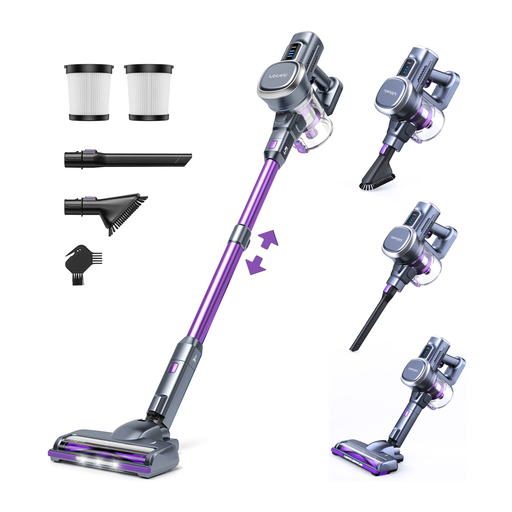
Why it suits this type of buyer: This model combines a relatively low weight of 2.2 kg with three suction settings and a stated run time of up to 50 minutes. That makes it suitable for everyday vacuuming in a flat or medium-sized home.
The product information lists the run time alongside three settings: 25 kPa on max, 17 kPa on medium and 10 kPa on eco. This lets you match the battery use to the task instead of always using the highest setting.
V-shaped anti-tangle brush, self-standing design, removable battery and included HEPA filter.
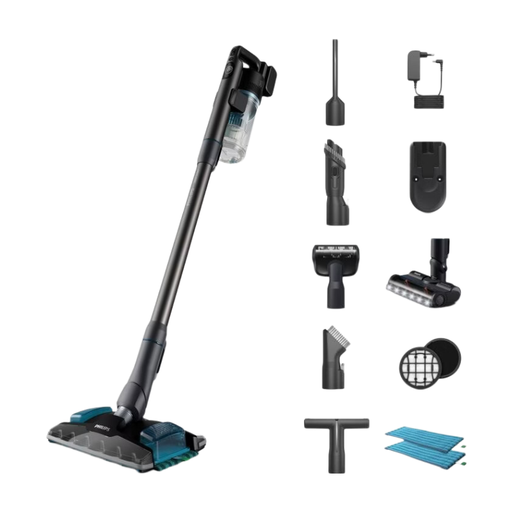
Why it suits this type of buyer: The combination of vacuuming, mopping, LED lighting and a handy handheld unit is ideal for households that want to tackle several cleaning tasks with one appliance.
The product specifications list the run time separately for low and turbo settings. They also clearly state that the filter isn’t a HEPA filter, so you won’t mistake its filtration capabilities.
2-in-1 stick and handheld vacuum, integrated mopping function, LED-lit nozzles and a 0.6-litre dust container.
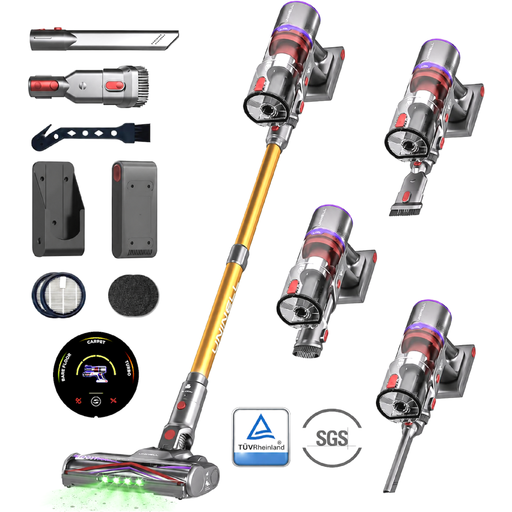
Why it suits this type of buyer: This model is designed for big cleaning sessions and homes with carpets and pets. The product information lists up to 65 minutes of use, a peak suction value of 60 kPa and a self-emptying charging base.
The product specifications list more than just suction power: they also cover seven filtration stages, an anti-tangle brush and instructions for cleaning the filter and brush. The stated 65-minute run time depends on the setting you choose.
Self-emptying charging base, multi-stage HEPA filtration, green LED lighting and self-standing design.
We’ve put together a complete, up-to-date list of products that meet these strict selection criteria and current European safety requirements.
It depends on the setting you choose, the type of floor and the age of the battery. Manufacturers often quote the maximum run time in eco mode. So check the run time on medium and turbo settings too. A removable battery can extend the cleaning time if you have a spare.
Yes, as long as the model has a motorised brush and an anti-tangle function. Also check whether the brush is easy to remove. A higher setting is useful for lots of pet hair on carpets, but it uses more energy and is usually noisier.
The main running costs are electricity, filters, brushes and, if needed, a replacement battery. A washable filter can help reduce replacement costs, but it must be completely dry before you put it back. Only use the charger and parts supplied with the vacuum or recommended by the manufacturer.
