
Vandaag of morgen in huis

Kwaliteit gegarandeerd
Download de app
Categorieën

Selecting a new cordless stick vacuum can be overwhelming. You're bombarded with specifications: Pascals, Air Watts, battery life, HEPA filters. The risk of making the wrong choice is real. You need a model that's powerful enough for your floors and doesn't give out after just ten minutes. This guide will help you make an informed decision based on facts and specifications, ensuring you find a device that perfectly suits your household.
To make a fair comparison, it's crucial to understand the technical specifications. Here are the most important criteria.
Suction power is often expressed in Pascals (Pa) or Air Watts (AW).
For everyday dust and debris on hard floors, a lower value is often sufficient. For a powerful stick vacuum that also needs to remove deep-seated dirt from carpets or stubborn pet hair, you should look for models with higher Pa or AW ratings.
The advertised battery life is almost always for the eco mode. In practice, you'll often use a combination of modes. A cordless vacuum with a maximum runtime of 60 minutes might only last 10-15 minutes on turbo mode. For a more realistic picture, check the runtime on the standard or medium setting. Charging time typically varies between 3 and 5 hours.
For households with allergies or pets, a stick vacuum with a HEPA filter is a key consideration. A HEPA filter captures up to 99.97% of microscopic particles, such as pollen, dust mites, and pet dander. This results in cleaner exhaust air and helps reduce allergic reactions.
A lightweight vacuum is more comfortable to use, especially when cleaning stairs or using the device in handheld mode. Pay attention to the weight distribution: a heavy motor at the top can strain your wrist over time. Some models feature a self-standing design, which is convenient if you need to pause your cleaning.
The effectiveness of a vacuum also depends on the included accessories. A motorised (turbo) brush is essential for cleaning carpets and removing pet hair. A crevice tool and a soft dusting brush are standard, but also look for specialised attachments for furniture or hard-to-reach areas. A flexible wand can be useful for easily getting under low furniture.
Virtually every modern stick vacuum is a bagless vacuum. Note the capacity of the dustbin, expressed in litres. A larger bin requires less frequent emptying, which is convenient for larger homes or households with pets. A hygienic emptying mechanism that allows you to dispose of dirt with the press of a button prevents contact with dust.
Based on the criteria above, we have selected models that stand out for their specifications and features.
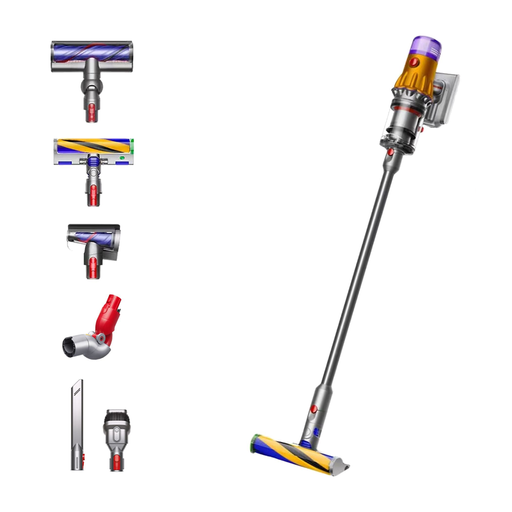
Why this product: The Dyson V12 Detect Slim Absolute stands out for its technological features. The laser on the Fluffy cleaner head reveals invisible dust on hard floors. A piezo sensor measures and counts the dust particles, automatically adjusting suction power where needed.
Pros:
Who is this for? This model is ideal for users who value technological innovation and data-driven cleaning. It's an excellent choice for households with a mix of carpet and hard floors and for those who want visual confirmation of a clean floor.
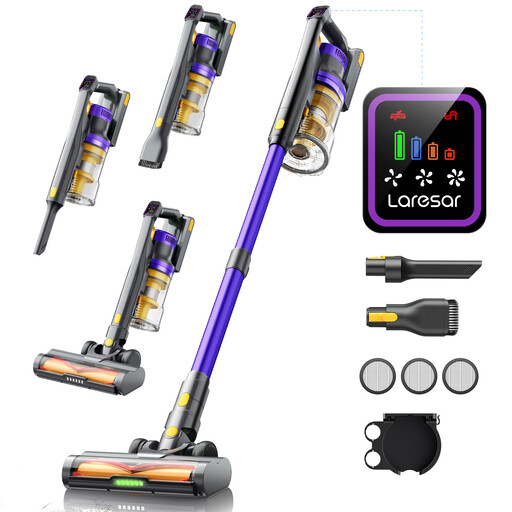
Why this product: The Laresar X11 focuses on raw power. With a 550W motor and a maximum suction of 55 kPa, this model is designed for the most demanding cleaning tasks. The touchscreen display makes it easy to switch between the three suction modes.
Pros:
Who is this for? Users looking for maximum suction power for deep cleaning carpets or vacuuming heavier debris and pet hair will appreciate the performance of the Laresar X11. Its various modes make it versatile for the entire home.
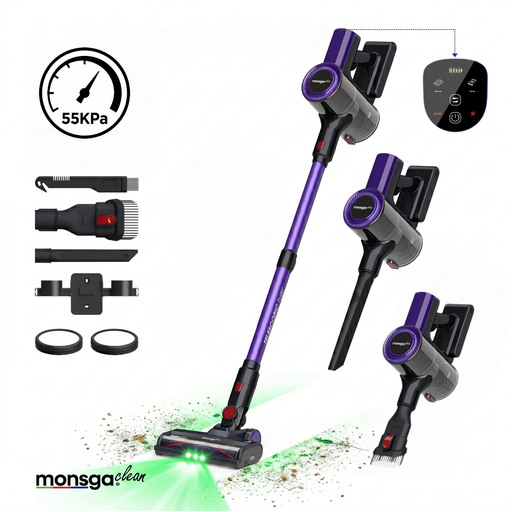
Why this product: The Monsga M100 combines high suction power with practical features for families and pet owners. The extra-large 1.8-litre dustbin and the anti-tangle brush roll are designed to minimise maintenance.
Pros:
Who is this for? This model is a practical choice for larger households and people with pets. The large dustbin capacity and anti-tangle technology make it a low-maintenance stick vacuum for pet hair.
A cordless stick vacuum offers flexibility and convenience for most daily cleaning tasks. However, for very large areas or commercial use, where uninterrupted runtime and even greater capacity are essential, a different type of vacuum might be a better solution. In that case, a backpack vacuum can be an efficient alternative, as it distributes weight on the back and often has a larger capacity and continuous power supply.
1. How many Pascals (Pa) does a good stick vacuum need? This depends on its intended use. For hard floors and light debris, 15,000-20,000 Pa is often sufficient. For households with carpets and pets, a model with a maximum suction power of 25,000 Pa or more is recommended for a deep clean.
2. Is a stick vacuum suitable for pet hair? Yes, many modern stick vacuums are very effective for pet hair. Look for models with high suction power (AW or Pa) and a motorised brush roll. A brush with an anti-tangle design is an added benefit, as it prevents long hairs from wrapping around the brush.
3. What is the difference between a stick vacuum and a regular vacuum? The main difference is the cordless freedom and the lighter, more compact design of a stick vacuum. This makes them more manoeuvrable and easier to grab for quick clean-ups. Traditional canister vacuums often have a larger dust bag or bin and higher, constant suction power because they run on mains power, but they are less flexible to use.