
Vandaag of morgen in huis

Kwaliteit gegarandeerd

Welkomstaanbiedingen ontgrendelen: GRATIS bezorging | Tot 80% korting | Gratis 30 dagen JoyPlus-proefperiode
Download de app
A cordless polishing machine gives you the freedom to move around without an extension lead. That is useful for car detailing, waxing furniture or tackling small jobs in the workshop. However, many models look similar while differing considerably in drive system, battery capacity and intended use.
If you only look at the speed or the number of accessories, you could end up buying a machine that runs out of charge too quickly in practice, offers insufficient control or is unsuitable for the surface. Use these checkpoints to make a well-informed choice.
A speed of 5.500 rpm sounds powerful, but tells you little without information about the drive system, the size of the polishing pad and the low-speed control. For applying wax, a smooth, steady movement is generally more useful than a high top speed.
An orbital polishing machine moves the pad in an orbit alongside the rotation axis. This can help you work evenly. A rotary polishing machine spins directly around a single axis and is mainly intended for targeted polishing. This method requires more control.
Always check:
Some models are supplied as the machine only. The Einhell TE-OS 18/230 Li Solo, for example, uses the Power X-Change platform, but according to the product information is supplied without a battery and charger. It is also a sander rather than a car polishing machine.
A set with lots of sponges, pads and adapters is only useful if the sizes and fittings are suitable for your job. Pay attention to the backing plate diameter, the type of hook-and-loop fastening and the availability of replacement pads. For small areas, emblems and wheels, a mini polishing machine is often more practical than a machine with a large pad.
First decide whether you want to polish, wax, sand or combine several tasks. An orbital car polishing machine is designed for paintwork care. A sander uses abrasive paper and is intended for removing material from surfaces such as wood, metal or filler.
The Bosch PSS 250 AE is an electric orbital sander with a 250 W motor, electronic speed control and a Microfilter dust box. According to the product information, this model is suitable for flat surfaces made from wood, painted materials, metal, stone and plaster. Do not therefore use it as a substitute for a car polishing machine.
A machine with several settings gives you more control over different materials and products. Low settings are practical for wax and sealant, while higher settings may be suitable for certain polishes or material-processing tasks. Always follow the instructions for the polishing product and start in an inconspicuous area.
Also check how the speed is displayed. According to the product information, the BATOCA S2 has an LCD display, six speed settings and a stated range of 2.000 to 4.500 rpm. This makes the settings easier to read while you work.
A larger pad covers a large surface more quickly, but is less convenient in tight areas. A compact machine is often more comfortable to use around mirrors, bumpers, headlights and wheels.
For a standard car polishing machine, a pad of around 125 mm is common. A model with 25, 50 or 75 mm backing plates is more suited to detail work. Also check the weight with the battery fitted. A lightweight machine may be more comfortable, but it does not automatically provide enough power for prolonged correction work on a large vehicle.
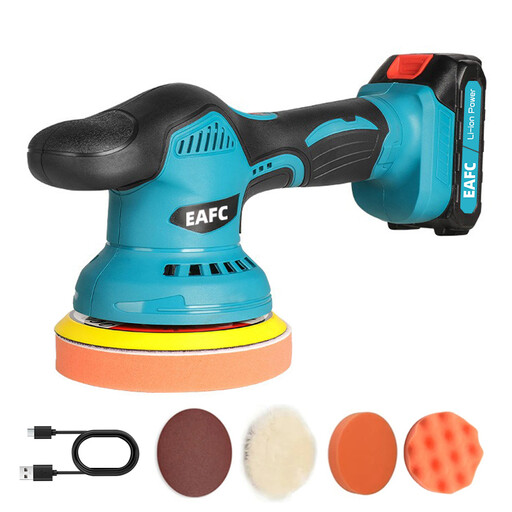
Why it suits this user profile: This cordless polishing machine is intended for users who want to wax or lightly polish cars, furniture and other surfaces from time to time. The package includes several pads and a Type-C charging cable.
The eight speed settings allow you to avoid working at maximum speed all the time. Do check the exact battery capacity and supplied accessories beforehand.
125 mm pad, adjustable range of 2.800 to 5.500 rpm and a stated weight of 1,13 kg.
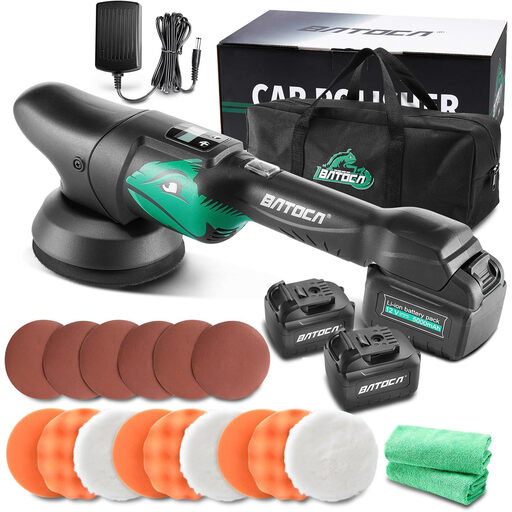
Why it suits this user profile: If you regularly maintain a car, the LCD display and two batteries give you a clearer view of the settings and available working time.
The product information lists two 5 Ah batteries, an expected operating time of approximately 60 minutes and a charging time of 2.5 hours. Check these figures against your own usage conditions.
Two interchangeable batteries, an LCD display and a 125 mm polishing sponge according to the product description.
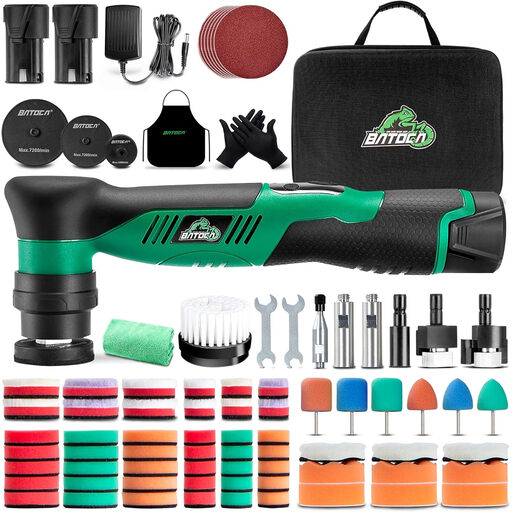
Why it suits this user profile: This mini polishing machine is designed for detail work on headlights, wheels, emblems and hard-to-reach edges, rather than quickly treating an entire car.
The three drive options make the intended applications clearer: rotary, 3 mm orbital and 12 mm orbital. Choose the setting and pad size for each area.
Two 12 V 2,0 Ah batteries, six speed settings and 25, 50 and 75 mm backing plates according to the product information.
A cordless model is practical when working outdoors, moving around a vehicle or when there is no nearby socket. For prolonged polishing across several vehicles, a mains-powered model may make more sense. The Einhell CC-PO 1100/1E has a 1.100 W motor, electronic speed control with an LCD display and accessories for both polishing and sanding.
A mains-powered machine does not require charging time or a spare battery, but you will have to work with a cable. With all power tools, pay attention to the instructions, the visible CE marking where stated, suitable personal protective equipment and the correct storage of lithium-ion batteries.
We have compiled a complete, up-to-date list of products that fully meet these strict selection criteria and the applicable European safety regulations.
That depends on the pad diameter, battery capacity and working pace. A model with a 125 mm pad is generally more practical for larger paintwork areas than a mini polishing machine. For prolonged use, two batteries or a mains-powered model are useful.
Not as standard. You can only use the machine for sanding if the manufacturer specifies sanding accessories and suitable use. A genuine orbital sander, such as the Bosch PSS 250 AE or Einhell TE-OS 18/230 Li Solo, is designed for abrasive paper, dust collection and material processing.
Operating time varies according to the battery, pressure, pad, material and speed. A stated time without a load is no guarantee of the same duration when polishing a car. Therefore, do not compare Ah alone; also consider the number of batteries, charging time and whether a spare battery can be purchased.
