
Vandaag of morgen in huis

Kwaliteit gegarandeerd

Welkomstaanbiedingen ontgrendelen: GRATIS bezorging | Tot 80% korting | Gratis 30 dagen JoyPlus-proefperiode
Download de app
A cordless handheld vacuum cleaner is handy for crumbs on the sofa, sand in the car or dust between keyboard keys. However, compact models can vary considerably in how they perform. A short battery life, fiddly filter maintenance or small dust container can quickly leave your new purchase unused in a cupboard.
Suction power is often measured in Pa or kPa. That figure doesn’t tell you everything about how a vacuum performs day to day. Airflow, the nozzle, the seal and a clean filter all play a part too. What’s more, brands use different testing methods. So don’t just compare 4,500 Pa with 18,000 Pa. Look at the accessories, run time and the type of dirt you want to remove as well.
Manufacturers may measure maximum run time using the lowest setting. Run time on turbo is often considerably shorter. For example, the ROUNY X3 Pro is listed as running for 30 minutes on the low setting and 15 minutes on the high setting. For a compact handheld vacuum cleaner for your car or desk, a short run time isn’t necessarily a problem, as long as it suits your cleaning routine.
A washable filter reduces replacement costs, but it does need regular maintenance. The filter must be completely dry before you put it back. A clogged filter can restrict airflow. Check whether the filter and dust container are easy to access too. A handheld vacuum cleaner with a HEPA filter is particularly useful if you want to collect fine dust, but the term HEPA doesn’t guarantee a particular overall cleaning performance.
For crumbs, sand and pet hair, a narrow crevice tool and a brush nozzle are more useful than a high Pa rating without suitable attachments. A cordless handheld vacuum for crumbs used on furniture and a handheld vacuum cleaner for the car often have different requirements. Several nozzles are useful for seats, air vents and crevices.
Want to clean keyboards or hard-to-reach places too? A handheld vacuum with a blower function could come in handy. Only use the blower where you can collect the dirt safely; around electronics, take care not to blow dust further into the device.
Check:
A rechargeable vacuum cleaner with USB-C is a good choice for students, campervan owners and motorists who want to top up the charge while out and about. The Oxerbog is listed as running for 12 to 13 minutes and taking around 2 hours to charge. The ROUNY Xs Pro is listed as running for 25 minutes on the low setting and 12 minutes on the high setting.
A compact car vacuum cleaner should fit in a door pocket, glove compartment or storage bag. A lightweight design is handy when cleaning the dashboard, seats and keyboard. Check the dust container’s capacity too. According to the product specifications, the ROUNY X3 Pro has a 150 ml dust container, while the ROUNY Xs Pro holds around 50 ml. A smaller container needs emptying more often, but usually makes the device more compact.
Check the safety instructions for every model. These handheld vacuum cleaners are designed for dry dirt. Don’t vacuum water, hot ash or burning materials.
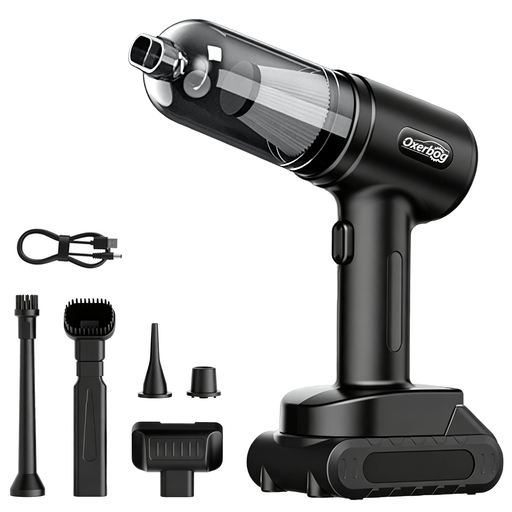
Why it suits this profile: This model combines a compact design with five attachments and a 4-in-1 function for vacuuming, blowing, inflating and deflating. That makes it useful for small cleaning jobs at home, in the car or in a student room.
The product specifications clearly state the run time and charging time: 12–13 minutes of use and around 2 hours to charge. This lets you factor in the short run time before making your choice.
According to the product specifications: 337 grams, a USB-C cable, a washable HEPA filter and a transparent dust container.
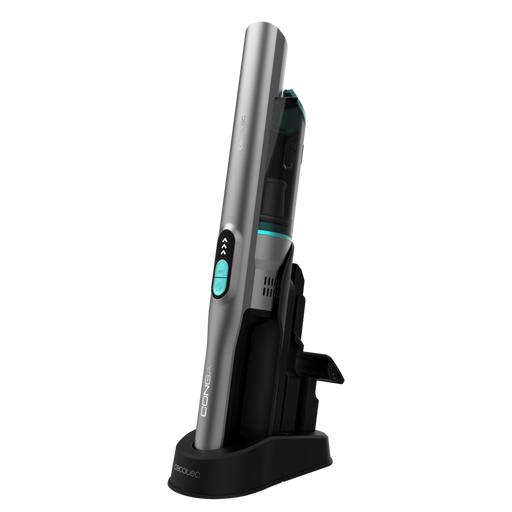
Why it suits this profile: This model is designed for households looking to clean furniture, mattresses and upholstery for longer sessions, as well as tackling smaller jobs in the car.
According to the product information, the stated 40-minute run time applies to the specified usage; Eco and Turbo modes are also available separately. If you plan to use it intensively, check which setting you’ll need.
Listed specifications include a brushless digital motor, maximum suction power of 20 kPa, a removable 2,500 mAh battery and a motorised nozzle for mattresses and upholstery.
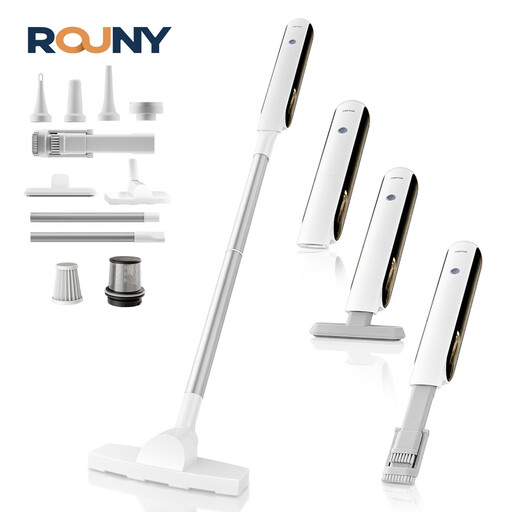
Why it suits this profile: With two speeds, LED lighting, a blower function and an extension tube, this model is well suited to users who switch between the car, desk, student room and light floor cleaning.
The run time is broken down into 30 minutes on the low setting and 15 minutes on the high setting. The filter type and 150 ml dust container capacity are also listed, making it easier to estimate maintenance needs and usage.
According to the product specifications: 9 kPa and 18 kPa across two settings, a washable HEPA filter, an LED light, seven nozzles and a noise level of up to 75 dB.
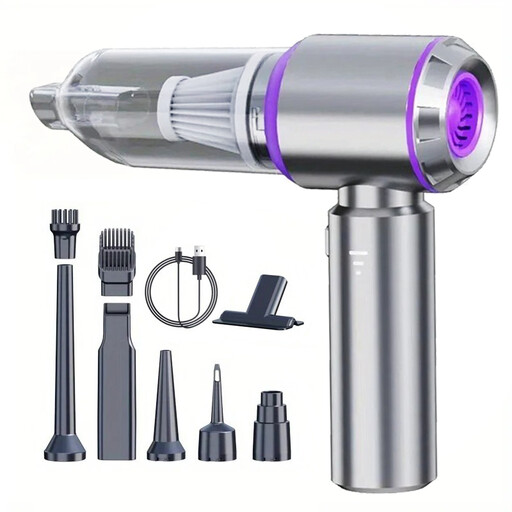
Why it suits this profile: As well as vacuuming, this model can blow, inflate and deflate, according to the product description. That makes it an interesting option for the car, camping, workshop and storage bags.
The manufacturer lists a 6,000 mAh battery and an indicator with three levels. The actual run time isn’t stated, so bear that in mind if you plan to clean for long periods.
Listed specifications include 16,000 Pa, USB-C charging, a compact 22 × 20 cm body and nozzles for crevices, floors, inflating and deflating.
We’ve put together a complete, up-to-date list of products that meet these strict selection criteria and comply with current European safety regulations.
A regular routine can help your vacuum last longer:
For fine dust in air vents, a soft car detailing brush can complement a vacuum cleaner for home and car. Loosen the dirt first, then vacuum it up without rubbing hard against delicate surfaces.
It depends on the setting, battery capacity and age of the battery. Always check the stated run time for each setting. Turbo usually uses more power than the low setting. For quick cleans in the car, 10 to 15 minutes may be enough; for several rooms, a model with a longer run time is a better choice.
Not necessarily. A HEPA filter can help collect fine dust, but overall performance also depends on the seal, airflow and maintenance. Check whether the filter is washable or replaceable, and whether the manufacturer provides clear maintenance instructions.
The electricity used per charge is usually minimal. The main ongoing costs are filters, replacement batteries if needed, and accessories. A washable filter can help keep replacement costs down, but only if you clean it properly and let it dry completely before putting it back.
