
Vandaag of morgen in huis

Kwaliteit gegarandeerd

Welkomstaanbiedingen ontgrendelen: GRATIS bezorging | Tot 80% korting | Gratis 30 dagen JoyPlus-proefperiode
Download de app
A cordless car polisher gives you more freedom of movement than a corded model. That is useful when working on the driveway, reaching awkward areas or quickly applying some wax. However, not every cordless polisher is suitable for every job. A compact mini polisher for a bumper corner works differently from a dual action polisher for an entire vehicle.
The three most common buying mistakes are:
A rotary polisher spins the pad around a single fixed centre point. This can be useful for targeted paint correction, oxidation or minor damage, but the tool requires a steady hand and an appropriate speed.
A dual action polisher, also known as an eccentric polisher, also moves the pad in an eccentric orbit. This helps distribute the polishing action more evenly and makes this type suitable for waxing, applying sealants and general maintenance. According to the product descriptions from various brands, a dual-mode model can be used flexibly, but the final result also depends on the pad, polish and technique you choose.
For precision work, small backing plates of 25, 50 or 75 mm are practical. For larger paintwork areas, a plate of around 125 mm is more suitable. A mini polisher is therefore mainly intended for badges, headlights, wheels, mirrors and edges, rather than quickly treating an entire car.
Do not look only at the maximum number of revolutions per minute. More important is whether the car polisher has sufficiently low settings and starts smoothly.
A model with four to eight settings gives you more control than a tool with just one fixed speed. A soft start, speed memory or display can also help you work consistently. Product descriptions from brands mention these features as user benefits; they do not guarantee a particular paintwork result.
For mobile use, a battery-powered polisher is particularly practical when the weight is well balanced. A lightweight straight polisher can be comfortable for smaller areas and for working above shoulder height for longer periods. A larger model with a 125mm plate may be more efficient on wide panels, but requires more space and control.
Also check:
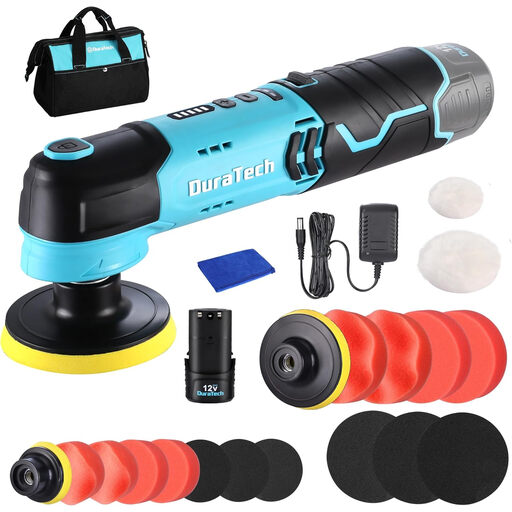
Why it suits this profile: According to the product description, this compact 12V model weighs 810 grams and is designed for smaller surfaces, detailing and occasional use on cars, motorbikes or other materials.
Five adjustable speeds from 600 to 3000 rpm offer more control than a fixed speed. The set includes 5cm and 8cm polishing wheels.
Low weight, LED speed indicator and accessories including sponges, sandpaper, lambswool pad and storage bag.
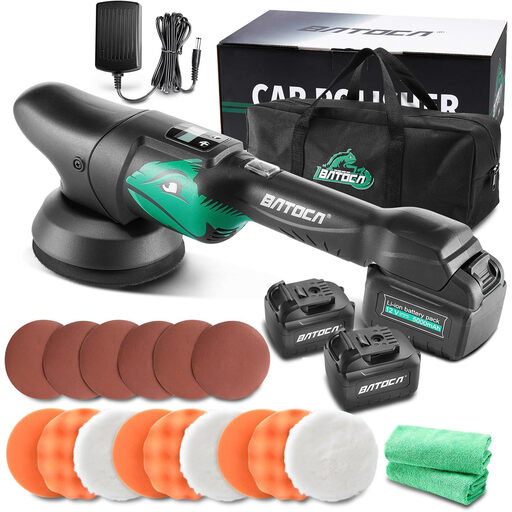
Why it suits this profile: Suitable for users looking for a more capable car polisher with larger batteries, a display and an eccentric movement for panels.
According to the product information, the set uses two 5000mAh batteries and has six speeds with soft start. This makes it easier to pause and resume work.
LCD speed display, 8mm eccentric throw, 125mm polishing pad and two interchangeable batteries.
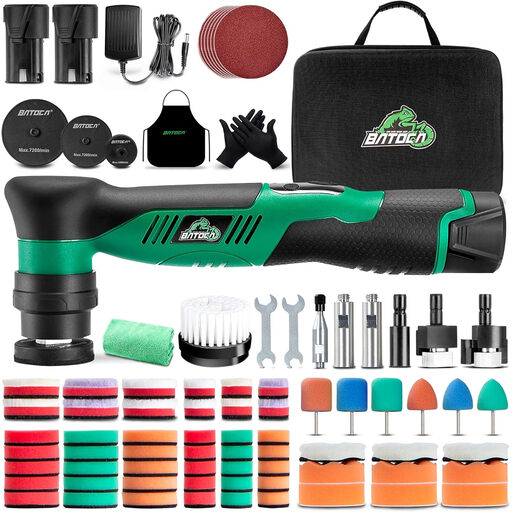
Why it suits this profile: A practical choice for detailers who want to switch between rotary and dual action polishing and regularly work on headlights, wheels, badges and bodywork contours.
The S5 has three functions: rotary, 3mm eccentric and 12mm eccentric. This allows you to match the working mode to the required precision or a more uniform movement.
Two 12V 2.0Ah batteries, six speeds from 2000 to 5500 rpm and backing plates measuring 25, 50 and 75mm.
We have put together a complete, up-to-date list of products that fully meet these strict selection criteria and the applicable European safety regulations.
Always use a suitable pad and start at a low speed. Clean the surface beforehand so that sand and dirt do not cause additional scratches. Work in small sections and regularly check the temperature of the pad and surface. Avoid sharp edges and do not apply excessive pressure.
Wear eye and hearing protection whenever this is required by the instructions for use. Keep ventilation openings clear and use only batteries and chargers recommended by the manufacturer. Before buying, also check the Dutch-language manual, warranty terms and information about the included charger.
This depends on the plate, battery capacity and model you choose. A 125mm dual action machine is more practical for large panels. A mini polisher is mainly suitable for edges, headlights, wheels and other small areas. For an entire car, two batteries or an additional charging option are useful.
Operating time varies according to capacity, speed and load. According to the product description, BATOCA states that the S5 offers around 30 minutes of no-load use per battery. Treat this as a product specification under those conditions, not as a fixed operating time. A second interchangeable battery can help minimise downtime.
In addition to the purchase price, you should allow for the electricity used to charge the batteries, pad wear and the possible cost of a replacement battery. Check whether batteries are available separately and whether the set already includes several types of sponges or backing plates. A complete set may be more practical to use than a cheaper tool that requires you to buy additional accessories straight away.
