
Vandaag of morgen in huis

Kwaliteit gegarandeerd

Welkomstaanbiedingen ontgrendelen: GRATIS bezorging | Tot 80% korting | Gratis 30 dagen JoyPlus-proefperiode
Download de app
A cordless car polisher gives you greater freedom of movement than a mains-powered model. You can work more easily around mirrors, bumpers and alloy wheels without having to trail an extension lead across the driveway. However, not every cordless car polisher is suitable for every job.
Many buyers focus mainly on the speed or the number of accessories included. This can be misleading. The following three pitfalls are common:
For occasional waxing, you need different features than for paint correction, headlight polishing or intensive car detailing. Below, you can find out which specifications to check first.
A dual action polisher, also known as a DA or random orbital polisher, combines a rotary and orbital movement. Product information often associates this action with even treatment of the surface. For beginners, a DA model is usually convenient because you can control the speed and pressure more easily.
A rotary polisher spins around a fixed centre point. This can be useful for targeted work and stubborn areas, but it requires a steady hand and a suitable pad. For small areas such as a scratch, headlight or badge, a mini car polisher may be more practical than a large model.
Bear in mind that terms such as “professional” or “powerful” may come from the product description. Do not treat them as a guarantee of a particular result. Instead, look at the actual drive system, speed settings and backing plates supplied.
For wax, sealant and polish, you want the machine to start gently. An adjustable speed prevents the product from immediately flying off the pad. According to the product information, the EAFC 21V operates with eight settings from 2,800 to 5,500 rpm. The BATOCA S3 has six speed settings from 2,500 to 5,000 rpm.
A soft start, clear speed indicator or memory function makes operation more straightforward. Also consider the weight. A machine weighing around 1 to 1.5 kilograms may feel less tiring during extended use than a heavier model, but the total weight including the battery and pad also matters.
A 125 mm backing plate is suitable for larger body panels, such as the bonnet, roof and doors. Smaller plates measuring 25, 50 or 75 mm are better for bumpers, alloy wheels, pillars and narrow edges.
Check the following before buying:
A cordless polisher is not the answer for every deep scratch. If the damage extends through the clear coat, polishing may only improve the appearance to a limited extent. Always test on a small, inconspicuous area first and use clean pads.
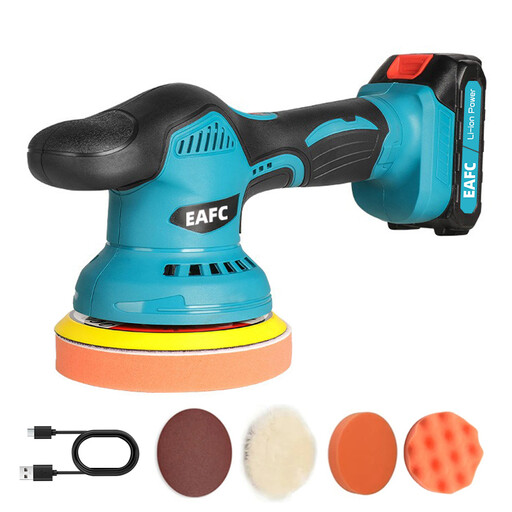
Why it suits this user profile: The 125 mm plate, eight speed settings and supplied selection of pads make this model suitable for regular waxing and light polishing work on the car.
According to the product information, the speed can be adjusted from 2,800 to 5,500 rpm. This means you are not limited to working at just one high setting.
21V system, 125 mm plate, eight settings and a stated weight of 1.13 kg.
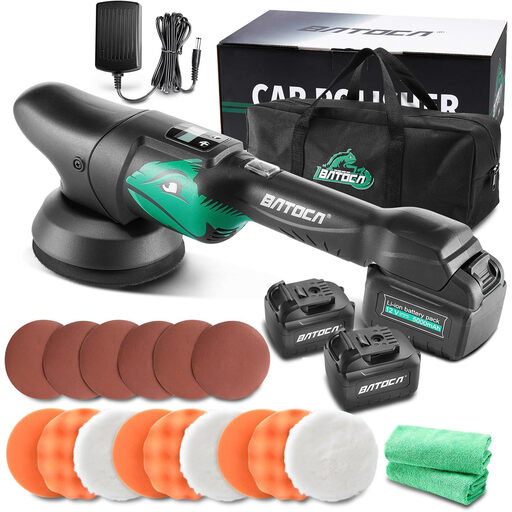
Why it suits this user profile: This model is designed for anyone looking for a complete car polisher for larger surfaces and greater control during longer jobs.
According to the product information, the set includes two 5Ah batteries and an LCD display for speed and battery diagnostics. This makes the remaining working time easier to monitor.
125 mm polishing pad, six speeds, two 5Ah batteries and a stated operating time of approximately 60 minutes.
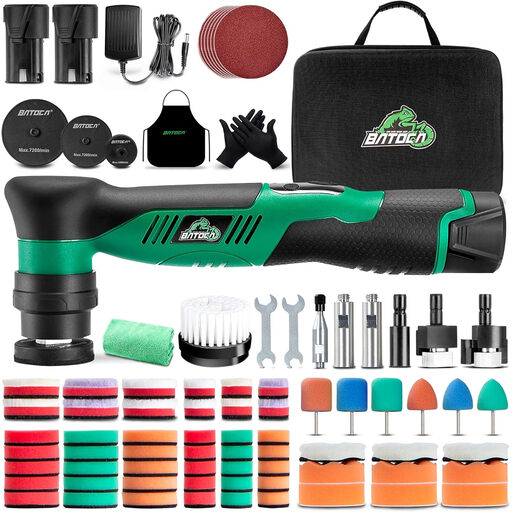
Why it suits this user profile: The combination of rotary and orbital action is practical for detailed work on headlights, alloy wheels, badges and hard-to-reach edges.
You are not limited to one type of movement: according to the product information, you can switch between rotary, 3 mm and 12 mm orbital action.
Six speeds from 2,000 to 5,500 rpm, two 12V batteries and 25, 50 and 75 mm plates.
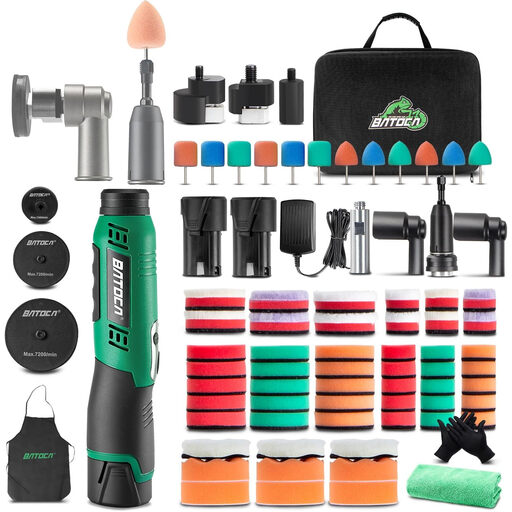
Why it suits this user profile: The compact design and small polishing heads are intended for edges, corners and parts that a standard car wax machine cannot easily reach.
The set is not focused solely on a large plate. According to the product information, it includes multiple drive options and plates for small-scale detail work.
DA and rotary modes, six speeds and two 12V batteries with a stated no-load run time of up to 30 minutes.
We have put together a complete, up-to-date list of products that fully meet these strict selection criteria and the applicable European safety regulations.
Wash and dry the car thoroughly first. Remove sand and dirt from the pad, as loose particles can cause new scratches. Apply a small amount of polish or wax and spread the product at low speed. Increase the speed only when the pad is making even contact with the surface.
Work in small sections and keep the machine moving constantly. Do not apply heavy pressure to edges, creases or plastic parts. When polishing headlights, use only products and pads intended for this purpose. Allow the battery to cool after use, charge it with the supplied charger and store it in a dry place according to the manual.
Not always. A polisher can visibly reduce light surface scratches, dull patches and oxidation. If you can clearly feel a scratch with your fingernail or see the underlying layer, polishing the paint alone is unlikely to be sufficient. Test a small area first and follow the instructions for the polishing compound you are using.
This depends on the speed, pressure, pad, temperature and battery capacity. Product information often states a no-load run time, so the actual operating time may be shorter. Two interchangeable batteries are practical when you want to treat an entire car. Also check the charging time and whether additional batteries are available.
A DA model can be easier to control than a rotary car polisher because of its orbital movement. That does not mean you can start without preparation. Use the lowest setting, a gentle pad and a small test area. This allows you to learn how the machine, product and paintwork respond to one another.
