
Vandaag of morgen in huis

Kwaliteit gegarandeerd

Welkomstaanbiedingen ontgrendelen: GRATIS bezorging | Tot 80% korting | Gratis 30 dagen JoyPlus-proefperiode
Download de app
A cordless car polisher is useful when you do not want to use an extension lead or need to work on hard-to-reach parts of a vehicle. Think bumpers, alloy wheels, headlights, badges and narrow bodywork lines. However, not every cordless polisher is suitable for every type of job.
Many buyers focus mainly on the maximum speed or the number of accessories included. This can lead to a poor purchase. A machine with a high maximum speed is not automatically suitable for delicate paintwork, while a compact model designed for detail work may be less practical on large panels.
A high speed may sound appealing, but when polishing car paint, control is more important than speed alone. Working too aggressively can create excess heat, uneven results or visible holograms. A model with several speed settings gives you more scope to start gently with wax, a fine polish or a delicate surface.
A rotary polisher spins the pad around a fixed centre point. This can be effective for localised correction, but it requires an even movement and careful monitoring of the paintwork temperature.
An orbital polisher, also known as a dual-action or DA polisher, also moves the pad away from the centre. This spreads the movement over a larger pattern and is an accessible choice for many DIY users. Always check the exact throw, though. A 3 mm orbital throw is different from a 12 mm throw and is suited to a different type of detailing work.
A polisher with a removable battery can be practical, but only if an additional battery is available or included. Check the voltage, capacity, charging time and compatibility. Also look at the backing plate size and the pads supplied. Different dimensions are useful for a large door panel than for a headlight or trim strip.
For waxing and light polishing, a low speed is usually more comfortable than starting straight away at the highest rpm. A range such as 2,000 to 5,500 rpm provides several adjustment points. A compact model for precision work may also have a much higher speed range for small pads. That does not mean you should use that setting on every material.
Pay attention to the number of settings and how they are adjusted. An LED indicator, memory function or clear start button makes it easier to repeat settings consistently and under control.
If you mainly want to carry out small paint corrections, work on alloy wheels or reach awkward areas, a model with multiple drive modes may be beneficial. Some machines can be converted from rotary to 3 mm or 12 mm orbital operation. This lets you use one device for different types of detailing work.
For beginners, an orbital setting is often easier to manage. A rotary setting is useful when you want to work precisely on a small area, but it requires extra care with pressure, speed and heat.
A backing plate of 25, 50 or 75 mm is suitable for detailing around badges, headlights and narrow edges. A plate of around 125 mm is more suitable for wider areas of the bodywork. Check whether the pads are self-adhesive or secured using another attachment system.
A rubberised handle, limited vibration and a low weight make longer periods of use more comfortable. Also look at the ventilation openings and the position of the battery. A heavy rear section can become tiring when working above shoulder height.
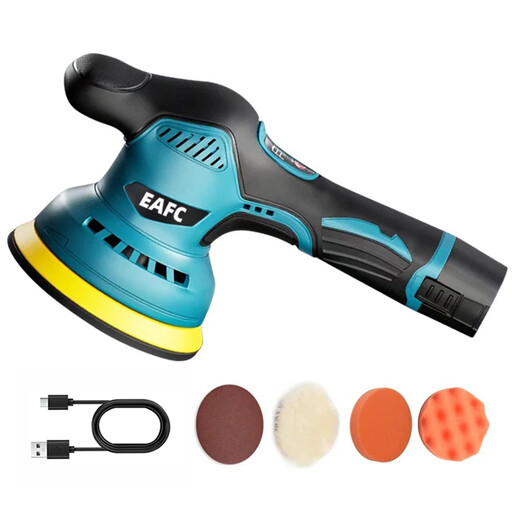
Why it suits this profile: This model is suitable for car owners who wax occasionally, carry out light gloss correction or want to use the machine for other jobs too.
The eight speed settings let you avoid starting at a high speed straight away. The 125 mm self-adhesive backing plate makes changing pads easy.
12 V system, adjustable from 2,800 to 5,500 rpm, with accessories for microfibre, waxing, restoration and sanding.
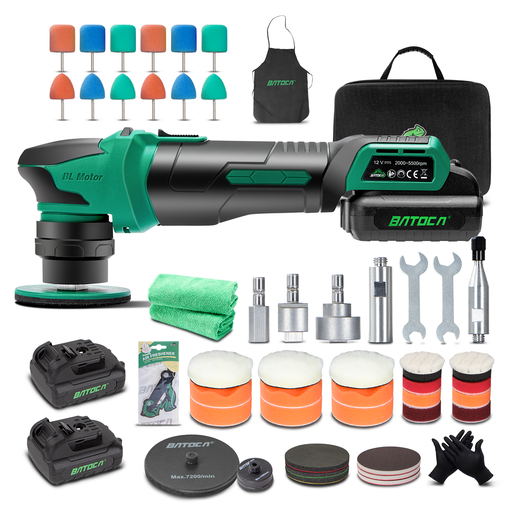
Why it suits this profile: Users carrying out precise detailing work get a compact machine with rotary and orbital drive modes.
The four settings from 2,000 to 5,500 rpm mean you are not limited to choosing between off and maximum power. According to the product information, the drive can be changed.
Brushless motor, two 12 V 2.5 Ah batteries, 3 mm and 12 mm orbital settings, and several pads for detailing work.
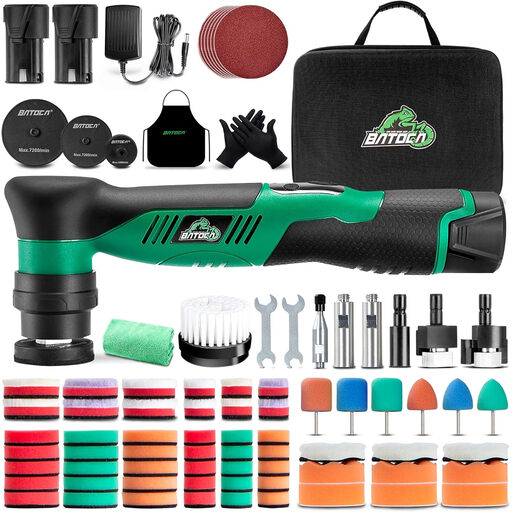
Why it suits this profile: This model is designed for car detailing, headlight polishing, alloy wheels and small surfaces where a large machine is difficult to manoeuvre.
You can switch between rotary, 3 mm orbital and 12 mm orbital operation. According to the product information, the two removable batteries allow you to use the second battery when the first runs out.
Six speeds from 2,000 to 5,500 rpm and backing plates of 25, 50 and 75 mm for different detailing areas.
We have put together a complete, up-to-date list of products that fully meet these strict selection criteria and the applicable European safety regulations.
Always work on a clean, dry surface. Remove sand and dirt before attaching a pad, as loose particles can cause new scratches. Start at a low speed with light pressure. Keep the machine moving and check the paintwork temperature regularly.
Use a suitable pad and polish for each step. A car scratch remover can deal with light surface defects, but deep scratches where the underlying layer is visible will not simply disappear through machine polishing. Test a product on a less noticeable area first and follow the instructions on the label.
Wear eye and hearing protection whenever required by the instructions for use. Before use, check that the battery, charger and plug show no visible signs of damage. Store lithium batteries in a dry place and charge them using the supplied charger. Information about performance and running time in product descriptions comes from the brands concerned, so treat it as product specifications rather than a guaranteed result on every car.
Yes, provided you choose a model with several speed settings and start slowly. An orbital setting can be a comfortable choice for general paint care. Practise on a small area first and use no more pressure than necessary.
This depends on battery capacity, load, speed and temperature. For example, the BATOCA S5 product information states approximately 30 minutes of no-load use per battery. In practice, the running time may vary during polishing. A set with a removable battery is therefore practical for longer jobs.
Technically, yes, but a mini car polisher is mainly designed for small areas. Treating large panels on an entire car takes longer than using a larger backing plate. Mini models are particularly useful for headlights, alloy wheels, badges, bumpers and hard-to-reach edges.
