
Livraison le jour même et le lendemain

Qualité garantie

Débloquez vos offres de bienvenue: Livraison GRATUITE | Jusqu'à -80 % | 30 jours d'essai gratuits à JoyPlus
Téléchargez l'application
A cordless car polisher gives you the freedom to move around without an extension lead. That is useful when polishing paintwork, applying wax or treating hard-to-reach areas. However, not every cordless car polisher is suitable for every job. A compact model for headlights works differently from a larger machine designed for an entire car.
Many disappointing purchases come down to three common pitfalls:
A dual action polisher, also known as a DA or random-orbit polisher, moves the pad in an eccentric orbit. This helps you work evenly and is often easier for many beginners to manage. For example, the BATOCA S3 uses a 5 mm random orbit.
A rotary polisher spins the pad around a single fixed centre point. This can be suitable for targeted correction, but requires greater control over pressure, speed and heat. A mini car polisher with interchangeable drives can offer both types of movement. This is useful for detailing, but also increases the number of settings you need to learn how to use.
A lower speed is often more practical for wax, sealant and light finishing work. Paint correction may require a higher setting, depending on the pad and compound. So do not just look at the maximum speed. Pay particular attention to:
A cordless polisher with six or eight settings gives you more control than a model with just one fixed speed. The right setting also prevents you from starting too aggressively on delicate areas, such as paint edges or plastic.
A 12V machine is compact and often suitable for private users. For larger surfaces, having two batteries is practical, as you can swap them while one is charging. Always check whether the battery is included. The Einhell CE-CB 18/254 Li Solo, for example, does not include a charger; the machine works with the Einhell Power-X-Change 18V platform.
Also check:
A larger battery can extend runtime, but it also makes the machine heavier. This is noticeable in your arms and wrists when working on an entire car.
A car detailing polisher is only as useful as the pads that fit it. Hard pads are generally used for more intensive correction work, while softer foam pads are suitable for refining, enhancing gloss and applying wax. Ideally, use a separate pad for each type of product to prevent compounds from mixing.
Pay attention to the following points:
A car wax machine is not the same as a paint correction machine. Applying wax generally requires less aggressive movement than removing oxidation or light scratches. Always test the machine first on a small, inconspicuous area and follow the instructions for both the compound and the machine.
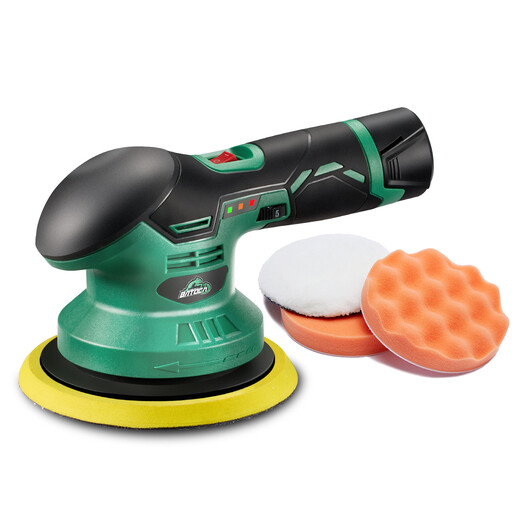
Why it suits this profile: This 12V model has six speed settings from 2500 to 5000 rpm, a 5 mm random orbit and a supplied 2.0Ah battery with charger. This makes it easy to operate if you are polishing car paintwork for the first time.
The six settings reduce the risk of immediately starting at a fixed, excessively high speed. According to the product description, the battery status is shown using three colour indicators.
12V, 2.0Ah battery, charger included, 5 mm eccentric movement and a weight of approximately 1.36 kg according to the product information.
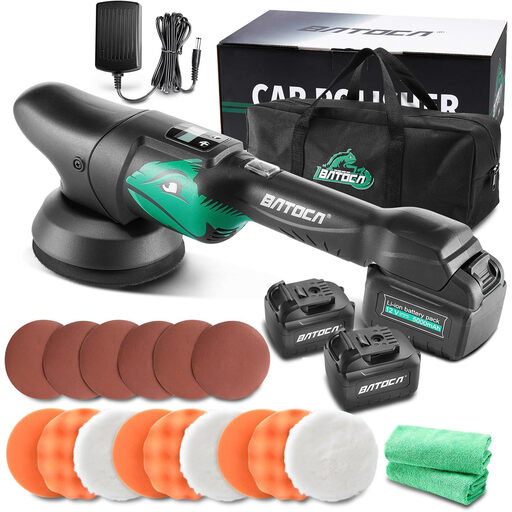
Why it suits this profile: This machine is designed for longer periods of use and has two 5.0Ah batteries, an LCD screen and a 125 mm polishing pad, according to the product description.
Two interchangeable batteries address the limited runtime of a single battery. The screen keeps the speed and battery status visible while you work.
Two 5.0Ah batteries, six speeds, LCD display and a stated charging time of approximately 2.5 hours.
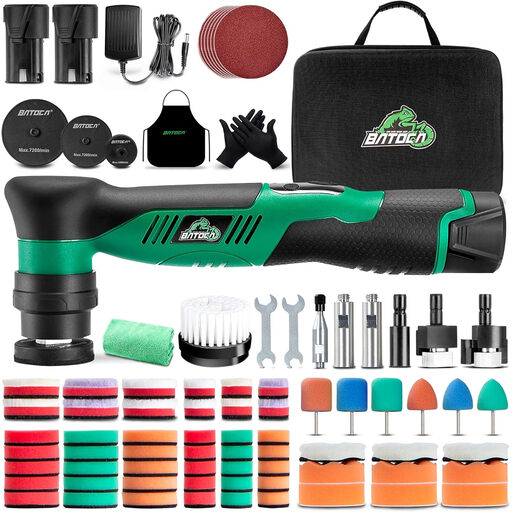
Why it suits this profile: According to the product information, this model switches between rotary, 3 mm orbit and 12 mm orbit. With plates measuring 25, 50 and 75 mm, it is designed for headlights, alloy wheels, badges and narrow bodywork sections.
The different drives and small plates prevent you from using a large backing plate on hard-to-reach surfaces.
Three movement modes, six settings from 2000 to 5500 rpm and two 12V 2.0Ah batteries.
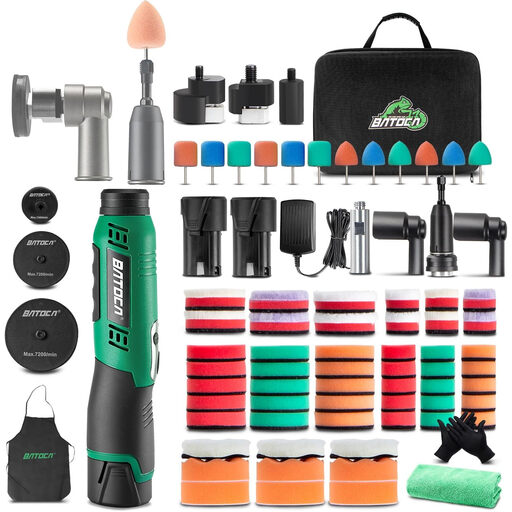
Why it suits this profile: According to the product description, the S6 combines DA and RO modes with a mini polishing head. This makes it suitable for detailers who mainly work on edges, alloy wheels, mirrors and other small areas.
The small plates and extensions are intended for areas where a standard car polisher is difficult to manoeuvre.
DA and RO functions, six speeds and two 12V 2.0Ah batteries; the stated mini speed reaches up to 21,000 rpm.
Never use a damaged pad or an accessory that does not fit the backing plate. For a small area, a mini car polisher may be more efficient; for large panels, a larger DA machine is often more practical.
We have put together a complete, up-to-date list of products that fully meet these strict selection criteria and the applicable European safety regulations.
A dual action or random-orbit model with adjustable speed is generally easier to get to grips with than a rotary machine. Always start at a low speed with a soft pad and a mild polishing compound.
This varies depending on capacity, speed, pressure and load. A 2.0Ah battery is compact, while 5.0Ah generally offers greater capacity. Manufacturers’ stated runtimes depend on the conditions of use and should not be treated as a fixed guarantee.
For a basic set, a medium foam pad and a soft finishing pad are a practical starting point. Smaller 25, 50 or 75 mm pads can be useful for detailing. Always check the diameter, attachment method and maximum speed before buying.
