
Vandaag of morgen in huis

Kwaliteit gegarandeerd

Welkomstaanbiedingen ontgrendelen: GRATIS bezorging | Tot 80% korting | Gratis 30 dagen JoyPlus-proefperiode
Download de app
A cordless car polisher is useful when you want to work on paintwork, wheels, headlights or hard-to-reach areas without an extension lead. However, many models look similar. A high speed, several settings or a large battery doesn’t automatically mean a machine is right for the job.
These common pitfalls can lead to the wrong purchase:
A random orbital polisher, also known as a DA polisher, moves the pad in an orbital pattern. This generally distributes heat more evenly. For many car owners, it’s a practical choice for waxing, treating light dull patches and general car paint polishing.
A rotary polisher spins around a fixed centre point. This can be useful for targeted work, but requires an even motion and suitable pressure. If you want to use both methods, consider a machine with interchangeable drive mechanisms.
Pay attention to the throw size. An orbit of, for example, 5 mm, 8 mm or 12 mm affects how the pad moves. A smaller throw is often better for detailed work; a larger throw may suit wider surfaces, depending on the pad and polish.
A practical car polisher has several speed settings. A low speed is useful for spreading wax or polish. A medium setting may suit general polishing. A higher setting isn’t automatically suitable for delicate paintwork.
A soft start helps reduce splashing when you apply the product to the pad and paintwork. A display or battery indicator can also help you keep a closer eye on the machine while you work. Always check the manual and test the machine on an inconspicuous area first.
A removable battery is useful if you have a large car or several vehicles. Check the following:
A complete car detailing polishing kit isn’t always better value than buying individual parts. Compare what’s in the box with what you actually need. Extra accessories are only useful if they’re compatible with the machine and suited to the work you’ll be doing.
Why it suits this user: This compact cordless car polisher is designed for smaller jobs and comes with two batteries, a charger and several pads.
The two speed settings, from 2600–7000 rpm, mean you’re not limited to one fixed setting. The European plug makes the included charger practical to use in the Netherlands.
According to the product description, the machine weighs 0.88 kg including the battery. The set contains two 2000 mAh batteries, six foam pads and a wool pad.
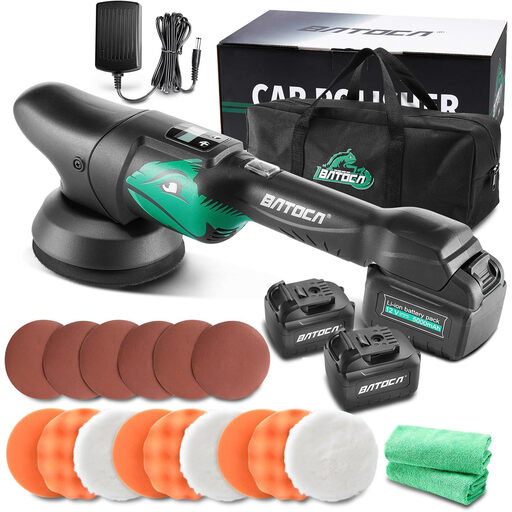
Why it suits this user: This cordless polisher is designed for larger areas of paintwork, thanks to its 125 mm pad and 8 mm random orbital movement.
The machine has six speed settings and an LCD display. This lets you adjust the setting more precisely than on a model with just an on/off switch.
According to BATOCA’s product description, the set includes two 5000 mAh batteries, with a stated runtime of around 60 minutes and a charging time of approximately 2.5 hours.
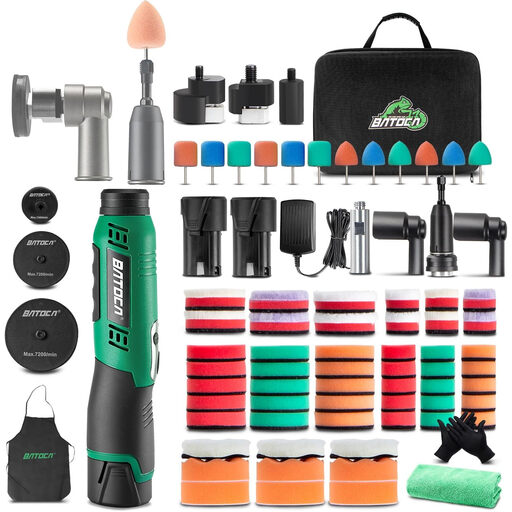
Why it suits this user: This mini car polisher is designed for badges, wheels, headlights and narrow areas where a large pad won’t work well.
According to the product description, the set combines rotary and random orbital action with several small backing plates. That means you’re not restricted to a single large pad size for every job.
The listed speed ranges are 1000–5000 rpm and 4200–21000 rpm. The set also includes two 12 V, 2.0 Ah batteries and 25, 50 and 75 mm backing plates.
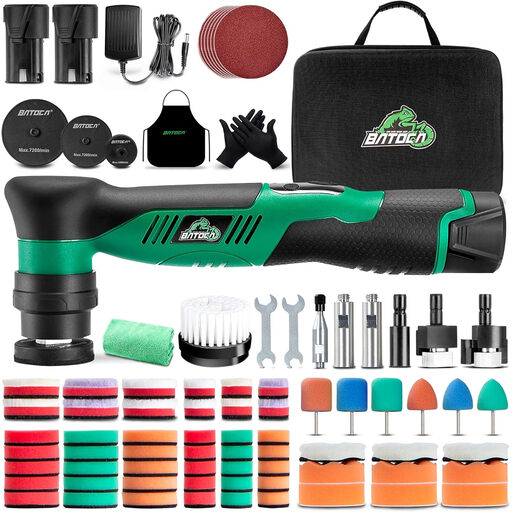
Why it suits this user: This cordless polisher combines detailed work with several drive options for different surfaces and areas.
The three drive options — rotary, 3 mm random orbital and 12 mm random orbital — reduce the need to use a separate machine for every detailing job.
The specifications list six speed settings from 2000–5500 rpm, two 12 V, 2.0 Ah batteries and 25, 50 and 75 mm backing plates.
Wash and dry the car first. Remove sand and dirt before placing a pad on the paintwork. Then work in small sections and use only as much polish as you need. Keep the pad flat against the surface and don’t apply heavy pressure.
When using a car scratch remover, first check whether the damage is superficial. Scratches you can feel, damage that reaches the primer or rust won’t disappear just by polishing for longer. Always test the product and pad on an inconspicuous area first. Wear suitable eye and skin protection, and follow the safety instructions for the machine and polish.
We’ve put together a complete, up-to-date list of products that meet these strict selection criteria and the applicable European safety regulations.
Often, yes, because it doesn’t simply rotate around a fixed centre point. This makes the machine easier for many users to control. Start at a low speed, with a soft pad and light pressure. The result also depends on the paintwork, polish and technique you use.
This varies by model and working conditions. The stated capacity in Ah is a guide, not a guaranteed runtime. According to the product description, the BATOCA S2 offers around 60 minutes of use with a 5.0 Ah battery, while the BATOCA S5 and S6 specify up to around 30 minutes without load with a 2.0 Ah battery. Actual runtime may be shorter under load.
As well as the purchase price, replacement pads, polish and any extra batteries are the main costs to consider. A set with several pads can make your first purchase more practical, but check that the sizes and firmness suit your car. Charge batteries according to the instructions and store them in a dry place to avoid unnecessarily reducing their lifespan.
