
Vandaag of morgen in huis

Kwaliteit gegarandeerd

Welkomstaanbiedingen ontgrendelen: GRATIS bezorging | Tot 80% korting | Gratis 30 dagen JoyPlus-proefperiode
Download de app
A cooking pot seems easy to choose, until you have to decide between stainless steel, cast iron, ceramic, a steamer insert or a model for one person. The wrong size can quickly end up unused in the cupboard. A base that is too thin distributes heat less evenly, while an impractical lid can make cooking more difficult.
In this buying guide from the Joybuy Product Recommendation Officer, you’ll discover what to look for in a cooking pot, braising pan, stock pot or multifunctional pan. The selection is based on verifiable product specifications, such as material, capacity, hob compatibility and included components.
A 24 cm cooking pot could be deep and spacious, but it could also be a shallower model with less capacity. Always check the capacity in litres, rather than looking only at the diameter. For one person, 1 to 2.5 litres can be practical. For a family, models of around 4 to 6 litres are often more useful. For a large stock pot, also consider how heavy it will be when full.
Induction requires a magnetic base. A pan intended only for gas and ceramic hobs will not always work on induction. Check whether the product description explicitly mentions induction. An induction cooking pot with a multi-layer or composite base can also distribute heat more evenly.
A stainless-steel cooking pot usually does not have a non-stick coating, while an enamelled cast-iron pan has an enamel coating over the cast iron. These are different properties. Stainless steel is generally resistant to acidic ingredients, but it can discolour if overheated. Enamel requires care to avoid knocks and sudden changes in temperature. Claims such as “healthy”, “chemical-free” or similar benefits are not automatically proven; check the stated materials and product information.
A compact 16 to 18 cm saucepan is suitable for milk, porridge, sauces or small portions. A 22 to 24 cm cooking pot is better suited to pasta, soup and meals for several people. For hotpot or entertaining, 26 cm or more can be useful. Consider the space available on your hob and in your dishwasher.
A cooking pot with a lid helps retain heat and moisture. A glass lid allows you to monitor the cooking process, but check the maximum temperature. If you want to prepare several dishes at once, you can choose a steamer pot with an insert. For oven use, the pan and lid must each be suitable; always check the stated temperature limit.
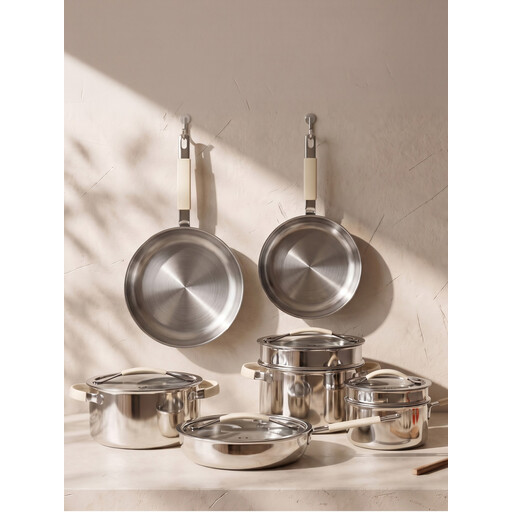
Why it suits this profile: The 18 cm diameter and compact design are ideal for small households, studio flats and anyone who mainly prepares milk, porridge, sauces or meals for one.
The product information clearly states the diameter and includes a steamer insert. This gives you a clearer idea of how it can be used than a pan that only specifies a general capacity.
304 stainless steel, glass lid, steaming and simmering functions, plus stated compatibility with gas, induction and ceramic hobs.
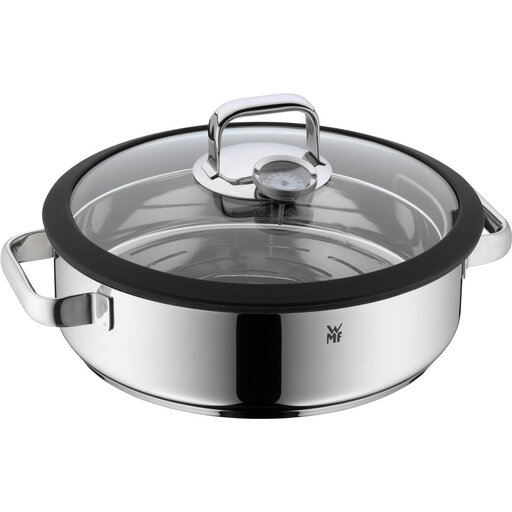
Why it suits this profile: Ideal if you want to combine steaming, braising and roasting in one pan. The pan has a diameter of 28 cm, a capacity of approximately 5 litres and a thermometer.
The product details specify separate oven limits: up to 180 °C with the lid and 250 °C without it. This makes it easier to check that your set-up is suitable.
18/10 stainless steel, induction base, steamer insert, glass lid and dishwasher-safe cleaning, except for the thermometer.
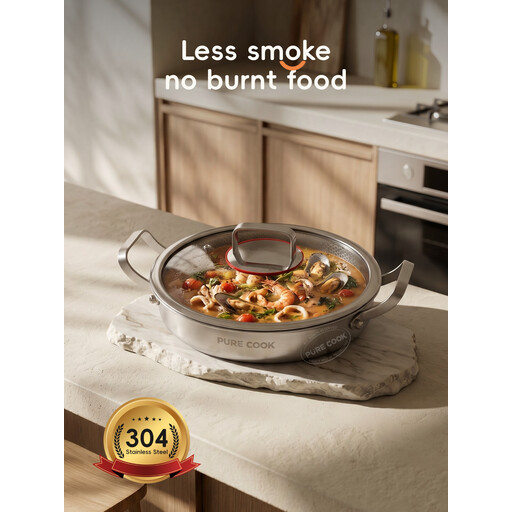
Why it suits this profile: According to the product specifications, this wide pan is designed for hotpot, soup, noodles, dumplings and meals for approximately 3 to 6 people.
The product description lists the base construction and hob compatibility separately. It also warns against overheating the empty pan and cooling it down suddenly.
304 stainless steel, 26 cm diameter, glass lid, dual handles, and suitable for gas, induction and ceramic cooking.
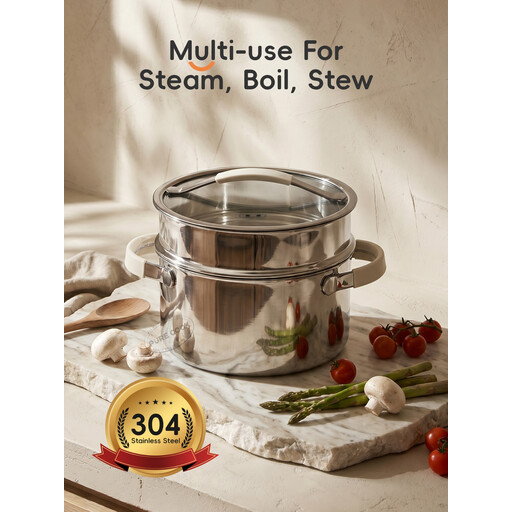
Why it suits this profile: According to the product information, this deep cooking pot is intended for 3 to 5 people and combines cooking and steaming in two layers.
The stated 24 cm size, serving capacity and included steamer insert give you a clear idea in advance of how practical it will be for everyday use.
Tri-ply composite base, glass lid, steaming rack, silicone handles, and use on gas, induction and ceramic hobs.
We’ve put together a complete, up-to-date list of products that fully meet these strict selection criteria and the applicable European safety regulations.
A PFAS-free cooking pot may be worth considering if you do not want a non-stick coating. However, check exactly what this means: a pan without an interior coating is different from one with a ceramic exterior. For baby food, a small saucepan or compact cooking pot with a steamer insert can be practical, but never leave a pan unattended while it is cooking.
Choose a model whose product information explicitly states induction compatibility. A magnetic composite base or a stainless-steel base with a magnetic layer is a common construction. If in doubt, check whether a magnet sticks to the underside, but always use the official product specifications as your guide.
For soup, pasta and stews for three to five people, a cooking pot of around 4 to 6 litres is often suitable. A 24 cm pan usually offers a practical mid-size option. If you regularly cook large quantities, you could consider a model of 8 to 10 litres, provided you have enough storage space and hob surface area.
Yes, an enamelled cast-iron pan can be used for stews, soup and oven-cooked meals. Bear in mind its greater weight, the need to heat it slowly and the importance of cooling it carefully. For quick cooking and easy lifting, a stainless-steel cooking pot is generally more practical.
