
Vandaag of morgen in huis

Kwaliteit gegarandeerd

Welkomstaanbiedingen ontgrendelen: GRATIS bezorging | Tot 80% korting | Gratis 30 dagen JoyPlus-proefperiode
Download de app
A new frying pan, sauté pan or cookware set may seem easy to choose at first glance. However, attractive marketing claims can hide important details. For example, a pan that appears suitable for induction may have a base that is too small. A ceramic pan may be PFAS-free but unsuitable for oven use. And a dishwasher-safe pan may lose its appearance more quickly with daily intensive cleaning.
With these practical selection tips, you can choose cooking pans that suit your hob, household and cooking style.
Always check whether induction, gas, electric, ceramic and halogen are listed separately. Induction requires a magnetic, flat base. Size also matters: a 28 cm pan may only partially cover a smaller induction zone, resulting in less even heat distribution.
A PFAS-free pan or ceramic pan can help you cook with less oil, but that does not mean the coating is indestructible. Sharp metal utensils, overheating and sudden cooling can shorten its lifespan. Also check whether the pan is dishwasher-safe and whether the manufacturer recommends hand washing.
With an RVS pan, also known as a stainless steel pan, there is usually no traditional non-stick coating. Cooking technique is therefore more important: heat the pan, add oil and only then place the food in the pan. Excessively high temperatures increase the risk of food sticking.
A pan with a lid is practical for simmering and slow cooking, but the lid may have a different temperature limit from the pan. Some models are not suitable for oven use at all. For example, the USELUCK ceramic cookware set states that it is not oven-safe, while various stainless steel models are suitable for oven use. Always check the product specifications and warnings before use.
The terms “non-toxic” and “safe” are not sufficient selection criteria on their own. Look for specific details, such as the stated material, coating and any applicable standards. According to the product information for various PURECOOK models, certain materials comply with, among others, GB 4806.9, FDA regulations or REACH. Such statements provide information about the stated product specification, but are not a reason to ignore other usage and care instructions.
For one or two people, a 20 to 22 cm frying pan is often practical for eggs, dumplings or a small portion of vegetables. For three to four people, 26 to 28 cm offers more space. A sauté pan with a higher rim is suitable for sauces, stews and one-pan meals.
A cookware set may seem cost-effective, but check that you will actually use every item. A set with several cooking pans makes sense for families preparing pasta, sauce and vegetables at the same time. If you mainly fry food, you may get more use from one large frying pan or wok with a lid.
Look out for three separate specifications:
A steamer has different requirements. According to the product information for the WMF Vitalis, a steaming insert, glass lid and thermometer are included. The pan is suitable for induction and oven use, but the thermometer is not dishwasher-safe.
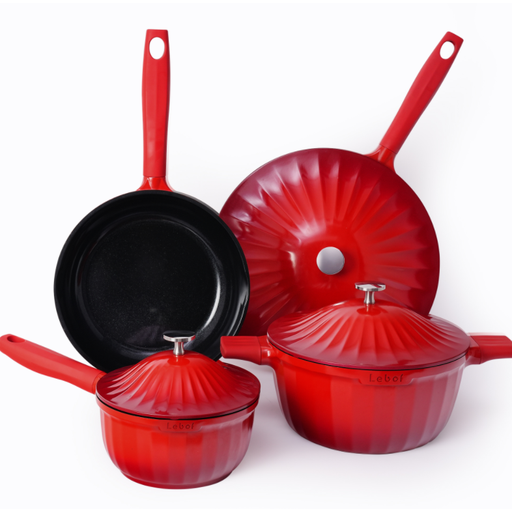
Why it suits this profile: This set contains two frying pans, two saucepans and a roasting pan with lids. This gives beginners several sizes for everyday cooking on all the listed hobs, including induction.
The product information states that it is PFAS-free, PFOA-free and PTFE-free. It also clearly states that the set is not oven-safe, so you can take this limitation into account.
7 pieces, ceramic coating, suitable for induction and dishwasher-safe according to the product description.
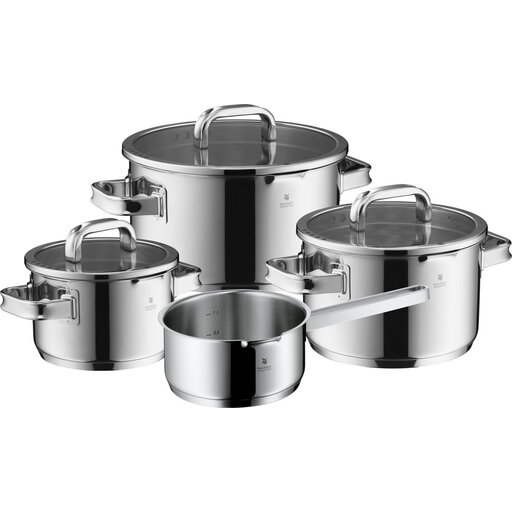
Why it suits this profile: This set is designed for households that combine different cooking tasks. It includes three cooking pans with glass lids and a saucepan, with capacities ranging from 1.4 to 5.7 litres.
The specifications explicitly state that it is suitable for induction, oven use up to 250 °C without the glass lid, and dishwasher use with hand-washing advice.
Stainless steel construction, TransTherm base, functional glass lids and four sizes for family cooking.
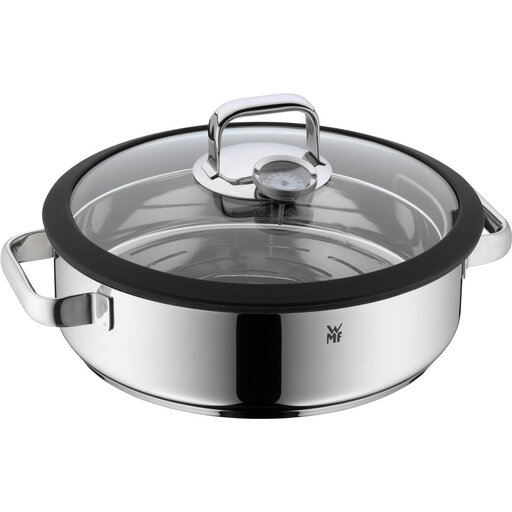
Why it suits this profile: This steamer is designed for users who want to combine steaming, braising and roasting in one pan. According to the specifications, it has a capacity of approximately 5 litres.
The oven limits are specified: up to 180 °C with the lid and up to 250 °C without the lid. It is also stated that the thermometer is not dishwasher-safe.
18/10 stainless steel, steaming insert, glass lid with thermometer, and compatibility with induction and other heat sources.
We have compiled a complete, up-to-date list of products that fully meet these strict selection criteria and the applicable European safety regulations.
Choose a pan that explicitly lists induction in its product specifications. A flat base with a sufficiently large contact area helps ensure even heat transfer. For a cookware set, check that every item is suitable for induction; this is not automatically the case for every piece.
Its lifespan depends on temperature, use and maintenance. Do not use sharp metal utensils, avoid heating an empty pan for extended periods and allow the pan to cool before washing it. A ceramic pan may be dishwasher-safe, but according to the product information, hand washing may be recommended to help preserve the coating for longer.
A stainless steel pan usually requires a little more attention to temperature and oil. Heat the pan evenly first, then add oil and allow the food to sear gently before turning it. In return, a stainless steel pan does not need a traditional non-stick coating and is often suitable for high temperatures.
