
Vandaag of morgen in huis

Kwaliteit gegarandeerd

Welkomstaanbiedingen ontgrendelen: GRATIS bezorging | Tot 80% korting | Gratis 30 dagen JoyPlus-proefperiode
Download de app
A cooker hood won’t automatically stop your kitchen smelling of fried food or fried onions. How well it works in practice depends on the model you choose, how it’s installed and the type of filter it uses. Renters, people living in flats and those with smaller kitchens often face the same challenges: no outlet to the outside, limited space above the hob, or a cooker hood that’s too noisy on its highest setting.
So when comparing models, don’t just look for high extraction capacity or an attractive design. Check the dimensions, noise level, filter and how the air is extracted too.
A cooker hood with external extraction can vent cooking fumes straight out of your home. But you’ll need a suitable duct, the right diameter and enough space behind or above the hood. In a rented home or flat, this type of connection may not be available or permitted.
With recirculation, air passes through a grease filter and usually a carbon filter. The cleaned air is then returned to the kitchen. A cooker hood with a carbon filter is therefore more flexible, but the filter needs to be cleaned or replaced regularly. Always check whether the carbon filter is included or needs to be bought separately.
A 60 cm cooker hood suits many standard hobs, but measure the available space and the distance to the cabinets beforehand. A 90 cm model can cover a wider cooking area more effectively, but it needs more wall space.
An integrated cooker hood fits underneath a kitchen cabinet and is practical when space is limited. A wall-mounted cooker hood often has a visible chimney and needs to be securely fixed to the wall. An angled cooker hood keeps the space above the hob clear, but check that you can meet the recommended installation height.
Noise levels are usually measured at different speeds. So check the maximum decibel level rather than relying on a general marketing claim. For comparison, the Ciarra Slimline lists a maximum of 61 dB, while the Ciarra angled hood with Wi-Fi controls is listed at 58 dB in the product information.
An energy label doesn’t tell you everything about day-to-day running costs either. Check the stated annual energy consumption, motor power and how often you’ll use the cooker hood. An energy-efficient cooker hood can be a good choice for everyday cooking, but lower energy consumption shouldn’t come at the expense of having enough extraction capacity for the way you cook.
Extraction capacity is measured in m³/h. A model rated at 180 to 220 m³/h may suit light everyday cooking in a small kitchen. For frequent frying or an open-plan kitchen, a higher figure could be useful. However, the stated capacity depends on the installation method, duct and selected speed.
If possible, switch the cooker hood on a few minutes before you start cooking and leave it running for a little while afterwards. This gives fumes and odours less chance to spread around the room.
A metal grease filter, often made of aluminium, traps grease particles. Check whether the filter can be removed and washed. The specifications for several Ciarra models list washable aluminium filters; the Ciarra Slimline comes with two.
Recirculation also requires a carbon filter. It traps odour particles, but has a limited lifespan. How often you need to replace it depends on how much you cook and the manufacturer’s guidance. Don’t let grease build up over time: it reduces performance and can create a safety risk.
A cooker hood with LED lighting illuminates the cooking area without the need for additional lights. Check how many brightness settings it has and whether you can control the lighting separately.
Mechanical push buttons are easy to use and respond reliably, even with damp or greasy fingers. Touch controls and app features offer more control, but add electronic components too. Also check which installation parts are included, whether the chimney height is adjustable and the recommended distance from the hob. For example, the COMFEE visor hood specifies an installation height of 650 to 750 mm.
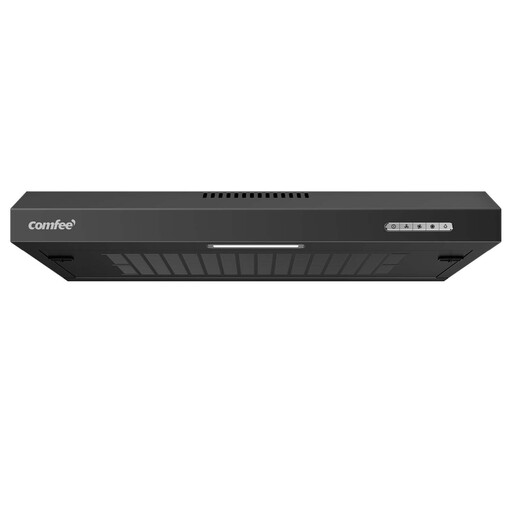
Why it suits this type of buyer: This 60 cm cooker hood is compact enough for a small kitchen and offers both external extraction and recirculation. Its three-speed controls are straightforward to use.
The product information lists two installation modes and a removable aluminium filter. For recirculation, the required cotton filter is sold separately, according to the description.
Stated airflow of 200 m³/h, LED lighting, three speeds and a stainless steel housing with a B energy rating.
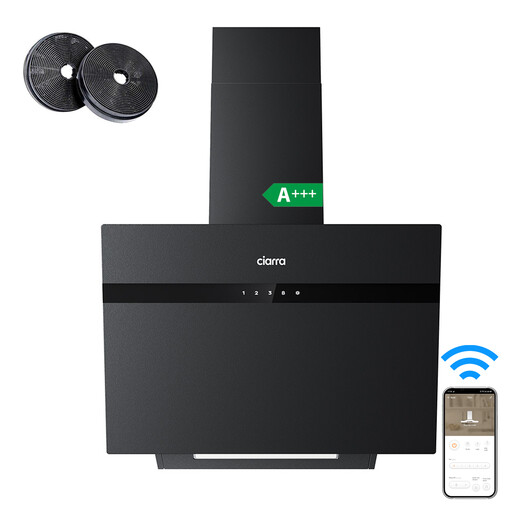
Why it suits this type of buyer: This angled cooker hood combines a modern look with app and Wi-Fi controls. It’s a good fit for a contemporary kitchen where you want to control the hood and lighting remotely.
The product details list both external extraction and recirculation. This lets you choose the installation method that suits your home, provided the dimensions and connection are right.
Stated airflow of 650 m³/h, maximum noise level of 58 dB, two LED brightness settings and an A+++ energy rating, according to the product listing.
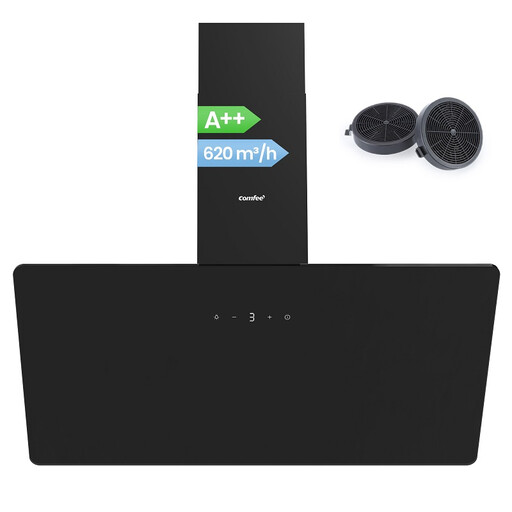
Why it suits this type of buyer: A 90 cm model provides wider coverage for larger cooking areas and frequent cooking. Its angled design keeps the space in front of your head clear.
The product listing specifies four speeds, a five-layer aluminium filter and support for both external extraction and recirculation. Be sure to check the available wall width first.
Stated airflow of 620 m³/h, noise level of 59 dB, touch controls and an A++ energy rating, according to the product information.
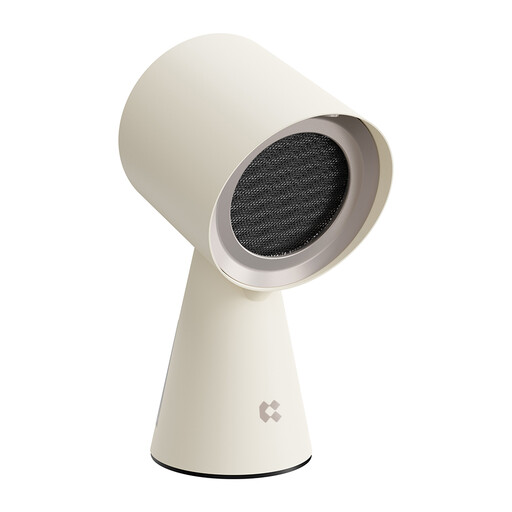
Why it suits this type of buyer: According to the product description, this compact recirculating model doesn’t need a wall duct or permanent installation. It’s designed for temporary cooking areas, studios and rented homes.
There’s no need to install an outlet to the outside. Bear in mind, though, that its stated airflow is lower, and clean the filters regularly.
Two speeds, compact size, stated maximum noise level below 65 dB and a reusable filter module.
We’ve put together a complete, up-to-date list of products that meet these strict selection criteria and current European safety regulations.
Not in every home. External extraction vents air straight outside, but requires a suitable duct and permission to make alterations. Recirculation is more practical in flats and rented homes. It’s important to keep the hood well maintained and replace the carbon filter when needed.
That depends on how often and how intensively you cook. Many product guides recommend cleaning the filter every two to four weeks. If you regularly deep-fry or stir-fry, you may need to clean it more often. Always follow the manufacturer’s maintenance instructions.
Running costs depend on the power rating, energy label, how long you use it for and the speed you select. So compare annual energy consumption in kWh, not just the energy label. LED lighting generally uses little power, but the motor accounts for a large part of the energy used while cooking.
