
Vandaag of morgen in huis

Kwaliteit gegarandeerd

Welkomstaanbiedingen ontgrendelen: GRATIS bezorging | Tot 80% korting | Gratis 30 dagen JoyPlus-proefperiode
Download de app
A cooker hood should be compatible with your hob, kitchen layout and ventilation options. However, when buying one, people often focus on its appearance or a high extraction rate. This can lead to choosing a model that's too noisy, doesn't fit properly in the cabinet, or isn't suitable for recirculation without extra parts.
This practical guide will help you focus on the specifications that really make a difference in a typical kitchen. Afterwards, you'll find some popular choices for different living situations and cooking habits.
A figure like 580 or 768 m³/h sounds straightforward, but it doesn't tell the whole story. The actual performance also depends on the length and diameter of the ducting, any bends in the pipe, the fan speed you select and how it's installed.
With ducted extraction, cooking fumes are vented outside. With recirculation, the air passes through a grease filter and usually a charcoal filter before it's released back into the room. A model that supports both options offers flexibility, but always check whether charcoal filters are included or need to be purchased separately.
A 60 cm cooker hood is suitable for many standard hobs, but the exact width varies between models. For example, one Ciarra wall-mounted model is 595 mm wide, while another might be exactly 600 mm. For an integrated cooker hood, the internal dimensions of the kitchen cabinet and the cut-out are also crucial.
Therefore, you should measure:
For installation, always follow the manual and the specified minimum distance. Different installation heights may apply for gas, electric and induction hobs.
A cooker hood with a low noise level on its first setting can be significantly louder on its intensive or boost mode. Therefore, don't just look at a single dB rating; check the values for each fan speed if they are available. This is especially important for an open-plan kitchen or a flat.
A wall-mounted cooker hood is fitted to the wall above the hob. An angled model can leave your cooking area feeling more open, while a traditional T-shaped model often has a larger horizontal filter surface.
An integrated cooker hood is built into an overhead cabinet, creating a seamless, minimalist look. Before you buy, check that the cabinet is suitable for the appliance's height, depth and mounting points.
An under-cabinet cooker hood is mounted beneath a cabinet. This is a practical choice for kitchens with limited cabinet space, rental properties or compact layouts. The extraction rate of slimline models is often lower, which can be noticeable if you do a lot of wok cooking or frying.
For a kitchen with an external vent, a ducted cooker hood is the logical choice, provided your setup is suitable for it. In a flat or a home without a usable vent, a recirculating cooker hood offers more flexibility.
Pay attention to these points:
A washable aluminium grease filter reduces running costs, but it must be cleaned regularly. Ciarra's product information advises doing this every two to four weeks, depending on use.
You can't identify a quiet cooker hood by marketing terms alone. Always check the stated dB values. The Ciarra CBCB6765B lists a maximum of 64 dB, while the Ciarra CBCS6201 specifies a maximum of 63 dB. These are verifiable product specifications; the perceived noise level can vary depending on installation and your kitchen's acoustics.
An energy-efficient cooker hood will have a good energy rating and a low stated annual consumption. The CBCS6201 has an A++ energy rating and an annual consumption of 9 kWh. The CBCB6765B is rated A+ with 16 kWh per year. Compare these values in the product information and consider how often you'll be using it.
The controls are a matter of practical choice. Touch controls suit a sleek glass front, while push buttons or a rocker switch are simple and direct. A cooker hood with LED lighting can provide extra illumination for your cooking surface, but also pay attention to the number of lights and their placement.
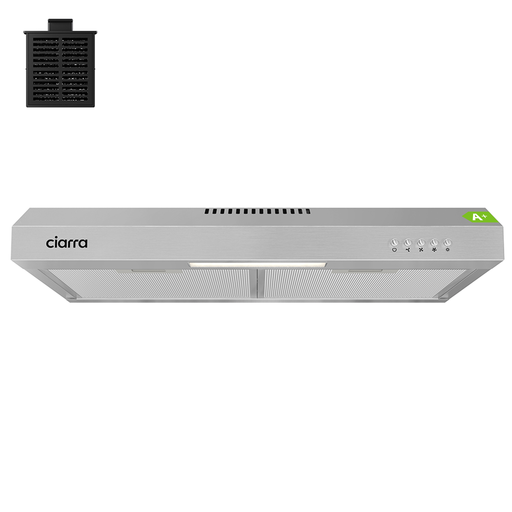
Why it's a good match: This compact model is designed for tight spaces and features push buttons for the fan and lights. Its stated width is 596 mm.
The specifications list both ducted extraction and recirculation, so you can check in advance which installation method suits your kitchen.
A+; max. 184 m³/h; two washable aluminium filters; dimensions of 596 × 440 × 85 mm.
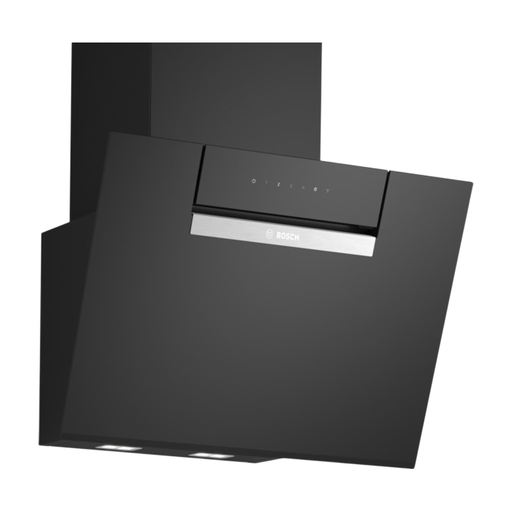
Why it's a good match: This black glass wall-mounted hood combines touch controls, LED lighting and a stated extraction rate of 768 m³/h.
The product information mentions four speeds, a dishwasher-safe metal filter and a maximum noise level of 56 dB.
A+; LED lights; 150 mm ducting diameter; suitable for recirculation according to the product specifications.
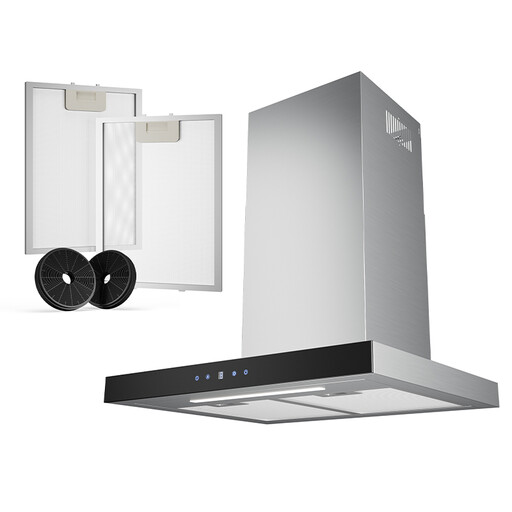
Why it's a good match: This 60 cm stainless steel cooker hood is aimed at users who want multiple speeds, a digital display and a high stated airflow.
Both ducted extraction and recirculation are listed. The included charcoal filter set also prevents surprises when installing it without an external vent.
611 m³/h; A++ energy rating; LED lighting; five-layer aluminium grease filter; digital controls.
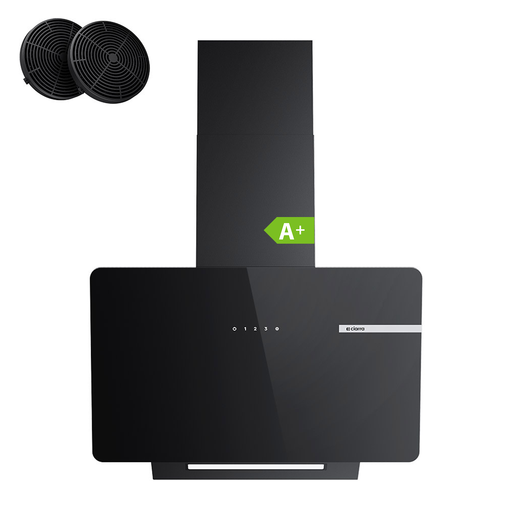
Why it's a good match: According to the product description, the angled design keeps the cooking area clear. The model supports both recirculation and ducted extraction.
The specifications mention a washable metal filter, touch controls and an adjustable height from 633 to 900 mm.
580 m³/h; A+; max. 64 dB; LED lighting; two-year stated warranty.
We have compiled a complete, up-to-date list of products that fully meet these strict selection criteria and comply with current European safety regulations.
Before ordering, check that your chosen cooker hood can be connected to a suitable electrical socket and that the fittings are compatible with your wall or cabinet. For ducted extraction, the ducting should be as straight and short as possible. Do not block any air outlets, and if in doubt, have the installation carried out by a qualified professional.
Clean the grease filter according to the manual. A dirty filter reduces airflow and can be a safety hazard. If you are using recirculation, check the charcoal filter regularly. A washable grease filter doesn't automatically mean that all the filters are reusable.
Ideally, the cooker hood should be at least as wide as your hob. For a standard hob of around 60 cm, a 60 cm model will often fit, but you should always measure the exact dimensions of the hob, the recess and the mounting space.
That depends on your home. Ducted extraction vents moisture and odours outside but requires suitable ducting. Recirculation is easier to install in flats or kitchens without an external vent, but it requires maintenance and timely replacement of the charcoal filter.
The lifespan depends on usage, installation and maintenance. Clean the grease filters regularly, use the appropriate fan speed and follow the maintenance instructions. If you cook frequently, also check the fan, lighting and connections for wear and tear.
