
Vandaag of morgen in huis

Kwaliteit gegarandeerd

Welkomstaanbiedingen ontgrendelen: GRATIS bezorging | Tot 80% korting | Gratis 30 dagen JoyPlus-proefperiode
Download de app
A new cooker hood needs to suit your hob, kitchen layout and ventilation setup. Yet many shoppers focus mainly on appearance or a high extraction rate. This can lead to a model that doesn’t fit properly, makes too much noise or needs extra parts to install.
As a Joybuy Product Recommendation Officer, I’ve picked out the key product specifications and set the most common pitfalls alongside practical options for UK kitchens.
A high maximum extraction rate sounds appealing, but it doesn’t tell you everything about day-to-day use. Check the noise level, the available settings and whether the stated extraction rate applies to normal or intensive operation. A cooker hood that only performs well on its highest setting may be noisier than expected in practice.
Also check the unit of measurement. Extraction rate is usually given in m³/h. If a product specification uses a different unit, check the manual or ask the seller to clarify.
With extraction to the outside, cooking fumes are carried outdoors through a duct. With recirculation, the air passes through grease and carbon filters before flowing back into the kitchen. A recirculating cooker hood can be useful when there’s no extraction duct, but carbon filters are often needed and must be replaced according to the instructions.
So, before buying, check whether the required filter kit is included. For example, a recirculation kit isn’t included with the Siemens LC91KLT60. Other models may also need an optional kit.
A 60 cm cooker hood won’t necessarily fit every kitchen cupboard. Measure the available width, height and depth, and check the diameter of the extraction duct. Many models use a 150 mm connection, but your existing kitchen may be set up differently.
For a wall-mounted cooker hood, you’ll also need to consider the distance from the hob. Always follow the installation manual and the requirements for your type of hob. Gas hobs often need a greater minimum clearance than electric hobs.
A 60 cm cooker hood suits many standard hobs and compact kitchens. A 90 cm cooker hood provides a wider capture area and is often a better fit above a wide hob or in an open-plan kitchen. Ideally, the hood shouldn’t be narrower than the cooking surface.
A black cooker hood works well with dark appliances and modern kitchens. Stainless steel models often blend in better with light-coloured kitchen doors. Look beyond the material, too: consider how visible fingerprints and grease will be.
For semi-integrated models, also measure the cupboard structure and the clearance around the motor. A telescopic cooker hood can save space, but it needs a suitable cupboard and proper ventilation.
A quiet cooker hood is often described as having a low decibel rating. When comparing models, check the noise levels at the same setting. A figure for the lowest setting can’t be directly compared with one for intensive use.
An energy-efficient cooker hood has a good energy rating and a low stated annual energy consumption. Your actual costs will also depend on how often and for how long you use the motor and lights.
A model with touch controls is easy to wipe clean, while buttons offer tactile control. A cooker hood with LED lighting can direct light onto the cooking surface; check whether the lights are dimmable or replaceable.
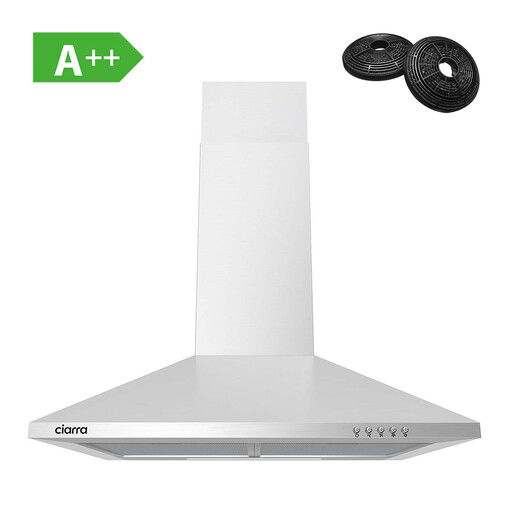
Why it suits this type of user: This 60 cm model is designed for standard cooking areas and offers both extraction to the outside and recirculation. Its push-button controls are straightforward for everyday use.
The product specifications clearly state the width, three settings and both ventilation options. This makes it easier to plan the installation in advance.
Stated maximum noise level of 63 dB, washable aluminium filters and a stated A++ energy rating.
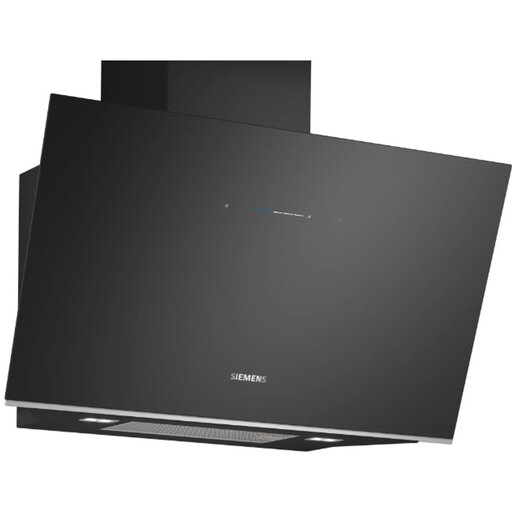
Why it suits this type of user: This 90 cm black wall-mounted cooker hood suits a spacious or open-plan kitchen and has an angled design. According to the product specifications, it features touch controls, LED lighting and Home Connect.
The product is listed as suitable for both extraction to the outside and recirculation. Check in advance whether you’ll need to buy a separate recirculation kit.
Stated A+ energy rating, maximum stated extraction rate of 1007 m³/h and a 150 mm connection.
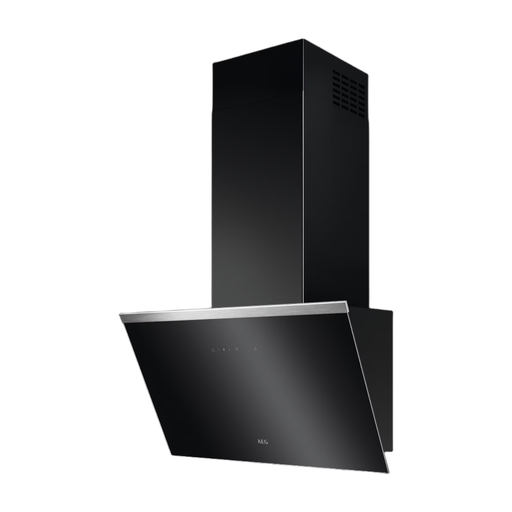
Why it suits this type of user: This 90 cm wall-mounted cooker hood has several settings, including an intensive setting. It’s a good match for cooking with several pans or using a wide hob.
The specifications distinguish between extraction to the outside and recirculation, and list different noise levels. This helps set realistic expectations about how loud it will be.
Stated extraction rate of up to 710 m³/h on the intensive setting, A energy rating and two LED lights.
We’ve put together a complete, up-to-date list of products that meet these strict selection criteria and the applicable European safety requirements.
Ideally, choose a cooker hood that’s at least as wide as your hob. A 60 cm model is common for a standard hob. For an 80 or 90 cm hob, a wider hood can provide a larger capture area.
Recirculation is practical when extracting air to the outside isn’t possible. You’ll need suitable carbon filters and must maintain or replace them according to the manual. Also check whether the filter kit is included as standard with your chosen model.
Clean the metal grease filters regularly, following the manual. Some filters are dishwasher-safe, while others need to be cleaned by hand. Wipe the outside with a soft, damp cloth and don’t use abrasive products. Switch off and unplug the appliance before carrying out any maintenance.
