
Vandaag of morgen in huis

Kwaliteit gegarandeerd

Welkomstaanbiedingen ontgrendelen: GRATIS bezorging | Tot 80% korting | Gratis 30 dagen JoyPlus-proefperiode
Download de app
A cooker hood should suit your hob, kitchen layout and ventilation setup. Yet many shoppers focus mainly on its appearance or a high extraction rate. As a result, a cooker hood can disappoint in practice: it may be too noisy, difficult to install or unsuitable for recirculation.
There are three common pitfalls to watch out for, especially in flats, rented homes and small kitchens:
A cooker hood is usually about the same width as the hob. A 60 cm cooker hood will often suit a standard 60 cm hob, while a 52 cm model may be a better fit for a more compact kitchen. Measure the depth and available height as well as the width.
The main installation types are:
Also check that there’s enough space between the hob and cooker hood. Always follow the manufacturer’s installation instructions and the requirements for your type of hob.
A ducted cooker hood carries cooking fumes outside through a duct. This can be effective, but it requires suitable ducting. Check the duct diameter, total length and number of bends. A long or narrow duct can restrict airflow and create extra noise.
A recirculating cooker hood doesn’t vent air outside. Instead, air passes through a grease filter and usually a carbon filter before being returned to the kitchen. This is practical for flats and homes without existing ducting, but the filter needs to be cleaned or replaced according to the product instructions.
Check the difference between:
The 52 cm Ciarra CBCB5913A-B supports both ventilation methods, but according to the product information, the CBCF005 carbon filter is sold separately. The 60 cm Ciarra CBCB6102-B is listed as including two CBCF003 filters.
The extraction rate is measured in m³/h. A small kitchen where you do light cooking will usually have different requirements from an open-plan kitchen where you often fry or stir-fry. Also check the noise level in dB. Where possible, compare both the lowest and highest settings: even a quiet cooker hood can become noticeably noisier at full power.
The energy rating and annual energy consumption are also useful points of comparison. For example, the product specifications in this article list:
Don’t use the energy rating as your only buying criterion. An energy-efficient cooker hood that doesn’t suit your kitchen or ventilation setup may still be an impractical choice.
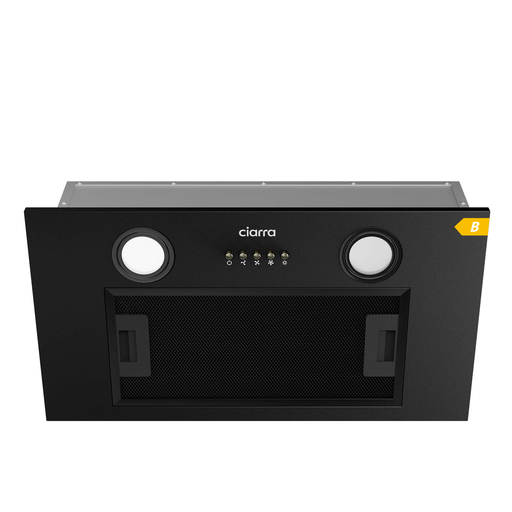
Why it suits this type of buyer: Its compact integrated design suits a smaller kitchen or a hob around 52 cm wide. Push-button controls keep things simple.
The product information clearly states that both ducted extraction and recirculation are possible. Bear in mind that the carbon filter is sold separately.
52 cm wide, washable aluminium grease filter, LED lighting and three speeds, with a maximum airflow of 206 m³/h.
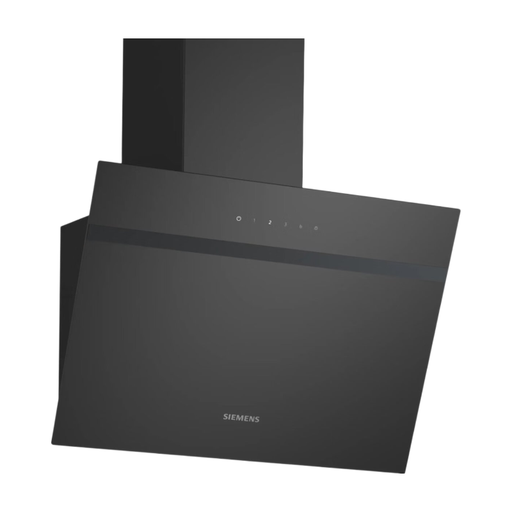
Why it suits this type of buyer: This angled wall-mounted model combines touchControl with filter reminders and LED lighting, making it a good choice if you’re looking for added convenience.
The product specifications mention a grease-filter cleaning indicator and a carbon-filter reminder. The carbon filter isn’t listed as included.
59 cm wide, up to 430 m³/h, three speeds, dishwasher-safe filter and up to 60 dB according to the product information.
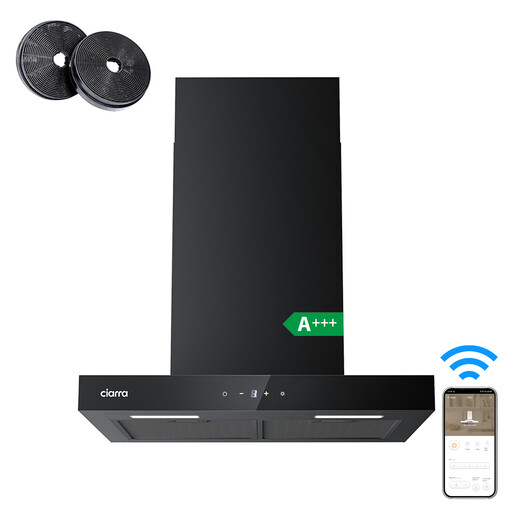
Why it suits this type of buyer: This wall-mounted cooker hood is designed for more intensive cooking, with three speeds and a boost function. App control can be handy in an open-plan kitchen.
The product description lists both recirculation and ducted extraction, and says that two CBCF003 carbon filters are included. Check which configuration you’ll use before installation.
600 mm wide, up to 650 m³/h, energy rating A+++, up to 59 dB, with touch, Wi-Fi and app controls according to the product specifications.
We’ve put together a complete, up-to-date list of products that meet these strict selection criteria and current European safety regulations.
Clean the metal grease filter regularly. The product instructions for several models recommend cleaning it roughly every two to four weeks, depending on how often you use the hood. A saturated filter can restrict airflow and make the hood noisier.
If you use recirculation, you’ll also need to check the carbon filter. Only use the filter type designed for your model. Switch off the power before removing the filter or carrying out any maintenance. If you’re unsure about the electrical connection, wall mounting or distance from the hob, it’s best to have the hood installed by a qualified professional.
Not necessarily. Ducted extraction can be a practical choice if there’s already suitable ducting to the outside. Recirculation is often easier in a flat or rented home, but the filters need to be maintained properly and the carbon filter will usually need replacing periodically.
Its lifespan depends on how it’s used and maintained, how it’s installed and the quality of its components. Clean the grease filter regularly, keep the air outlet clear and follow the manufacturer’s instructions. The models listed in this guide have a 24-month warranty or a statutory warranty, according to the product information.
Annual energy consumption varies by model and how long you use it for. A model with a good energy rating may have lower annual consumption according to its specifications, but using it frequently on the highest setting will increase energy use. So compare both the energy rating and the stated kWh-per-year figure.
