
Vandaag of morgen in huis

Kwaliteit gegarandeerd

Welkomstaanbiedingen ontgrendelen: GRATIS bezorging | Tot 80% korting | Gratis 30 dagen JoyPlus-proefperiode
Download de app
Choosing a new cooker hood might seem simple—until you dive into the specifications. The market is filled with models that promise impressive figures and features but often disappoint in practice. Many homeowners fall into the same traps, leading to a noisy kitchen, lingering cooking odours, or an appliance that doesn't suit their cooking style.
Before you make a decision, it's helpful to know the most common missteps:
To avoid a bad purchase, focus on a few objective criteria. These specifications determine how well a cooker hood will function in your kitchen.
The required capacity depends on the size of your kitchen. A simple guideline is to multiply your kitchen's volume (length x width x height in metres) by 10. This gives an estimate of the required capacity in cubic metres per hour (m?/h).
A model with multiple speed settings gives you the flexibility to adjust the power to what you're cooking, without constantly running it at full blast.
The cooker hood should be at least as wide as your hob. The most common sizes are 60 cm cooker hood and 90 cm cooker hood. The installation type determines the aesthetic of your kitchen:
A quiet cooker hood significantly enhances comfort. Pay attention to the noise level in decibels (dB) on the most frequently used setting.
Also, check the energy label. An energy-efficient cooker hood with a class A+ rating or higher consumes significantly less power, which saves money in the long run.
Based on these objective criteria, we have selected several models that suit different user profiles and kitchen layouts.
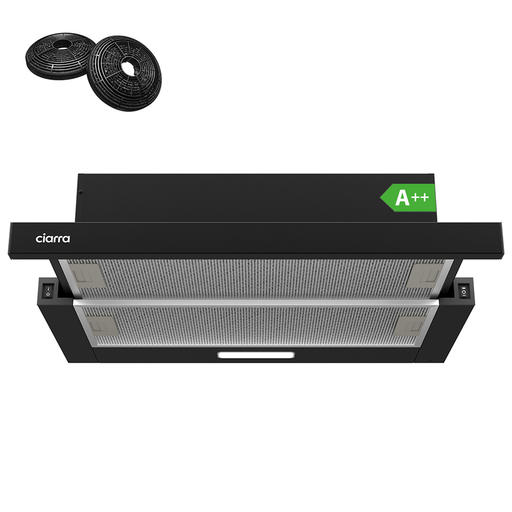
Why This Fits You: Ideal for those who are space-conscious. This telescopic under-cabinet model can be retracted when not in use, making it perfect for smaller kitchens, studios, or rental properties where a large chimney hood is not desirable.
This model solves the 'wrong type' trap by supporting both ducted and recirculating modes. Its 370 m?/h capacity is more than sufficient for a compact space, avoiding the overkill of a too-powerful model.
Space-saving telescopic design; Memory function remembers the last-used settings; Energy Class A++.
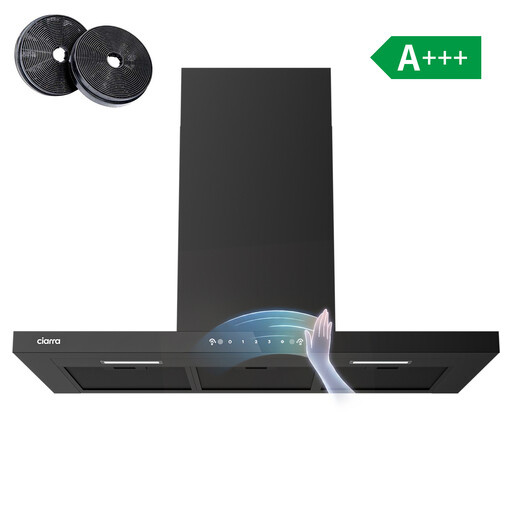
Why This Fits You: For those who see the kitchen as a living space and value aesthetics. The ultra-slim 40mm glass panel and modern controls make this a statement piece that fits into a sleek, open-plan kitchen.
Tackles the 'noise' trap. Despite its powerful 650 m?/h capacity, the noise level is limited to 59 dB. The A+++ energy class makes it a highly energy-efficient cooker hood, ensuring design doesn't come at the expense of efficiency.
Ultra-slim black cooker hood glass panel; Hygienic Wave & Touch controls; Highly energy-efficient (A+++).
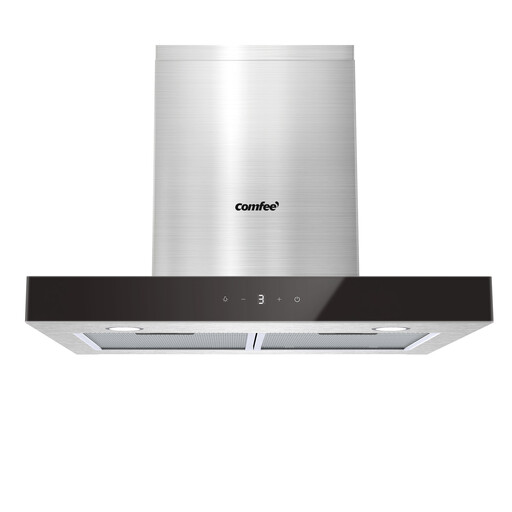
Why This Fits You: For the practical buyer seeking a reliable, powerful, and durable solution. This T-shaped model combines a high capacity with an efficient motor and a robust stainless steel cooker hood design, ideal for a standard family kitchen.
Offers a high capacity (650 m?/h) that is easily controlled with 4 speed settings, thus avoiding the 'overkill' trap. The A+++ BLDC motor ensures powerful performance without a high energy bill.
Powerful and energy-efficient A+++ motor; Convenient Gesture Control; Reusable 5-layer aluminium filter.
We have compiled a complete, up-to-date list of products that meet these selection criteria and applicable regulations.
This depends on the filter type and how intensively you cook.
A ducted cooker hood captures cooking fumes and expels them outside through a duct. This is the most effective method for removing moisture and odours. A recirculating cooker hood filters the air through a grease filter and a carbon filter, then blows the clean air back into the kitchen. This type is easier to install as it doesn't require an external duct, making it a popular choice for apartments.
A quiet cooker hood produces sound below 60 decibels (dB) on a normal, frequently used setting. To put this into perspective, a normal conversation is about 60 dB. Always check the specifications for the noise level at various settings, not just the lowest one, to get a realistic idea of the sound output during cooking.
