
Vandaag of morgen in huis

Kwaliteit gegarandeerd

Welkomstaanbiedingen ontgrendelen: GRATIS bezorging | Tot 80% korting | Gratis 30 dagen JoyPlus-proefperiode
Download de app
A cooker hood needs to suit your hob, kitchen layout and cooking habits. Yet when buying one, people often focus mainly on its appearance or maximum extraction rate. This can lead to disappointment in a small rented kitchen, an open-plan living space or a modern kitchen.
The three most common pitfalls are:
A 60 cm cooker hood is a popular choice for compact kitchens and standard hobs. A 90 cm cooker hood offers a wider capture area and can be practical above a wide hob or in an open-plan kitchen. Check more than just the width. Also consider:
A wall-mounted cooker hood is fixed to the wall. An island cooker hood hangs above a kitchen island and requires a sturdy ceiling structure. This is not always permitted or practical in a rented home.
With a ducted cooker hood, steam and cooking fumes are carried outside through a duct. This requires a suitable opening, a duct of the right diameter and enough space behind or above the hood. Sharp bends and long ducts can affect airflow.
A recirculating cooker hood filters the air and blows it back into the kitchen. This is useful when drilling or making changes to the outside wall is not possible. Carbon filters need to be maintained or replaced in line with the product instructions. Metal grease filters are often washable; check this for each model.
A quiet cooker hood is especially welcome in an open-plan kitchen. Compare the stated noise level at the highest setting, but also check the figures for the regular settings. In everyday use, a model rated at 59 dB on maximum may feel different from one that only gives a low figure for its lowest setting.
Also consider:
Touch controls are easy to wipe clean, while push buttons can be practical if you prefer direct, mechanical controls. A cooker hood with Wi-Fi may offer app control, but check that this feature really suits your daily routine.
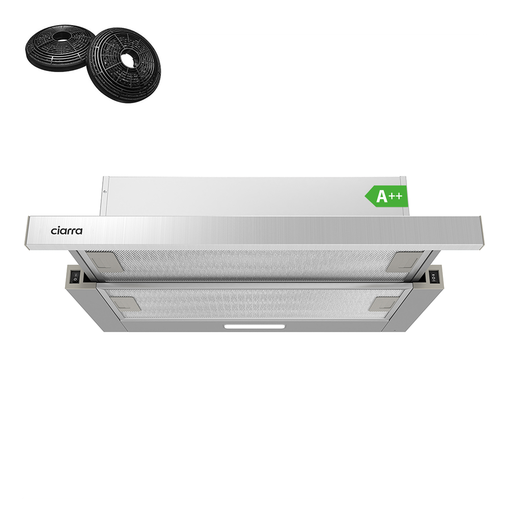
Why it suits this profile: The telescopic design can be fitted beneath a kitchen cabinet and takes up little visible space when not in use. The specifications list 370 m³/h, A++ and a maximum noise level of 61 dB.
The product description lists both ducted extraction and recirculation, as well as included carbon filters. This makes the available installation options clearer from the outset.
60 cm wide, two speeds, LED lighting, two washable aluminium filters and energy class A++.
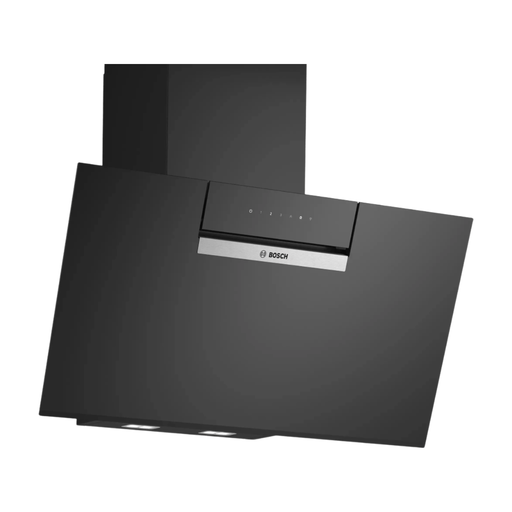
Why it suits this profile: This wall-mounted model is 80 cm wide and, according to the product specifications, offers app control, Home Connect, three settings and an intensive setting. It’s a good fit if you want to tailor the controls and settings to a modern kitchen.
The stated figures distinguish between regular extraction and the intensive setting: 431 m³/h on regular and 768 m³/h on intensive. The noise levels are also listed: 56 dB on regular and 68 dB on intensive.
A+, dishwasher-safe aluminium grease filter, LED lighting with adjustable colour temperature, and a choice of external extraction or recirculation.
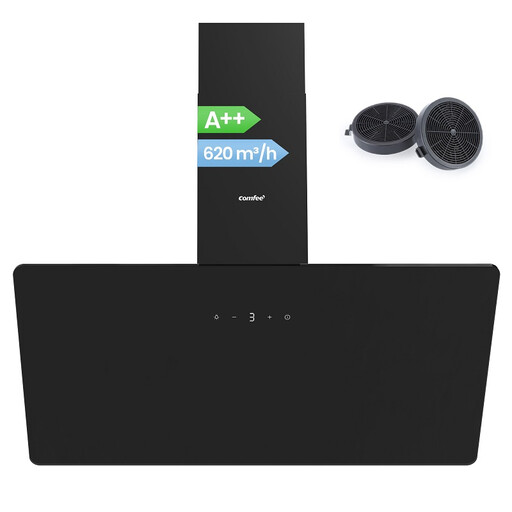
Why it suits this profile: This 90 cm-wide angled cooker hood is designed for larger cooking areas and more intensive cooking. The product specifications list four speeds, 620 m³/h and 59 dB.
The specifications bring together extraction rate, noise level and ventilation mode. So you don’t have to rely on the highest m³/h figure alone.
90 cm wide, A++, four settings, and support for both external extraction and recirculation.
Before buying, check that the wall, cabinet or ceiling is suitable for installation. Always follow the installation instructions and keep to the specified distance from the hob. If you’re unsure about the electrical connection, wall fixings or duct outlet, it’s best to use a qualified installer.
Clean metal grease filters regularly; product manuals often recommend doing so every few weeks, depending on use. Wipe the outside with a soft cloth and avoid abrasive cleaning products. Switch off the power before carrying out any maintenance.
We’ve put together a complete, up-to-date list of products that fully meet these strict selection criteria and the applicable European safety regulations.
It depends on your kitchen. External extraction carries air straight outside, but requires a suitable duct. Recirculation is more flexible in flats and rented homes, but requires good filter maintenance and carbon filter replacement in line with the instructions.
Its lifespan depends on use, cleaning, installation and maintenance. A washable metal grease filter may last longer than a disposable filter, but the motor, lighting and electronics also affect the lifespan. Check that replacement filters are available before you order.
A higher energy class and a low stated annual energy consumption can help limit energy use. Actual consumption depends on the speed setting, how long you use the hood and whether you use the boost function. Choose an appropriate setting and avoid leaving the hood running for longer than necessary.
