
Vandaag of morgen in huis

Kwaliteit gegarandeerd

Welkomstaanbiedingen ontgrendelen: GRATIS bezorging | Tot 80% korting | Gratis 30 dagen JoyPlus-proefperiode
Download de app
Buying a new cooker hood seems simple, until you have to choose between a wall-mounted hood, angled hood, under-cabinet model or a recirculating cooker hood. Marketing copy often focuses on design, “powerful” motors and smart features. In practice, it’s the dimensions, installation and maintenance costs that determine whether a model will work well in your kitchen.
Here are some common pitfalls to watch out for:
First, measure your hob, the available wall space and the distance to the ceiling. A 60 cm cooker hood suits many standard hobs. A 90 cm cooker hood provides a larger capture area and may be suitable for a wider cooking zone.
Also check:
The installation height varies by model. For example, the COMFEE’ Visor specifies a height of between 650 and 750 mm. Always follow the manual and local installation regulations. Gas hobs often require different clearances from electric hobs.
Capacity is usually given in m³/h. A compact kitchen may be fine with a lower airflow rate, while an open-plan kitchen or more intensive cooking habits may call for greater capacity. Don’t just look at the maximum setting; check the noise level during everyday use too.
A quiet cooker hood is particularly useful in an open-plan kitchen. Check the dB rating and whether it applies to the normal or intensive setting. For example, the Ciarra 60 cm wall-mounted cooker hood with push buttons has a maximum airflow of 367 m³/h and a noise level of 63 dB. The Ciarra with Wi-Fi and app control has a maximum airflow of 650 m³/h and a noise level of 59 dB. These figures come from the product information; actual performance may depend on the installation, exhaust duct and kitchen layout.
A washable aluminium grease filter helps reduce ongoing costs and can be cleaned regularly. Recirculating models also need a suitable carbon filter. Check whether it’s included or needs to be bought separately.
You can identify an energy-efficient cooker hood by its energy label and stated annual energy consumption. Compare both figures: a model with more features or a higher capacity may use a different amount of energy. LED lighting is handy for illuminating the cooking area, but also check the number of lights, their brightness and whether they’re dimmable.
Controls include:
Wi-Fi is no substitute for effective ventilation or regular filter maintenance.
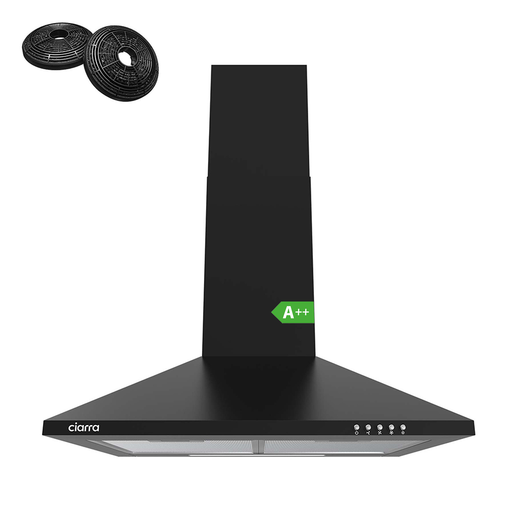
Why it suits this profile: A straightforward wall-mounted cooker hood for a standard cooking zone, with mechanical push-button controls and two installation options.
The product information lists both ducted extraction and recirculation. The two washable aluminium filters help cut down on repeat filter purchases, although they still need regular cleaning.
60 cm wide, three speeds, maximum airflow of 367 m³/h, A++ energy rating and integrated lighting.
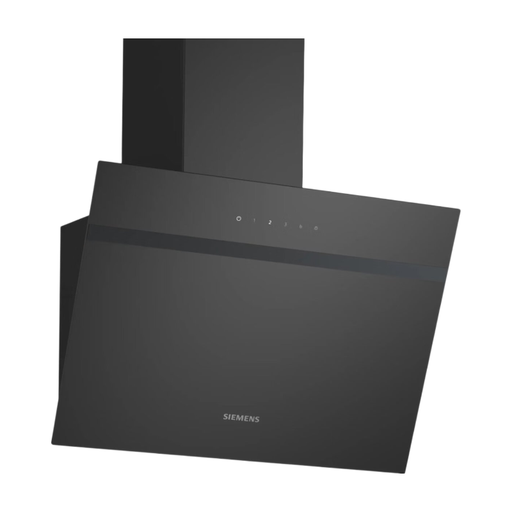
Why it suits this profile: An angled cooker hood for anyone who values touch controls, filter reminders and a less intrusive look on the wall.
The product details mention automatic reminders for grease and carbon filter maintenance. According to the listing, the carbon filter is not included.
59 cm wide, maximum airflow of 430 m³/h, 51–60 dB according to the specifications, touchControl and a dishwasher-safe filter.
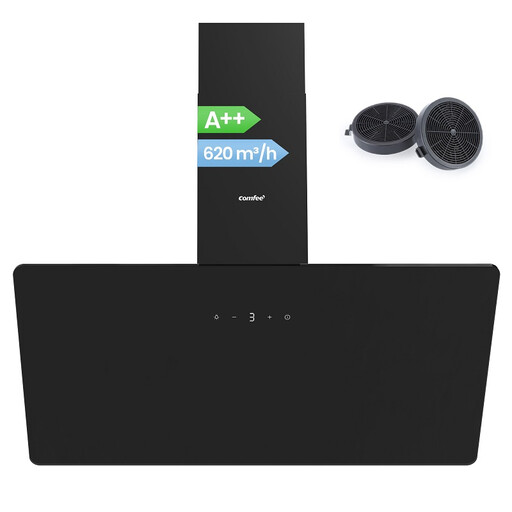
Why it suits this profile: This wide angled cooker hood is a good match for larger hobs, open-plan kitchens and households that cook intensively on a regular basis.
The four speeds let you adjust the extraction to suit different levels of cooking. According to the product information, it can be installed for ducted extraction or recirculation.
90 cm wide, maximum airflow of 620 m³/h, A++ energy rating, 59 dB according to the listing and five-layer aluminium filters.

Why it suits this profile: An option for homes without a direct external exhaust and for anyone looking to add smartphone control.
The listing mentions both recirculation and ducted extraction, and includes carbon filters for recirculation. Before buying, check that it’s compatible with your Wi-Fi network and the app you’ll need.
Maximum airflow of 650 m³/h, A+++ energy rating, four speeds with boost function, touch controls and up to 59 dB according to the specifications.
We’ve put together a complete, up-to-date list of products that meet these strict selection criteria and comply with current European safety regulations.
Yes, a recirculating cooker hood can be a practical choice when there’s no exhaust duct to the outside. Air passes through a grease filter and carbon filter before being returned to the room. Check which filters are included and allow for replacements as specified in the manual.
That depends on how often you cook and how much you fry. Ciarra’s product information recommends cleaning the grease filter every two to four weeks, depending on use. A metal filter can often be washed; a carbon filter for recirculation usually has a limited lifespan.
Check the stated annual energy consumption in kWh on the energy label. Low energy use can help keep your regular electricity costs down, but the total cost also includes filters, installation and, where needed, an exhaust duct. So compare more than just the label: check the capacity, noise level and maintenance requirements too.
