
Vandaag of morgen in huis

Kwaliteit gegarandeerd

Welkomstaanbiedingen ontgrendelen: GRATIS bezorging | Tot 80% korting | Gratis 30 dagen JoyPlus-proefperiode
Download de app
A new cooker hood might seem easy to choose at first. Yet many households end up with a model that’s too noisy, doesn’t fit the hob properly or needs more maintenance than necessary. The connections and dimensions are especially important when you’re renovating your kitchen or moving into an apartment.
Look out for these three common pitfalls:
A 60 cm cooker hood is a popular choice for compact kitchens and hobs of a similar width. For a wide hob, a kitchen island or frequent cooking, a 90 cm cooker hood can provide more coverage.
As well as the width, check:
A wall-mounted cooker hood or angled cooker hood is a good choice if you want more headroom while cooking. A built-in cooker hood is mostly concealed in a wall cabinet, while an under-cabinet cooker hood is fitted directly beneath a cabinet. Always measure the recess using the product specifications, rather than relying on the nominal width alone.
Capacity is usually listed in m³/h. A compact kitchen doesn’t automatically need a very powerful motor. Extra capacity may be useful in an open-plan kitchen, if you often stir-fry or if you regularly deep-fry food.
Always check the maximum noise level in dB, too. A model that’s quiet on its lowest setting may be noticeably louder on the highest. Where available, check the figures for each setting.
Examples from the range:
These are product specifications. Actual performance also depends on the installation, duct length, bends and ventilation mode you choose.
A ducted cooker hood carries air, cooking fumes and odours outside through a duct. It needs a suitable connection and correct installation. Check in advance that your existing duct is wide enough and suitable for use.
A recirculating cooker hood draws air through a grease filter and usually a charcoal filter, then releases it back into the kitchen. This is often a convenient option in apartments or homes without an external duct. However, charcoal filters add to maintenance costs and don’t remove moisture from the room.
Check whether the charcoal filter is included. According to the product information, the charcoal filter isn’t included with the Siemens LC65KDK60. Specific filters are listed for various Ciarra models, such as CBCF003 or CBCF005. So check the model number and filter type before you order.
A mechanical push-button control is simple and straightforward. A touch-control cooker hood has a smoother front that may be easier to wipe clean, but touch controls aren’t essential for everyone.
A Wi-Fi cooker hood can be useful if you want to control it through an app. Check which functions are actually available through the app and whether your kitchen has a stable Wi-Fi connection.
A cooker hood with LED lighting illuminates the cooking area directly. As well as checking the number of lights, look at their colour temperature and whether the lighting is dimmable.
Washable aluminium or metal grease filters help reduce ongoing costs. Clean them according to the instructions; some models are dishwasher-safe. With recirculation, you’ll also need to maintain or replace the charcoal filter.
Energy ratings such as A+, A++ or A+++ are useful for comparing models, but check the stated annual consumption in kWh as well. A more powerful model may use a different amount of energy from a compact one. So consider the rating alongside capacity, noise level and how often you’ll use it.
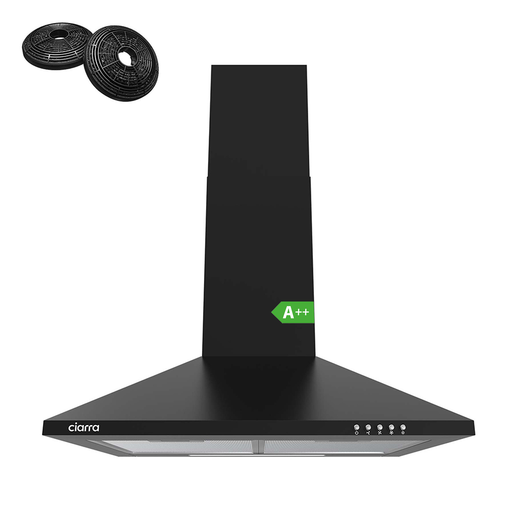
Why it suits this profile: A practical 60 cm wall-mounted cooker hood for a standard kitchen, with push-button controls and a choice of ducted extraction or recirculation.
The product information lists two washable aluminium grease filters and two ventilation modes. This makes it clear in advance what maintenance and installation are needed.
60 cm wide, three settings, LED lighting, maximum capacity of 367 m³/h and energy class A++ according to the product specifications.
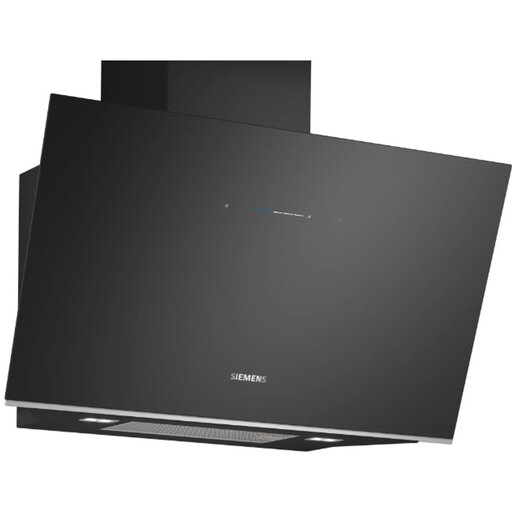
Why it suits this profile: An 89 cm angled wall-mounted cooker hood for spacious kitchens, with a touchscreen, LED lighting and Home Connect control according to the product description.
The product specifications list both ducted extraction and recirculation. Bear in mind that, according to the description, the recirculation system is required separately.
89 cm wide, energy class A+, three speeds, dishwasher-safe filters and a stated maximum capacity of 1,007 m³/h.

Why it suits this profile: A good choice if you cook often and value app control, a boost function and flexible installation.
The specifications list both recirculation and external extraction, and name the charcoal filter type as CBCF003. Check before buying whether the filter set you need is included.
60 cm wide, maximum capacity of 650 m³/h, maximum noise level of 59 dB, energy class A+++ and sensor touch controls with Wi-Fi and app connectivity according to the product information.
We’ve put together a complete, up-to-date list of products that meet these strict selection criteria and current European safety regulations.
The exact distance varies depending on the model, hob and fuel type. Always check the installation instructions. For example, the product information for some models specifies a minimum of 50 cm above an electric hob and 54 cm above a gas hob. The instructions and local installation regulations should always take precedence.
It depends on the filter type and how often you cook. Check the manufacturer’s guidance and look for a saturation indicator, if there is one. A grease filter usually needs cleaning more often than a charcoal filter needs replacing.
The cost depends on its annual consumption in kWh, how many hours you cook and the setting you choose. So compare the energy rating and annual consumption, but check capacity and noise levels too. An energy-efficient cooker hood is only practical value for money if it’s also suited to the size and use of your kitchen.
