
Vandaag of morgen in huis

Kwaliteit gegarandeerd

Welkomstaanbiedingen ontgrendelen: GRATIS bezorging | Tot 80% korting | Gratis 30 dagen JoyPlus-proefperiode
Download de app
Your cooker hood should suit your hob, kitchen layout and cooking habits. Yet when shopping, it’s easy to focus mainly on appearance or the highest m³/h figure. That can leave you with a model that’s too noisy, doesn’t fit properly or fails to remove enough odours in recirculation mode.
Watch out for these three common pitfalls:
Choosing the right cooker hood starts with the space available and how the air can be vented.
A wall-mounted cooker hood is fitted above the hob on the wall. This type often has an adjustable chimney and suits kitchens with a visible cooking area. A 60 cm cooker hood will generally suit a standard 60 cm hob. For a wider hob or more intensive cooking, a 90 cm cooker hood can provide more coverage.
An angled model leaves more space above the hob. This can be handy if you’re taller or have an open-plan kitchen, but check that the bottom of the hood sits at the right height above the hob.
A built-in cooker hood is fitted inside a kitchen cupboard, creating a streamlined look while making use of existing cupboard space. A canopy hood often has a pull-out front. When closed, it takes up less space; when extended, it provides more coverage while you cook.
Before buying, measure:
A cooker hood that vents outside carries cooking fumes out of your home through a duct. This can be effective for steam and odours, but it requires a suitable outlet and correct installation. Long or sharply curved ducts can affect airflow.
A recirculating cooker hood is often more convenient in a flat or rented home where you’re not allowed to alter a wall or external façade. The grease filter traps grease particles, while the carbon filter is designed to tackle odours. The manufacturer’s product information should specify how often carbon filters need to be checked and replaced in recirculation mode.
The maximum airflow indicates how much air the appliance can move per hour according to its product specifications. On paper, a 580 m³/h model, such as some Ciarra wall-mounted models, has more capacity than a 200 m³/h model. That doesn’t automatically mean it will work better in every kitchen. Duct length, dirty filters and installation all affect performance.
Use the higher setting for frying, wok cooking or deep-frying. A lower setting is usually enough for simmering and will keep noise levels down.
A quiet cooker hood is especially welcome in an open-plan kitchen or flat. Check whether the stated noise level is the maximum. A product rated at up to 59 dB may be noticeably quieter on a lower setting than on its highest setting.
Only compare noise levels alongside the corresponding fan setting. A cooker hood with a boost function can move more air for a short time, but it may also produce more noise.
The energy rating helps you compare electricity consumption, but check the stated annual consumption in kWh too. For example, the Ciarra CBCB6102-B has an A+++ rating and a stated annual consumption of 12 kWh. Your actual costs will depend on how long you use it, the fan setting and the lighting.
Washable grease filters help reduce ongoing maintenance costs. Clean them according to the manual. For some models, cleaning every two to four weeks is recommended, depending on how often you cook and how greasy your cooking is. Always switch off the power before removing a filter or carrying out maintenance.
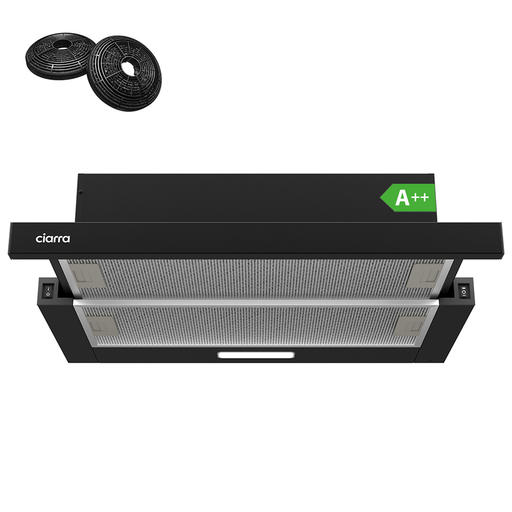
Why it suits this buyer: A compact canopy hood for a small kitchen or rented home, with two fan settings and the choice of recirculation or external venting.
Its pull-out design takes up less space. The product specifications state a maximum noise level of 61 dB and include two washable aluminium filters.
60 cm wide, A++ according to the product details, maximum airflow of 370 m³/h and integrated LED lighting.

Why it suits this buyer: A good fit for a modern open-plan kitchen where convenient controls, low stated energy consumption and flexible installation matter.
The specifications include both recirculation and external venting, so you’re not tied to just one installation method.
Stated airflow of up to 650 m³/h, maximum noise level of 59 dB, A+++ according to the product information, and control via touch, Wi-Fi and app.
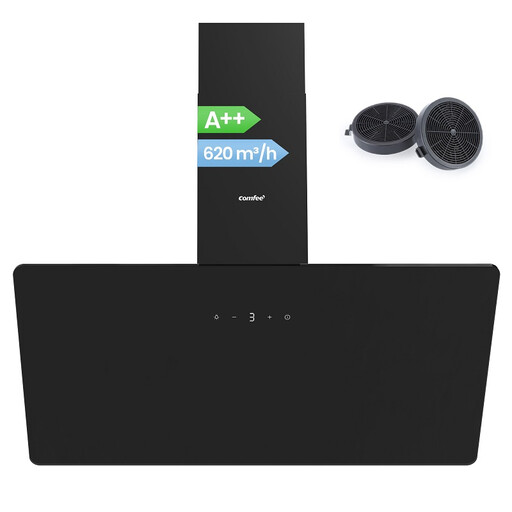
Why it suits this buyer: A wide angled cooker hood for large hobs, open-plan kitchens and households that cook intensively on a regular basis.
The four settings let you adjust the hood to suit different cooking tasks. Check beforehand that the 90 cm width will fit your hob and wall.
Stated airflow of 620 m³/h, 59 dB, A++ according to the product description, touch controls and a five-layer aluminium filter.
We’ve put together a complete, up-to-date list of products that meet these strict selection criteria and the applicable European safety requirements.
Before fitting your cooker hood, check the manual for your chosen model. The required distance between the hob and cooker hood can vary depending on the type of hob and the manufacturer. The appliance must be securely fixed to a suitable wall or cupboard. Professional installation may be needed when connecting it to the electricity supply or a duct.
Also remember to:
For regular use, cleaning every two to four weeks is often recommended. If you do a lot of frying or deep-frying, you may need to clean it more often. Always follow the manufacturer’s maintenance instructions.
Yes. A recirculating cooker hood can be a good option if ducting to the outside isn’t available or isn’t allowed. Bear in mind that carbon filters need regular maintenance and periodic replacement. Recirculation also doesn’t vent moisture directly outside, so it’s still important to ventilate the room.
That depends on its annual consumption in kWh, how long you use it and the price of electricity. So don’t compare energy ratings alone: check the stated annual consumption too. LED lighting and lower fan settings can help limit energy use, while still letting you use the full capacity when cooking intensively.
