
Vandaag of morgen in huis

Kwaliteit gegarandeerd

Welkomstaanbiedingen ontgrendelen: GRATIS bezorging | Tot 80% korting | Gratis 30 dagen JoyPlus-proefperiode
Download de app
Choosing a new cooker hood may seem straightforward: measure the hob, select a model and consider how it looks. In practice, installation, noise levels and maintenance have the biggest impact on everyday use. A model with a high capacity on paper won’t necessarily suit every kitchen.
As a Joybuy Product Recommendation Officer, I focus on verifiable specifications and practical considerations. Read on to find out which common pitfalls can lead to a disappointing purchase, and what to check before you buy.
Manufacturers often quote the maximum airflow rate, for example 580 or 650 m³/h. This is a useful guide, but it doesn’t tell you everything about how the hood will perform. Noise levels, the fan setting, the length of the duct and any bends in it can all affect performance.
So compare the noise level in dB too, and check whether the maximum airflow rate applies to extraction or recirculation.
A recirculating cooker hood doesn’t vent air outside the home. Instead, the air passes through a grease filter and usually a carbon filter before returning to the kitchen. This is useful in a flat or rented home without an existing extraction duct, but the carbon filter needs to be maintained or replaced as instructed.
With extraction, cooking fumes are vented through a duct. Before you buy, check that there’s a suitable connection point and that the accessories supplied will work with your installation.
A grease filter that’s difficult to remove may not get cleaned as often as it should. Grease build-up can reduce performance and needs extra attention for fire safety. If possible, choose a model with a washable grease filter—for example, an aluminium filter that the product information says can be cleaned by hand or in the dishwasher.
Also measure the depth and adjustable height, not just the width. A chimney-style cooker hood may be harder to fit than expected if there’s a mantelpiece or wall unit in the way.
A 60 cm cooker hood will usually suit a standard hob of a similar width. A 90 cm cooker hood can provide a wider capture area for a larger hob. Always check the clearance above the hob and follow the minimum installation distance in the manual, particularly if you have a gas hob.
For a compact kitchen, an integrated, telescopic or angled cooker hood can be a practical choice. An angled design may give you more headroom, as the front slopes forwards.
Airflow is measured in m³/h. A higher figure may suit frequent, intensive cooking, an open-plan kitchen or regular wok cooking, but the hood’s capacity needs to suit both the room and the installation.
A cooker hood isn’t necessarily quiet just because the marketing says so. Compare the stated maximum dB rating. In the product specifications provided, for example, ratings range from 59 to 65 dB. Bear in mind that the highest setting will generally be noisier than the lowest.
Check the energy rating, annual consumption in kWh and power consumption. An energy-efficient cooker hood may be a good choice if you’ll use it every day. Always consider the stated energy rating and annual consumption together.
LED lighting on a cooker hood illuminates the cooking surface. A model with touch controls has a smooth front, while push buttons or mechanical switches may be more practical if you cook with wet or greasy hands. Smart features, such as a Wi-Fi-enabled smart cooker hood, are most useful if controlling the hood via an app fits in with your cooking routine.
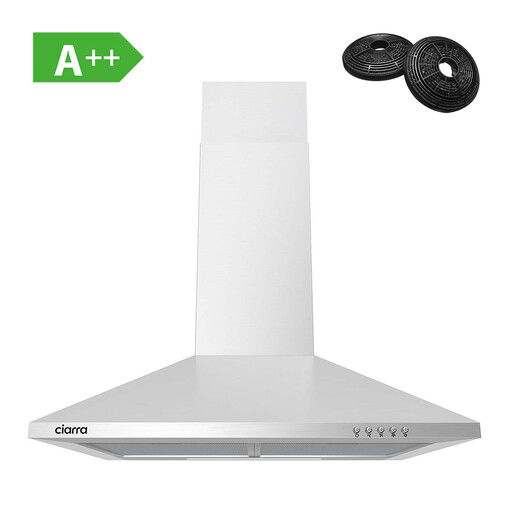
Why it suits this user: This 60 cm model has push-button controls, a metal casing and supports both extraction and recirculation. That makes it a straightforward choice for a first purchase or a kitchen renovation.
The product information lists three settings, a maximum airflow rate of 367 m³/h and a maximum noise level of 63 dB. This lets you look beyond appearance alone.
A++ energy rating, two washable aluminium filters and an integrated light, according to the product specifications.
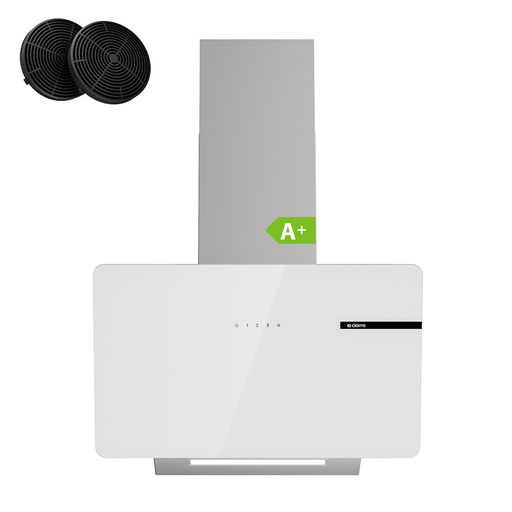
Why it suits this user: The angled design complements a modern kitchen and, according to the description, leaves more headroom above the hob.
The filters are removable and, according to the product description, dishwasher-safe. The hood also supports both extraction and recirculation.
Touch controls, a five-layer aluminium filter, a maximum airflow rate of 580 m³/h and an A+ rating, according to the stated specifications.

Why it suits this user: This model is designed for people who cook frequently and want smartphone or tablet controls in a compact, wall-mounted design.
The product information lists both recirculation and external extraction. This gives you the flexibility to choose an installation that suits a flat or a kitchen with an existing duct.
Maximum airflow rate of 650 m³/h, four settings including boost, a maximum noise level of 59 dB and an A+++ rating, according to the product specifications.
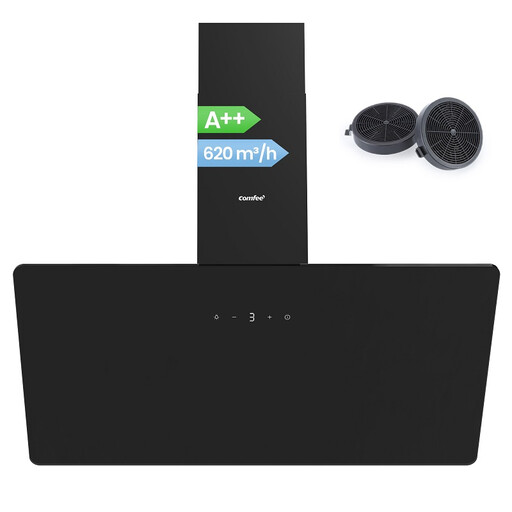
Why it suits this user: This 90 cm-wide angled cooker hood is designed for a wide cooking area and an open-plan kitchen, where odours and noise levels need extra consideration.
The product specifications list 620 m³/h, four speeds and a maximum noise level of 59 dB. The model also supports extraction and recirculation.
90 cm wide, A++ energy rating and four adjustable speeds, according to the product information provided.
We’ve put together a complete, up-to-date list of products that meet these strict selection criteria and the applicable European safety regulations.
Yes, a recirculating cooker hood can be suitable for a flat, rented home or kitchen without an extraction duct. It filters the air and returns it to the room. To reduce odours, you’ll need a suitable carbon filter. Also check that replacement filters are available and find out how much they cost.
That depends on how often you cook, the size of the room, the hob and the installation. Compare the maximum airflow rate with the noise level, and check whether the figure applies to extraction or recirculation. A high m³/h rating alone doesn’t guarantee quiet operation.
Its lifespan depends on installation, use and maintenance. Regularly cleaning the grease filter, replacing the carbon filter when needed and keeping moisture away from electrical components can help keep the appliance in good condition. Before you order, also check the warranty and the availability of filters and spare parts.
