
Vandaag of morgen in huis

Kwaliteit gegarandeerd

Welkomstaanbiedingen ontgrendelen: GRATIS bezorging | Tot 80% korting | Gratis 30 dagen JoyPlus-proefperiode
Download de app
A cooker hood should suit your hob, kitchen layout and ventilation options. Yet many households choose a model based only on its appearance or a high m³/h rating. This can lead to excessive noise, poor extraction or unexpected costs for filters and installation.
As a Joybuy Product Recommendation Officer, I focus on specifications you can verify. Read on to find out what matters when choosing a cooker hood, which common pitfalls to avoid and which type might suit your needs.
A high m³/h figure sounds appealing, but it doesn’t tell the whole story. How well the hood actually works also depends on the duct diameter, the length of the duct, bends in the pipework and the setting you choose. With a recirculating cooker hood, the air also passes through a carbon filter, so performance may differ from that of a model with external extraction.
Always compare the airflow at each setting, the noise level and the ventilation method. A quiet cooker hood on a lower setting may be more comfortable in an apartment or open-plan kitchen than a model that only performs well at its highest setting.
A 60 cm cooker hood is designed for a hob or cooking zone of roughly the same width, but always check the exact measurements. Consider:
A built-in cooker hood needs to fit neatly inside the cabinet. A wall-mounted cooker hood needs enough clear wall space. For gas and electric hobs, always check the product’s installation instructions and local regulations.
With external extraction, cooking fumes are carried outside through a duct. With recirculation, the air is filtered and returned to the room. A cooker hood with a carbon filter can be a practical option in a rented home, studio apartment or apartment without a suitable outlet through the wall, but the filter must be maintained or replaced according to the product instructions.
A model that supports both options gives you more flexibility. Check whether carbon filters are included or need to be bought separately. For example, CBCF005 carbon filters for the Ciarra 52 cm integrated cooker hood are available separately.
The most common size is a 60 cm cooker hood. For a 90 cm hob, a wider cooker hood can cover the cooking zone more effectively. In small kitchens, a slimline, under-cabinet or built-in model is often easier to install.
Noise is measured in dB. A difference of a few decibels can be noticeable in an open-plan kitchen. Don’t just look at the maximum level; check the noise level at the setting you’d normally use for cooking, too. For example, the Ciarra 60 cm wall-mounted cooker hood is listed at 51 dB on setting 1, 57 dB on setting 2 and 63 dB on setting 3.
Product claims such as ‘quiet’ come from the product description. Use the listed dB figures as a practical point of comparison, rather than a guarantee that a model will sound the same in every kitchen.
A metal grease filter needs regular cleaning. Some filters are removable and dishwasher-safe; always check the manual. Recirculation mode also requires a carbon filter. Factor in the cost of buying and replacing it.
A cooker hood with LED lighting directs light onto the cooking zone. This is useful when there’s little ambient light, but check the number of lamps and their total power output if lighting is important to you.
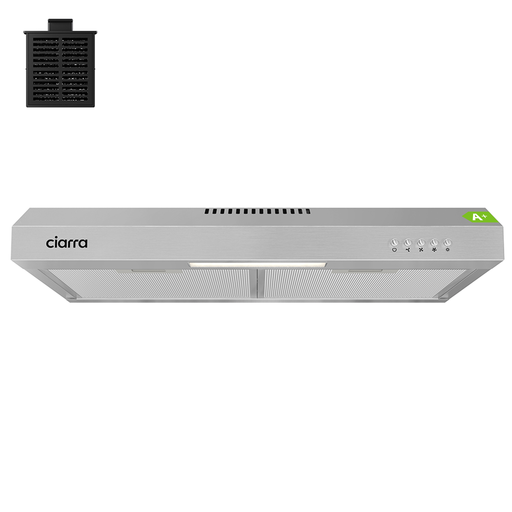
Why it suits this buyer: This compact model is ideal for small kitchens and cabinets with limited space or low clearance. It supports both recirculation and external extraction.
Its dimensions of 596 × 440 × 85 mm make it easy to check the available space before buying. The product listing gives three settings and a maximum noise level of 61 dB.
A+ energy rating according to the product specifications, two washable aluminium filters and integrated lighting.
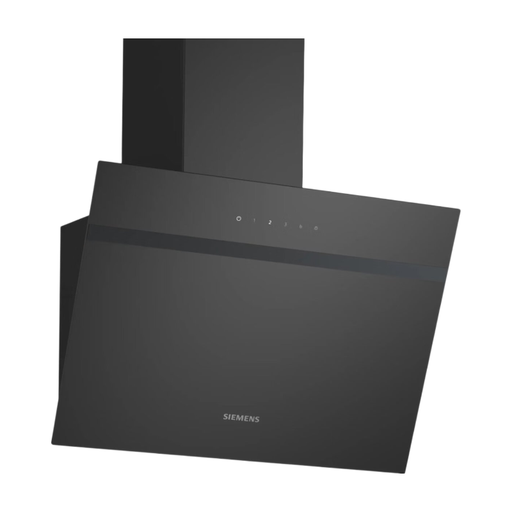
Why it suits this buyer: This angled wall-mounted model features touch controls, LED lighting and automatic filter maintenance alerts.
The product specifications list three settings, a maximum noise level of 60 dB and a dishwasher-safe filter. A carbon filter is not included.
TouchControl, a filter saturation indicator, LED lighting and a listed A energy rating.

Why it suits this buyer: This model is designed for households looking for multiple settings, app-based remote control and the choice of recirculation or external extraction.
The product listing clearly explains both ventilation methods and specifies that two CBCF003 carbon filters are included for recirculation.
Listed airflow of up to 650 m³/h, four speed settings including a booster, a maximum noise level of 59 dB and an A+++ energy rating according to the product details.
We’ve put together a complete, up-to-date list of products that meet these strict selection criteria and the applicable European safety regulations.
Yes, if external extraction isn’t possible. A cooker hood with a carbon filter doesn’t vent air outside; instead, it filters the air and returns it to the kitchen. Make sure you maintain it regularly and keep the room well ventilated.
It depends on how often and how intensively you cook. The product instructions for several models recommend cleaning the metal grease filter regularly; with frequent use, this may be needed every two to four weeks. Carbon filters generally have a limited lifespan and should be replaced according to the manual.
Energy use depends on the power rating, energy class and number of hours of use. Check the stated annual consumption in kWh, if available. Also allow for installation costs, any ducting and replacement carbon filters. An energy-efficient cooker hood can be a practical choice, especially if you use it every day, but always compare the full cost of maintenance and purchase.
