
Vandaag of morgen in huis

Kwaliteit gegarandeerd

Welkomstaanbiedingen ontgrendelen: GRATIS bezorging | Tot 80% korting | Gratis 30 dagen JoyPlus-proefperiode
Download de app
Choosing a new cooker hood seems simple—until you dive into the specifications. Manufacturers promise the world with terms like "whisper-quiet" and "professional-grade extraction." But what do these claims actually mean for your kitchen? Many people fall into common traps that lead to a noisy kitchen, unnecessarily high energy bills, or an appliance that simply doesn't deliver on its promises. Before you make a decision, it's crucial to separate fact from marketing fiction.
The 2 most common pitfalls when buying a cooker hood:
To avoid buyer's remorse, focus on the specifications that truly matter for your situation. These are the three most important factors to check.
The required capacity depends on the size of your kitchen. A simple rule of thumb is to multiply the volume of the kitchen (length x width x height in metres) by 10. This gives an indication of the required capacity in cubic metres per hour (m?/h) to refresh the air effectively.
The noise level, measured in decibels (dB), is crucial for your cooking comfort. Pay attention not just to the minimum, but especially to the maximum noise level.
A truly quiet cooker hood will stay below 60 dB even on its most frequently used (medium) settings.
You have a choice between two systems. The right choice depends on the layout of your home.
Based on objective specifications, we have selected several models that suit different user profiles and avoid the common pitfalls.
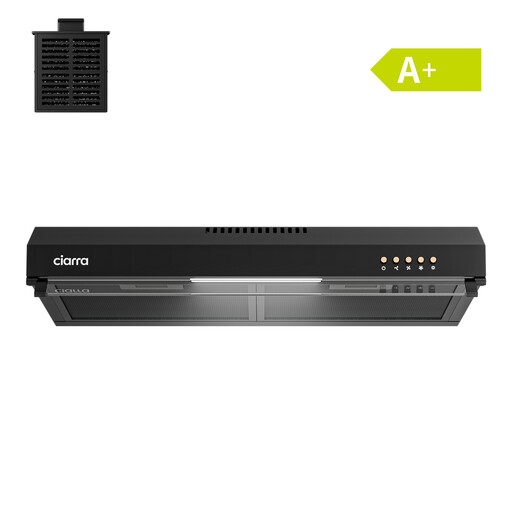
Why This Fits Their Persona: This model is a compact 60 cmbuilt-in cooker hood, perfect for smaller kitchens or rental properties. Because it's suitable for recirculation, no complex installation with external ducting is required. The sleek, black design fits well in a modern kitchen.
This model has an extraction capacity (max. 184 m?/h) tailored for compact spaces. You don't pay for excess power you won't use, thus avoiding the 'overkill' capacity trap.
Energy-efficient (Class A+), flexible installation (ducted or recirculating), and a discreet, integrated design.
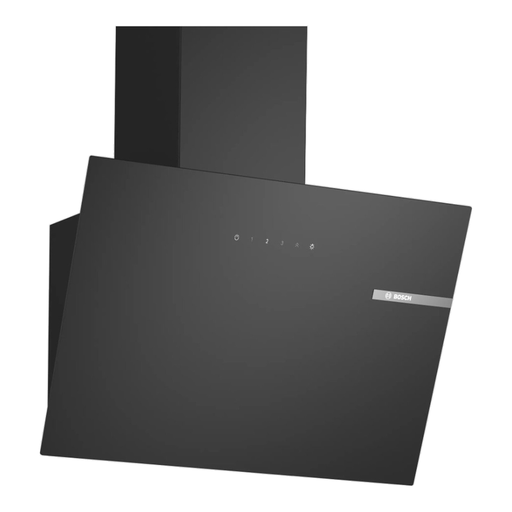
Why This Fits Their Persona: This black cooker hood from Bosch features a sleek, angled design that makes a visual statement in a modern kitchen. The TouchSelect controls and smooth surface contribute to a minimalist and premium aesthetic.
Bosch specifies a noise level from 46 dB to 60 dB. This is a realistic and acceptable range for a powerful motor, ensuring you won't be surprised by a loud appliance. It's a solid choice for those seeking a genuinely quiet cooker hood.
Quiet and powerful motor, intuitive TouchSelect controls, and an interior designed for easy cleaning.
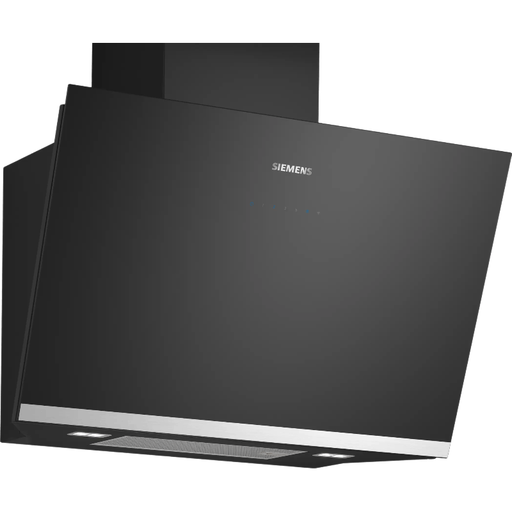
Why This Fits Their Persona: This wall-mounted chimney hood combines very low energy consumption (Class A+) with a powerful, quiet motor and smart features. The cookConnect function, which automatically adjusts the hood to the hob, is ideal for those seeking maximum convenience and efficiency.
Siemens is transparent about its performance: the noise level ranges from a very low 35 dB to an acceptable 51 dB. The iQdrive motor is specifically designed for quiet and efficient performance, meaning the "quiet" claim is genuinely delivered.
Extremely quiet and energy-efficient (A+), automatic control via cookConnect, and operation via the Home Connect app.
We have compiled a complete, up-to-date list of products that fully meet these strict selection criteria and UK/EU safety standards.
The recommended height depends on the type of hob. For an electric or induction hob, a minimum distance of 65 cm is advised. For a gas hob, a minimum distance of 75 cm is required due to the open flames. Always check the manuals for both the cooker hood and the hob for the manufacturer's specific guidelines.
The metal grease filters should be cleaned approximately once a month. These can often be placed in the dishwasher. The carbon filters, which neutralise odours in a ductless cooker hood, need to be replaced every 3 to 6 months, depending on usage. Some newer models have an indicator that shows when the filters are saturated.
A hob with integrated extraction is an elegant and space-saving solution, especially for kitchen islands. These systems draw fumes down directly at the source. They typically operate on a recirculation system and are effective, but their purchase price is often higher than that of a separate cooker hood. It's a popular choice for those who want a minimalist kitchen without a visible hood above the hob.
