
Turkey slicer for a small kitchen
You mainly want to slice cooked turkey thinly and be able to put the appliance away between uses.


For thin slices of cooked turkey, a slicer with a smooth blade is a good choice. A serrated blade is better suited to general use, such as slicing bread. Measure both the space you have while slicing and the space where you plan to store the appliance. Check the cleaning instructions and which blades are included with the exact model.
You mainly want to slice cooked turkey thinly and be able to put the appliance away between uses.
You want to use the same appliance to slice turkey and bread, and weigh the convenience of a single blade against its suitability for thinly sliced meat.
You slice cooked turkey to eat later and want to clean the parts carefully and store the meat safely. The Netherlands Nutrition Centre advises keeping raw and cooked food separate.
Start with the slice you want and the type of blade. Then compare the space needed during use and for storage, and finally check the cleaning requirements and any other uses.
| What to consider | What should you check? | Who is this important for? |
|---|---|---|
| Blade and slice | Check that a smooth blade is actually included. Dutch slicer advice recommends a smooth blade over a serrated one for thinly sliced meat. | If I mainly want thin slices of cooked turkey, I check which blade comes in the box; around 31% of consumers prioritise their preferred slice and blade. |
| Space during use and storage | Compare the appliance’s dimensions when in use with the available worktop space, and measure the storage space separately. Its folded dimensions don’t show how much room it needs while slicing. | For consumers with a narrow worktop, it matters whether the appliance can be used safely there and stored away; around 31% give space the highest priority. |
| Cleaning and storage | Check the cleaning instructions for each part and separately confirm whether it is dishwasher-safe. Keep clean parts separate from utensils that have been in contact with raw meat. | If you slice cooked turkey in advance, you’ll want to clean the parts carefully and store the meat safely; around 25% of consumers prioritise cleaning and storage. |
| Versatility and maintenance | Check which blades are included and which uses are listed for the exact model. Also look at the cleaning instructions and whether the parts you want are available. | If I also want to slice bread, I weigh that up against the blade needed for thin turkey slices; around 13% of consumers prioritise versatility and the associated purchase or maintenance costs. |
The storage dimensions don’t tell you whether there’s enough room for the appliance, carriage and meat while slicing. Manufacturers don’t always provide the same types of measurements either.
Measure the available worktop space, the room needed to move the carriage and the storage space separately.
A model may be described as suitable for meat and still have a serrated blade. Dutch slicer advice recommends a smooth blade for thinly sliced meat.
Check what’s included in the box and choose based on the turkey slices you want, not just the product category.
Removable doesn’t automatically mean a part can be cleaned in any particular way. Fritel states that the SL 3110 is not dishwasher-safe.
Before buying, read the cleaning instructions for the exact model and each part.
Parts that need to be washed by hand take extra time to clean carefully.
The MYtiny TWIN MT1200EU is an example of a folding slicer supplied with an extra-smooth ham blade.
Fritel describes the SL 3110 as a folding model for slicing bread, cheese and meat, among other things.
Ritter describes the icaro 7 as a folding metal slicer with a serrated blade.
Manufacturer documentation describes the AS 3915 as having a universal blade and a ham blade.
The MS-125000.1 is a folding all-purpose slicer for which Emerio specifies an adjustable slicing thickness.
These models are options to compare for slicing meat or poultry; some versions are also designed for bread. For your kitchen, check the space needed when in use as well as the storage dimensions, and see which blade comes with the exact model.
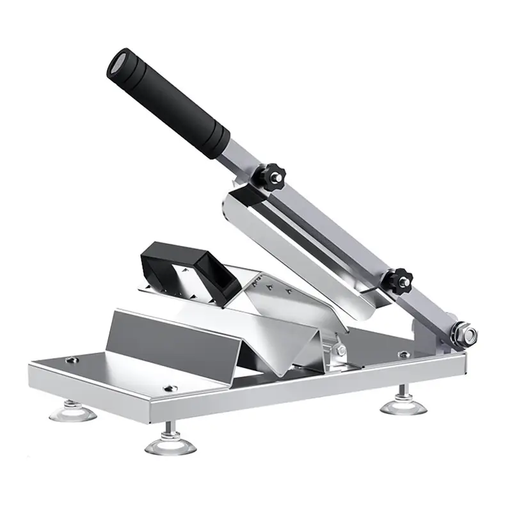 No image available
The product description lists meat and poultry as suitable uses; check that the dimensions and blade suit your worktop and the turkey slices you want.
The product information lists an SS304 stainless steel construction and a precision blade. These are product claims, not the results of an independent slicing test.
 No image available
This model may suit you if you’re looking for an electric slicer with a removable carriage; for thin turkey slices, bear in mind that it has a serrated blade.
The product name lists a metal construction, a removable carriage and a shatter-resistant glass base. Dutch slicer advice recommends a smooth blade over a serrated one for thinly sliced meat.
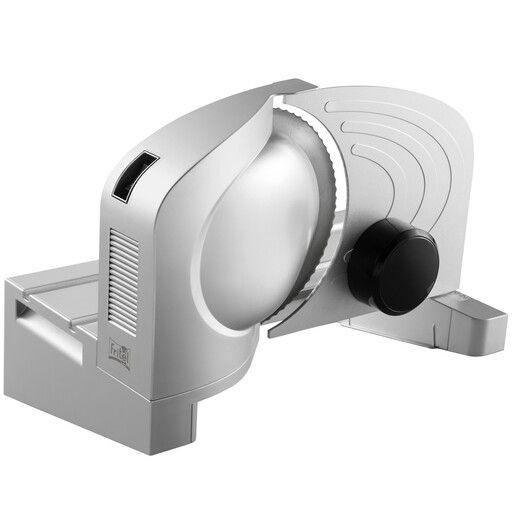 No image available
The product name describes an all-purpose slicer for meat and bread. Dutch slicer advice says a serrated blade is less suitable for thinly sliced meat.
Specifications listed in the product name: slicing thickness 0–20 mm, blade diameter Ø 17 cm, 160 W and a carriage angled at 15°. These figures alone can’t predict how thinly or neatly your turkey will be sliced.
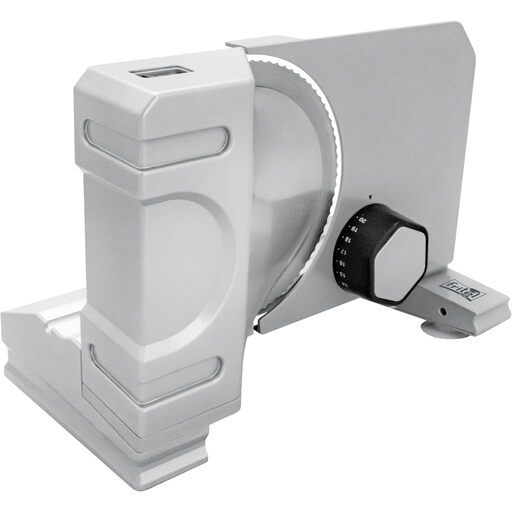 No image available
This model may be worth considering if you have other slicing jobs besides meat; the product information lists a universal blade. Check whether it suits your preference for thin turkey slices.
Specifications listed in the product name: slicing thickness 0–20 mm, blade diameter Ø 19 cm, 150 W and a carriage angled at 15°. The product description states that it can be used continuously for up to 10 minutes, followed by a 30-minute cooling period.
 No image available
The folding design may suit you if you want to put the appliance away after use and slice bread as well. Dutch slicer advice says a serrated blade is less suitable for thinly sliced meat.
Specifications listed in the product name: slicing thickness 0–15 mm, blade diameter Ø 17 cm and 100 W. Fritel states that the SL 3110 is not dishwasher-safe; follow the cleaning instructions for the exact model.
Check that a smooth blade is actually included. Dutch slicer advice recommends a smooth blade over a serrated one for thinly sliced meat; serrated blades are used for things such as bread. This is a guide to choosing, not a guarantee of a particular result when slicing your turkey.
Use clean parts that haven’t been in contact with raw meat, or wash them thoroughly with hot water before use. Unplug the appliance before removing or cleaning the blade, and follow the manual for the exact model. Check separately which parts, if any, are dishwasher-safe.
The Netherlands Nutrition Centre advises cooling cooked leftovers within 2 hours of cooking and storing them in a sealed container in the fridge or freezer. Keep leftovers in the fridge at 4 °C and eat them within 2 days.
No. You don’t need an extended warranty to have statutory rights when you buy in the Netherlands. According to the Government of the Netherlands, there is no fixed time limit for the statutory guarantee in the Netherlands; an extended warranty is a separate choice, based on its terms and conditions.
The Netherlands Food and Consumer Product Safety Authority (NVWA) states that CE marking is compulsory for electrical products covered by the relevant rules. The low-voltage rules described by the NVWA apply to electrical equipment with a rated AC voltage of 50 V to 1,000 V. Check whether these rules apply to the specific appliance and whether it has the required marking; CE marking alone is not a performance test or proof that the machine is right for your kitchen.